Home › Explainers › Acceleration that feels like a climb
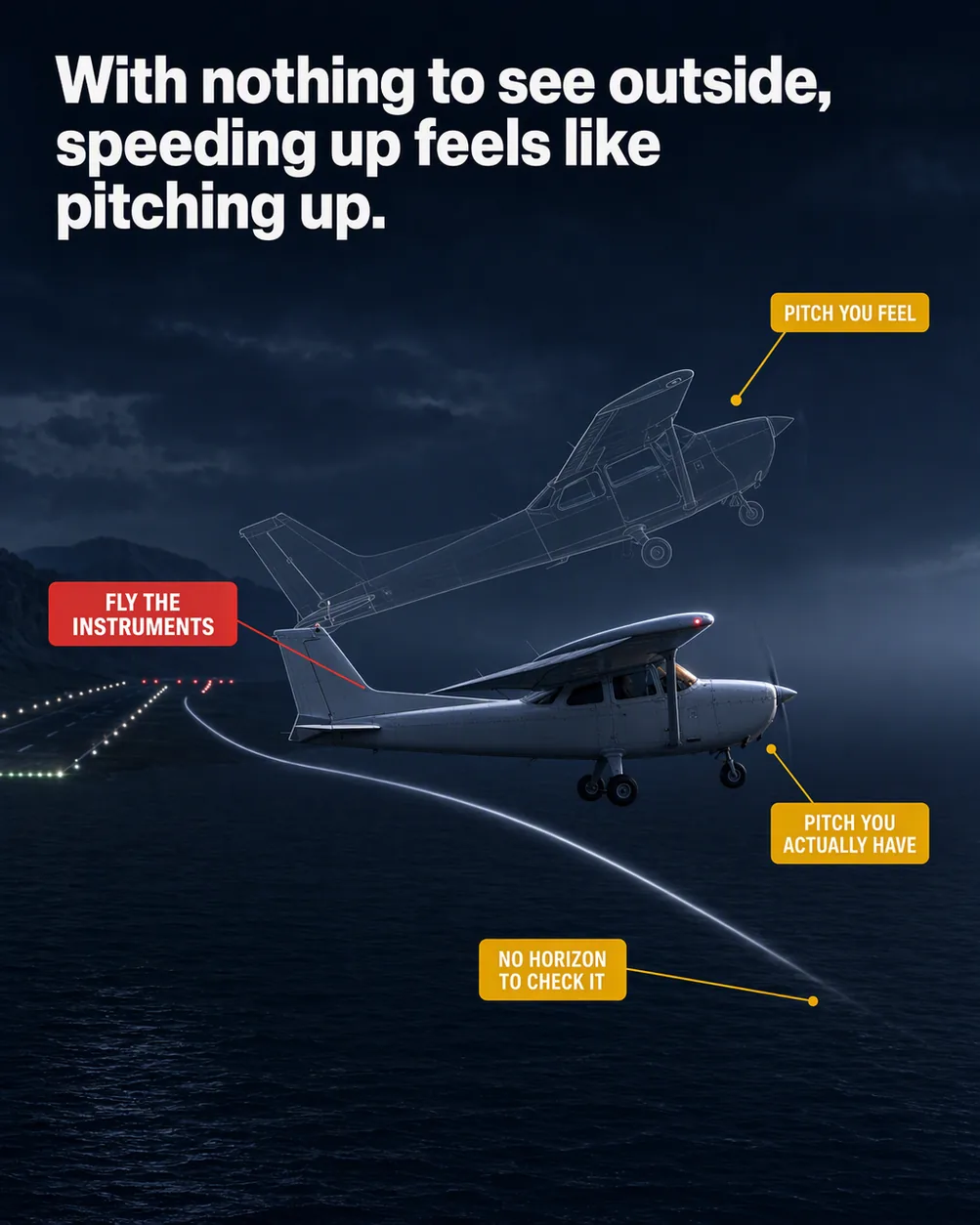
On a dark night takeoff, acceleration pushes the inner ear the same way a nose-up pitch would, and the instinct is to push down.
What the picture shows
The labels on the illustration, and what each one is pointing at.
- PITCH YOU FEELThe raised nose and spinner of the translucent ghost aeroplane.
- PITCH YOU ACTUALLY HAVEThe solid aeroplane's nose, visibly below the ghost's and below level.
- NO HORIZON TO CHECK ITThe place straight ahead of the spinner where black water meets sky with no seam.
- FLY THE INSTRUMENTSThe solid aeroplane's windscreen and the warm instrument glow behind it.
What happens on a dark night takeoff
Picture a night takeoff toward open water. You add full power, the aeroplane gathers speed, and the runway lights slide away behind you. Ahead of the windscreen there is nothing to look at.
Somewhere in the roll or the first part of the climb, your body tells you the nose has come up. It feels steep. The aeroplane has not pitched up at all.
The instinct that follows is to ease the stick forward and bring the nose down. That is the trap. The rest of this page walks through where the feeling comes from and why the answer is on the panel.
Why speeding up feels like tilting back
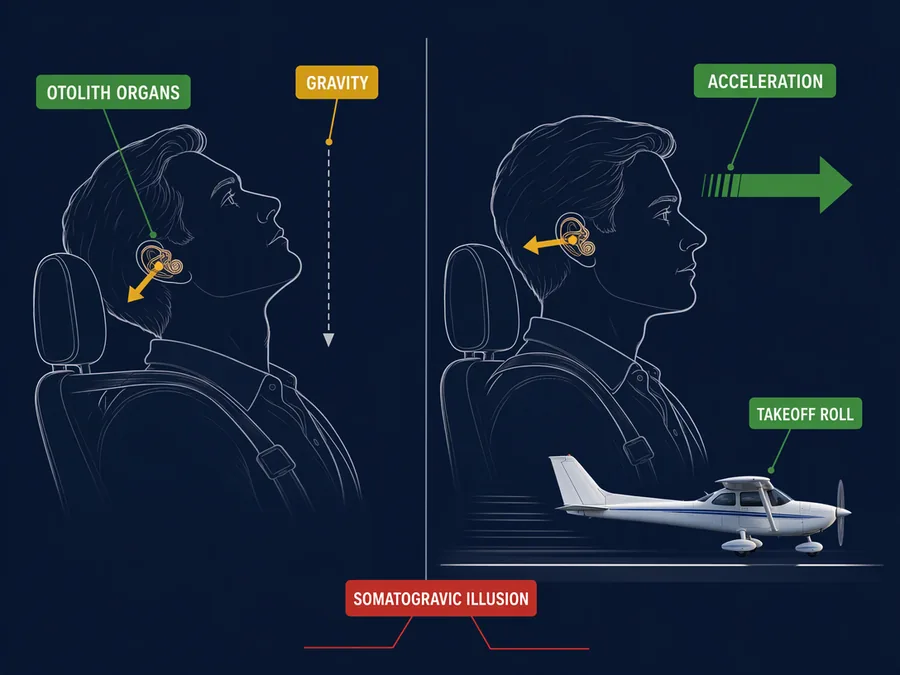
Your inner ear holds the otolith organs. They are the part of your balance system that senses which way gravity and acceleration are pulling on your head.
Tilt your head backwards and the otolith organs register the change. A hard shove forward, like the one you get on a takeoff roll, stimulates them in the same way. From that signal alone, your brain cannot tell the two apart.
So it reports the familiar story. You feel yourself tilting back, which in an aeroplane means nose-up. This false sense of a raised nose from speeding up is called the somatogravic illusion.
The handbook uses takeoff as its example, because that is where a rapid acceleration is part of every flight. You meet the conditions for it every time you open the throttle.
Why a dark night makes it worse
In daylight your eyes settle the question. You glance out, see the horizon where it should be, and know the nose is where you put it.
The illusion is most likely when visual references are poor. Over open water at night, black water meets black sky with no seam, and there is nothing to check the feeling against. The handbook names that exact case as flight without a visible horizon.
It lumps marginal visibility in with it, meaning visibility of less than 3 miles. In either case the inner ear becomes the loudest voice left in the cockpit.
Seat of the pants flying will not save you here. That means judging attitude from the pressure you feel through your seat, skin and muscles. Acceleration forces can overpower gravity, and then those signals go false as well.
What the wrong correction does
Convinced the nose is high, a disoriented pilot pushes forward. The handbook says this can put the aeroplane into a nose-low attitude, or into a dive.
Just after takeoff you have very little height to give away. Lowering the nose there points the aeroplane at the surface you just left, while your body still insists you are climbing.
The illusion also runs in reverse. Pull the throttle back quickly and the rapid slowdown can have the opposite effect. The disoriented pilot then pulls the nose up, toward a nose-high attitude or a stall.
| Change in speed | What it feels like | What the disoriented pilot does |
|---|---|---|
| Rapid acceleration, such as on takeoff | A nose-up attitude | Pushes into a nose-low or dive attitude |
| Rapid deceleration from a quick throttle reduction | The opposite effect | Pulls into a nose-up or stall attitude |
How to feel it safely with an instructor
You can meet this illusion on purpose. The handbook describes a demonstration called climbing while accelerating.
You close your eyes. Your instructor holds approach speed, straight and level, for several seconds. Then they speed up while keeping the aeroplane straight and level, and the usual sensation is that you are climbing.
A second exercise gets the same feeling from a turn. The instructor rolls slowly into a coordinated turn of about 1.5 positive G, approximately 50° of bank, and holds it for 90°. G is the load pressing you into your seat, and here it reads as a climb too.
Both exercises prove the same point. Your body's sense of attitude is often wrong, while the instruments are not fooled. Do them only at a safe height, with an instructor or a suitable safety pilot aboard.
How to fly pitch on the instruments
Take pitch from the flight instruments, and treat what your body reports as noise. On a dark takeoff, set the attitude you want on the panel and hold it there. If the nose feels like it is climbing away, check the instruments before you touch the stick.
The false feeling is normal, and no amount of training makes it go away completely. What training does is teach you to override it. The more instrument flying you do, the less these illusions pull on you.
Get that training before you need it. The handbook says to get it before flying in visibility under 3 miles. The same goes for anywhere without a visible horizon, such as over open water at night.
Keep your head still during the takeoff, since sudden head movement is on the handbook's list of things to avoid. Arrive rested, too. Illness, medication, alcohol, fatigue, lost sleep and mild hypoxia, a shortage of oxygen, all make you easier to fool.
What this teaches
- Forward acceleration can produce a false sensation of a nose-up pitch attitude.
- Without outside visual references the pilot may lower the nose toward the surface, so pitch must be flown on the flight instruments rather than on what the body reports.
Where to read more
Everything above rests on these. They are the FAA's own publications, free to read.
- Pilot's Handbook of Aeronautical Knowledge (FAA-H-8083-25), Chapter 17see Chapter 17
- Instrument Flying Handbook (FAA-H-8083-15)the FAA's own handbook
Keep reading
- Pilot guideWhat NOTAMs to Check Before a Flight
- Pilot guidePersonal Minimums: How to Set Yours
- Pilot guideThe Go/No-Go Decision Framework

Score the next flight before you go
FlightDecide reads the weather, the NOTAMs, your fuel and your weight and balance for the planned window, then scores them into a go / no-go call you can check against the raw data.
Get FlightDecide on the App StoreEducational content for pilots. It is advisory only and not a substitute for an official weather briefing, your POH, or your own judgment as pilot in command (14 CFR 91.3). The sources this explainer rests on are listed above.