Home › Explainers › Attention narrowing under fatigue
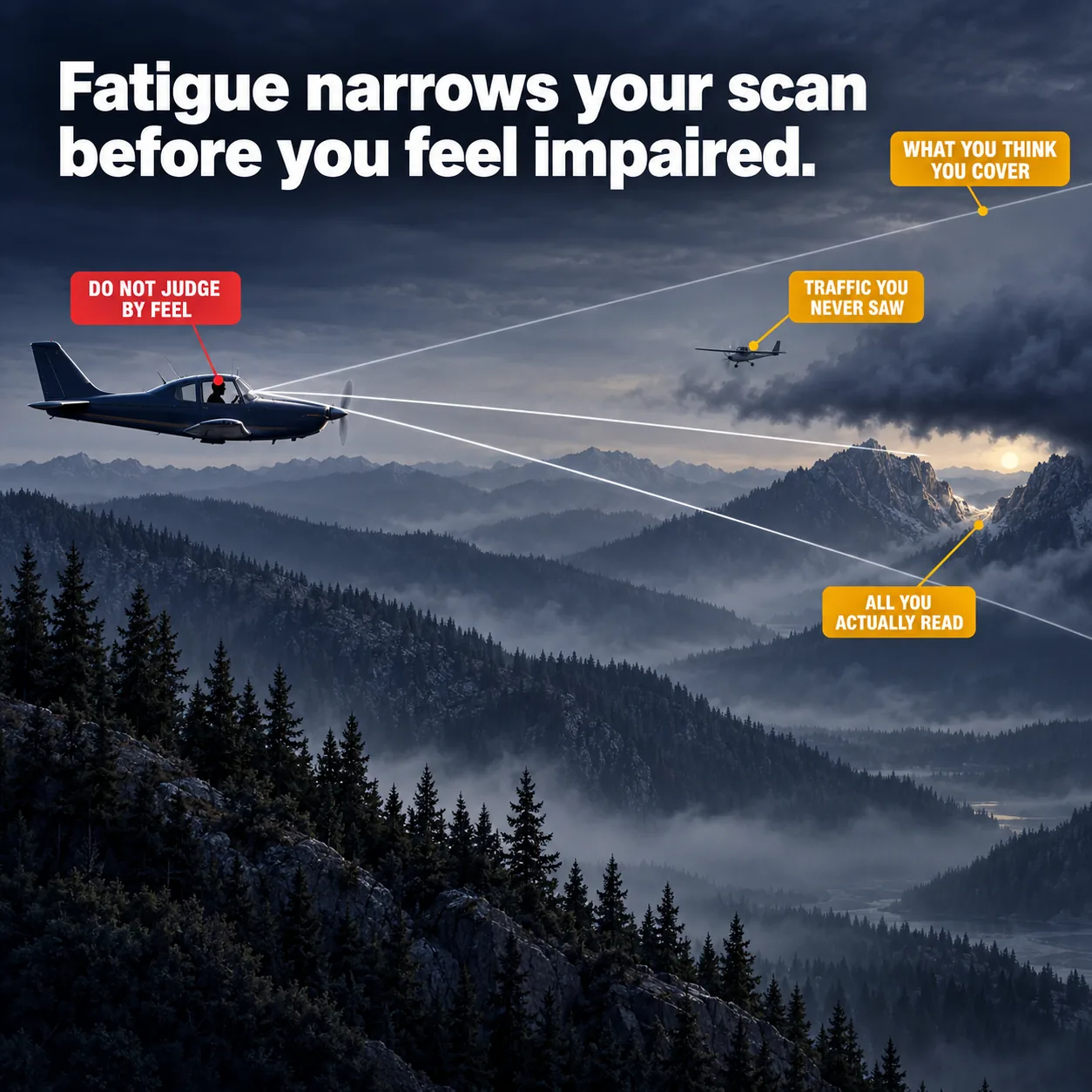
Fatigue narrows the field of attention before it feels like impairment, so the scan stops covering what you think it covers.
What the picture shows
The labels on the illustration, and what each one is pointing at.
- ALL YOU ACTUALLY READThe lit notch of rock at the near shoulder of the pass, where the narrow cone of attention lands.
- WHAT YOU THINK YOU COVERThe upper edge of the wide ghost outline spanning the forward view.
- TRAFFIC YOU NEVER SAWThe small crossing aeroplane sitting in the dimmed band between the narrow cone and the ghost outline.
- DO NOT JUDGE BY FEELThe pilot's upright silhouette in the cockpit.
What fatigue takes from your attention
Picture the last leg of a long day. You're holding altitude and the radio calls go out on time. Nothing feels wrong, so you assume your attention is where it always is.
Fatigue degrades your attention and your concentration. It also impairs coordination and makes you worse at communicating. Together these seriously weaken your ability to make good decisions.
It can be physical or mental. Sleep loss, exercise or physical work bring on the physical kind, while stress and long stretches of mental work bring on the other.
For your scan, attention matters most, especially your ability to divide it between several jobs at once. Flying asks for that split on every leg.
Why your scan shrinks toward the middle
Skill fatigue, a type of acute or short-term fatigue, shows up in how you fly. Its first effect is on timing, with each step of a task slightly off while the whole looks normal. You end up flying the steps as separate pieces instead of one smooth action.
Its second effect narrows what you see. Your attention settles on movements and objects in the center of your vision, and the periphery, the outer part of your view, gets neglected. Your control inputs lose accuracy and smoothness along with it.
Exhaustion on a night flight pushes the same way. A worn-out pilot tends to work one aspect of a situation and miss the total of what it needs. Instead of a proper scan, you may fixate on the instruments or stare off, and stop handling several tasks.
Taken far enough, this becomes fixation, locking your attention on one goal or object while ignoring the cues that show your orientation. It tends to set in while you concentrate on the instruments or on a landing. You lock onto one task and forget to look at what is going on around you.
That is how traffic gets missed. Whether you spot an aircraft on a collision course depends partly on where you are looking.
Why one task crowds out the rest
Fatigue, like stress or work overload, can lock you onto one item that seems important. Your awareness of the rest of the flight shrinks around it.
Distractions often start small. A gauge that is not reading right draws you in, and you stop monitoring the instruments and scanning outside. Control of the airplane is what slips while you work on it.
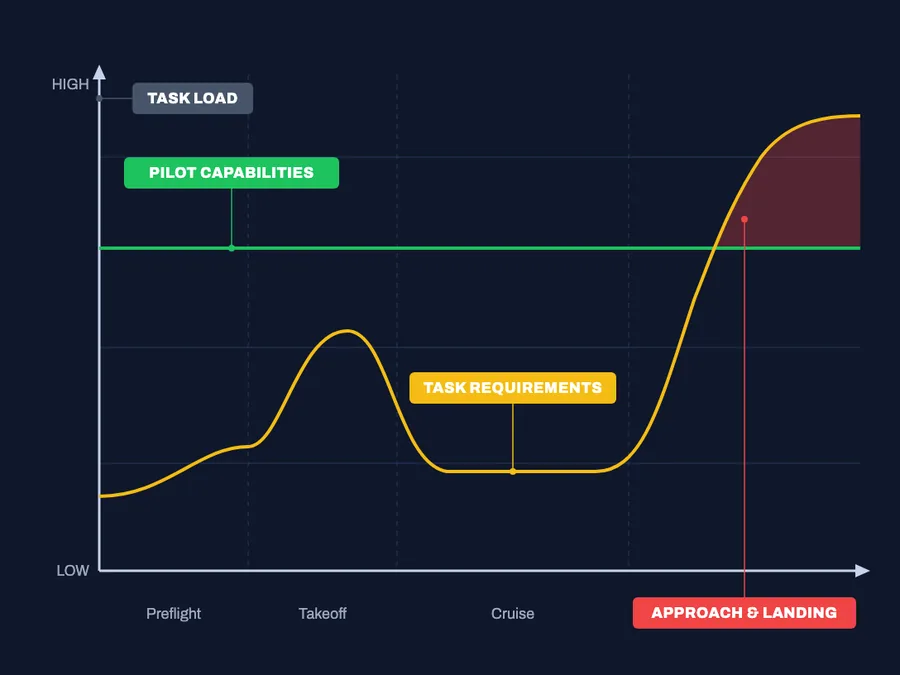
Workload makes it worse. As it climbs, you can no longer give attention to several tasks at one time, and you may begin to focus on one. At task saturation, having more to do than you can take in, input from other sources stops registering.
So fatigue removes the very skill a busy cockpit calls for, which is dividing your attention. Tasks also increase significantly in the landing phase, where the flying calls for more precision and attention.
How a long night flight adds to it
Stack late nights and fatigue on sustained flight above 5,000 feet, and you may grow less discerning and less decisive. You may also question information less and become more compliant and accepting.
The timing makes it dangerous. Take a night instrument approach in the weather after a 4-hour flight, the most demanding stretch of the trip. It arrives when your guard is down the most.
By the end of a long flight day, fatigue and low-altitude hypoxia, too little oxygen for the body, have drained much of your energy. The handbook describes the result as a shift from deciding to accepting.
Your eyes take a hit as well. Above 4,000 feet pressure altitude, night vision drops measurably unless you are on supplemental oxygen, and fatigue makes the loss worse. At 12,000 feet at night, parts of your normal vision may be missing or out of focus.
| Height or time | What the handbook says happens |
|---|---|
| Sustained flight above 5,000 feet | With late nights and fatigue, pilots may become less discerning, less decisive and more compliant |
| After a 4-hour flight | A night instrument approach in the weather comes when the pilot's guard is down the most |
| Above 4,000 feet | Without supplemental oxygen, night vision declines measurably |
| 12,000 feet at night | Elements of normal vision may be missing or not in focus |
Why feeling fine tells you little
Ask a fatigued pilot who has flown 16 hours if they are too tired to keep flying. The answer may be no.
Flying alone, you act as your own quality control. The tired mind that is missing things is the same one judging whether it is missing them.
Most pilots are goal oriented. Offered a flight, they tend to deny their own limits and give weight to things that have no bearing on the trip.
That makes fatigue one of the hardest hazards to catch, since it may not be apparent until you have made serious errors. Fatigued pilots have fallen asleep while flying, yet the effects may be subtle, such as dulled thinking and weaker decisions.
How IMSAFE asks the question for you
Since feel is unreliable, use a checklist that asks the question for you. IMSAFE is a self-check for before every flight, and it stands for Illness, Medication, Stress, Alcohol, Fatigue and Emotion.
The fatigue item asks whether you are tired and not adequately rested. Too little sleep is one cause, so start with how you slept rather than how you feel. Hypoxia and your emotional state can both intensify it.
Rest and 8 hours of sound sleep ordinarily cure acute fatigue. Sleep only corrects that kind, though. Chronic fatigue, which lasts over a long period, can involve several factors and needs more analysis and a remedy of its own.
The check does not stop at takeoff. On any flight longer than 2 hours, run the 5 P check, a review that includes you as the pilot, every hour.
What this teaches
- Fatigue degrades attention and the ability to divide it between tasks.
- Fatigue is hard to judge from how you feel: a pilot who has flown 16 hours may still say they are not too tired, so the IMSAFE checklist helps identify it.
Where to read more
Everything above rests on these. They are the FAA's own publications, free to read.
- Pilot's Handbook of Aeronautical Knowledge (FAA-H-8083-25), Chapter 17see Chapter 17
- Pilot's Handbook of Aeronautical Knowledge (FAA-H-8083-25), Chapter 2see Chapter 2
- Risk Management Handbook (FAA-H-8083-2)the FAA's own handbook
Keep reading
- Pilot guideWhat NOTAMs to Check Before a Flight
- Pilot guideThe Go/No-Go Decision Framework
- Pilot guidePersonal Minimums: How to Set Yours

Score the next flight before you go
FlightDecide reads the weather, the NOTAMs, your fuel and your weight and balance for the planned window, then scores them into a go / no-go call you can check against the raw data.
Get FlightDecide on the App StoreEducational content for pilots. It is advisory only and not a substitute for an official weather briefing, your POH, or your own judgment as pilot in command (14 CFR 91.3). The sources this explainer rests on are listed above.