Home › Explainers › Carburettor ice on a warm day
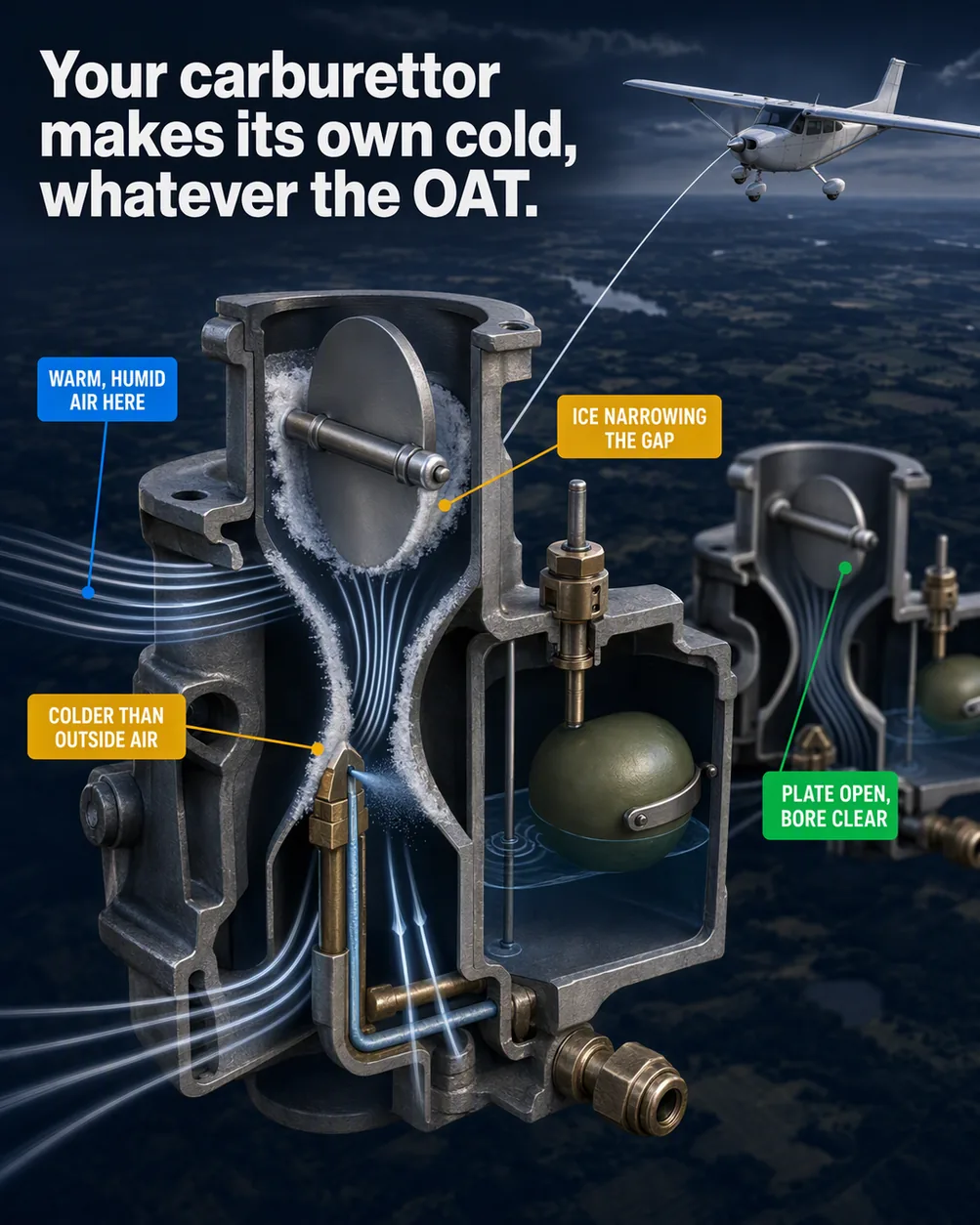
The temperature drop happens inside the carburettor, so ice forms on a day well above freezing.
What the picture shows
The labels on the illustration, and what each one is pointing at.
- WARM, HUMID AIR HEREThe flared intake mouth of the cutaway, where outside air enters.
- COLDER THAN OUTSIDE AIRThe narrow venturi throat, at the point the fuel spray leaves the nozzle.
- ICE NARROWING THE GAPThe rime collar on the partly closed throttle plate and the shrunken air gap past it.
- PLATE OPEN, BORE CLEARThe ghost cutaway's wide-open throttle plate and clean bore.
Where the cold comes from
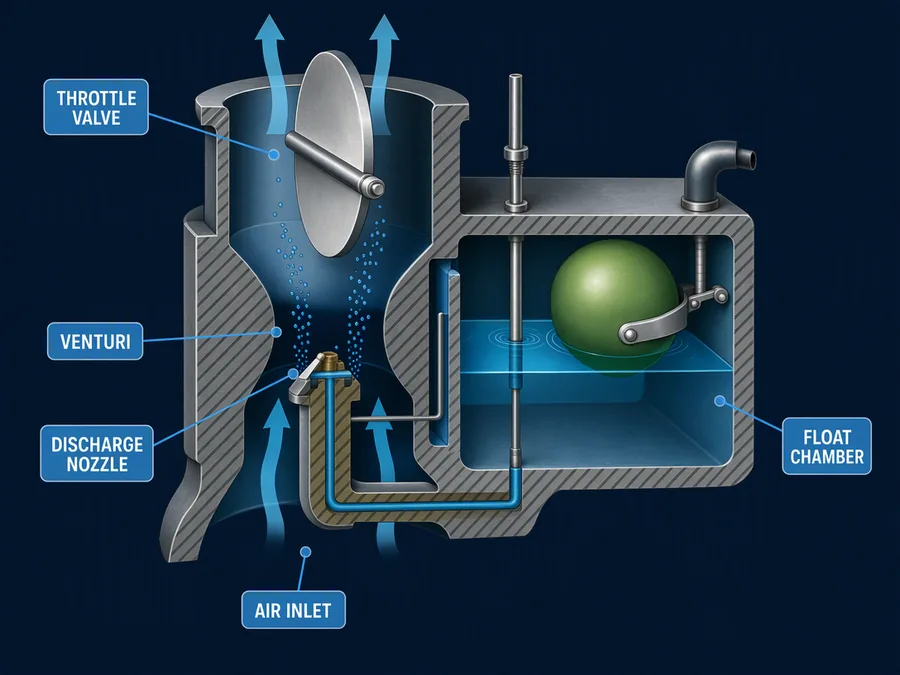
Start with a warm, humid day and a float-type carburettor, the more common type and the one small aircraft usually carry. It is named for a float that rests on the fuel in its float chamber, the bowl that feeds the carburettor. Outside air passes through a filter, usually at the front of the cowling, and enters through the air inlet.
Inside, the air passes through the venturi, a narrow throat in the carburettor. The venturi's shape creates an area of low pressure. Fuel in the float chamber sits at higher pressure, so it is pushed out of the discharge nozzle into that throat.
Two things now cool the air. Its pressure has dropped, and the fuel is turning from liquid to vapour, which is called vaporisation. Together they make a sharp temperature drop right inside the carburettor.
The discharge nozzle must sit at the venturi throat, where the pressure is low. The throttle valve, worked by the throttle in the cockpit, sits on the engine side of the nozzle. So the fuel cools the air inside the venturi, and ice forms readily there and on the throttle valve.
A pressure-type carburettor, rarely found on small aircraft, sprays fuel under pressure on the engine side of the throttle valve. There, engine heat offsets the cooling, and the risk of fuel vaporisation icing almost disappears.
How much colder the carburettor gets
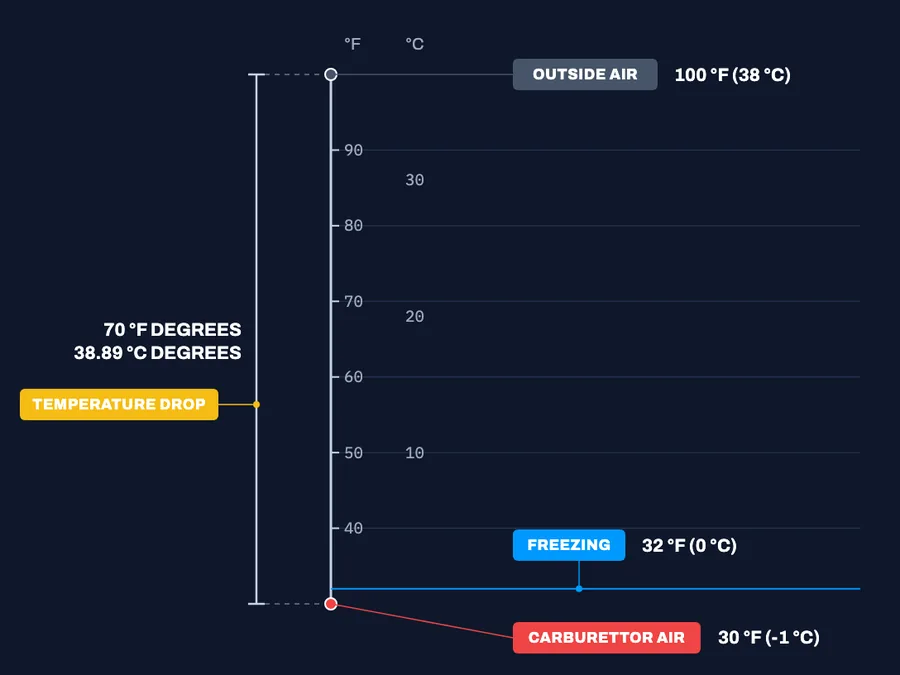
The FAA's Pilot's Handbook of Aeronautical Knowledge (FAA-H-8083-25, chapter 7) puts the temperature drop at as much as 60 to 70 Fahrenheit degrees. Read that as a difference on the scale, not a temperature of 70 °F.
Converting a difference takes care. Water freezes and boils 180 degrees apart in Fahrenheit and 100 degrees apart in Celsius. So a drop of 70 Fahrenheit degrees is 38.89 Celsius degrees.
Now run the handbook's own example. Air at 100 °F (38 °C) that loses 70 Fahrenheit degrees is at 30 °F (-1 °C) inside the carburettor. That carburettor air is below freezing, 32 °F (0 °C), on a day you would call hot.
The FAA's weather handbook, AC 00-6B, gives a similar figure. It says carburetion, the mixing of fuel and air, can cool the incoming air by as much as 33 °C.
Why a warm day is no protection
Cold air on its own makes no ice. Water vapour, the water carried invisibly in the air, has to condense into liquid while the carburettor is at or below freezing. When it does, ice may form on the surfaces inside, the throttle valve among them.
So the day's moisture matters too. Relative humidity tells you how close the air is to saturation, the point where it can hold no more water vapour. At 100 percent the air is saturated.
The Pilot's Handbook rates ice most likely below 70 °F (21 °C) with relative humidity above 80 percent. Because the cooling is so sharp, it also says icing can happen with outside air as hot as 100 °F (38 °C). Humidity on such a day can be as low as 50 percent.
The weather handbook agrees. It says ice can form even under clear skies, with outside air as warm as 33 °C (90 °F) and relative humidity of 50 percent or more.
The Pilot's Handbook charts these conditions from 20 °F (-7 °C) to 100 °F (38 °C). Its caption still warns that icing is possible in conditions the chart does not show.
| Source | Outside air temperature | Relative humidity | Carburettor ice |
|---|---|---|---|
| FAA-H-8083-25 | Below 70 °F (21 °C) | Above 80 percent | Most likely |
| FAA-H-8083-25 | As high as 100 °F (38 °C) | As low as 50 percent | Can occur |
| AC 00-6B, clear skies | As high as 33 °C (90 °F) | 50 percent or more | Possible |
Why low power raises the risk
The ice builds where the cold is, around the throttle valve and in the venturi throat. It narrows the path for the fuel-air mixture, and the engine loses power. If enough builds up, the engine may stop.
Reduced power makes this worse. Close the throttle in flight and the engine cools quickly, and the fuel vaporises less completely than it would in a warm engine. The Pilot's Handbook says the engine is more prone to carburettor ice in that state.
Ice can form in any phase of flight. A descent at reduced power is when it is particularly dangerous. Under some conditions it can build unnoticed there and show itself only when you add power.
Size is no comfort either. The weather handbook says even a small amount of carburettor ice costs power and may make the engine run rough.
How you notice it forming
With a fixed-pitch propeller, the first sign is a drop in engine rpm. Engine roughness may follow.
A constant-speed propeller changes its own pitch to make up for lost power, so it holds rpm steady. In that aircraft, the rpm will not show the ice.
Watch manifold pressure instead, the pressure in the intake manifold that carries the mixture to the combustion chambers. Carburettor ice shows there as a falling reading while rpm stays the same.
Whichever propeller you have, you are looking for lost power, and you may see it as lost altitude or airspeed. Vibration or roughness sometimes comes with it. Once you notice the loss, act at once to clear the ice that has formed and stop more from forming.
How carburettor heat clears the ice
Engines with float-type carburettors carry a carburettor heat system for this. It is an anti-icing system that warms the air before it reaches the carburettor, to keep the fuel-air mixture above freezing. It can also melt ice that has already formed, as long as there is not too much.
When you find ice, apply full heat immediately and leave it on until you are sure the ice is gone. Partial heat, or heat left on too briefly, might make things worse.
Full heat cuts power further, and the engine may run rough as melted ice passes through. That can last from 30 seconds to several minutes. Resist easing the heat back, and keep it at full hot until normal power returns.
The rpm tells you whether there was ice. With a fixed-pitch propeller and ice present, rpm drops when the heat goes on, then slowly rises as the ice melts. With no ice, rpm drops and then holds steady.
With a constant-speed propeller, ice shows as a fall in manifold pressure and then a slow rise. With no ice, you see no rise until you turn the heat off.
Using heat before the ice arrives
Prevention is the better use of carburettor heat, and you check that it works during the engine runup. If you suspect icing conditions and expect to close the throttle, set full heat first. Leave it on for as long as the throttle stays closed.
Every so often during that time, open the throttle smoothly for a few seconds. That keeps the engine warm, and without it the carburettor heater may not supply enough heat to stop ice forming.
Heat has a cost. Heated air is less dense, so engine power falls, sometimes by up to 15 percent, and the mixture gets richer. Because it cuts power and raises engine temperature, keep it off for takeoff and normal running unless checking for or clearing ice.
Some aircraft carry a carburettor air temperature gauge to help you spot icing conditions. Its face usually shows a yellow arc from -15 °C to +5 °C (5 °F to 41 °F), the range where icing may occur.
When the temperature and moisture make icing unlikely, the needle can sit in the yellow without harm. When conditions favour icing, use carburettor heat to keep it out of the arc.
What this teaches
- Fuel vaporisation and the pressure drop through the venturi cool the induction air substantially below ambient.
- Carburettor ice is therefore possible at outside air temperatures well above freezing, particularly at high humidity and reduced power.
Where to read more
Everything above rests on these. They are the FAA's own publications, free to read.
- Pilot's Handbook of Aeronautical Knowledge (FAA-H-8083-25), Chapter 7see Chapter 7
- Advisory Circular 00-6B, Aviation WeatherFAA advisory circular
Keep reading
- Free toolFuel Burn & Endurance Calculator
- Free toolWeight & Balance Calculator
- Aircraft dataAircraft Performance Library

Score the next flight before you go
FlightDecide reads the weather, the NOTAMs, your fuel and your weight and balance for the planned window, then scores them into a go / no-go call you can check against the raw data.
Get FlightDecide on the App StoreEducational content for pilots. It is advisory only and not a substitute for an official weather briefing, your POH, or your own judgment as pilot in command (14 CFR 91.3). The sources this explainer rests on are listed above.