Home › Explainers › Centre of gravity aft of the limit
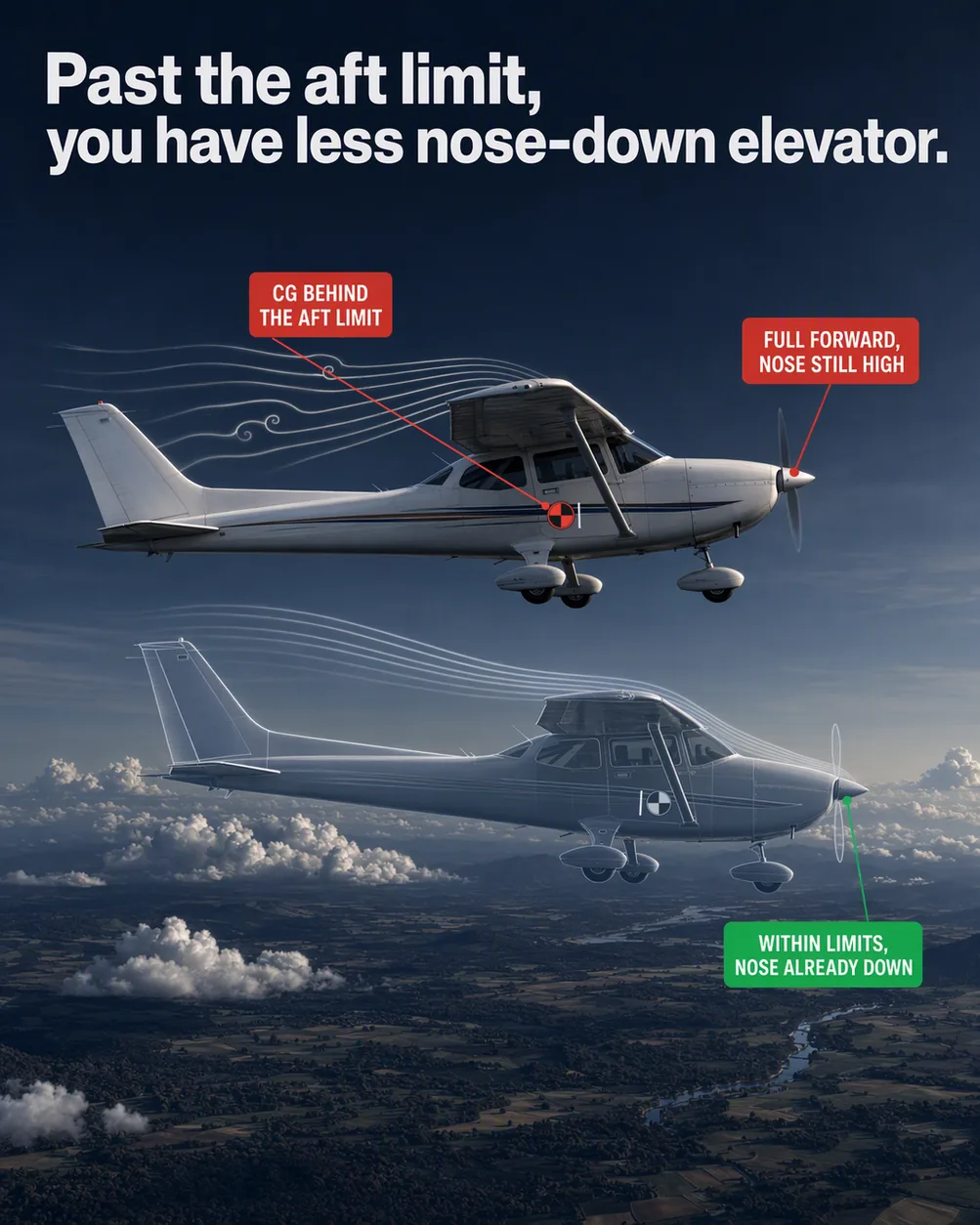
An aft CG shortens the tail's lever arm, so the aeroplane becomes less stable in pitch and harder to recover from a stall.
What the picture shows
The labels on the illustration, and what each one is pointing at.
- CG BEHIND THE AFT LIMITThe small red quartered-circle CG marker on the solid aeroplane's fuselage, just behind the pale aft-limit tick.
- FULL FORWARD, NOSE STILL HIGHThe solid aeroplane's raised spinner, still about twenty degrees above the horizon.
- WITHIN LIMITS, NOSE ALREADY DOWNThe ghost aeroplane's lowered spinner, a few degrees below the horizon.
What the centre of gravity is
Picture your loaded aeroplane hanging from a single hook. The centre of gravity, or CG, is the one point where you could hang it and it would balance.
The CG doesn't have to stay in one place. Where it sits depends on how the weight is spread through the aeroplane, so it shifts when load is moved or used up. A heavy bag moved aft takes the CG aft with it.
Balance side to side counts too, but the FAA's handbook treats the fore-and-aft position as the one that matters most. With the CG too far forward, the aeroplane is nose heavy. Too far aft, it's tail heavy.
The manufacturer sets a forward limit and an aft limit for the CG. The distance between them is the CG range, and the CG must sit inside it during flight.
What the aft limit is set for
The aft limit is the furthest back the CG can sit and still suit the most demanding manoeuvre or operation. In other words, it's drawn for the worst case.
You'll find the limits in the aeroplane's Type Certificate Data Sheet (TCDS) or its aircraft specification. They're also in the aircraft flight manual (AFM) or pilot's operating handbook (POH).
A regulation, 14 CFR 23.23, requires that safe ranges of weight and CG be established for the aeroplane. The manufacturer supplies them, and they go into the approved AFM, TCDS or aircraft specifications.
The aft limit isn't always one fixed spot. For some aeroplanes both limits may move as the aeroplane's total weight changes. They may also change for aerobatic flight, for retracting the landing gear, or for special loads and devices that alter how it flies.
Why a tail-heavy aeroplane is less stable
Fly into turbulence and a bump knocks the nose up. A stable aeroplane then rights itself, with the nose settling back where it was. That ability to right itself in pitch, nose up and nose down, is longitudinal stability.
As the CG moves aft, that ability shrinks. The aeroplane becomes less stable, and less able to right itself after turbulence or after you manoeuvre.
The handbook calls the effect of tail-heavy loading on longitudinal stability serious. The less the aeroplane corrects by itself, the more correcting is left to you.
At the far end, the handbook says it's possible the pilot could not control an aeroplane whose CG made it unstable. Extreme control difficulty is also on its list of possible effects of a CG aft of the range.
How stalls and spins change
Now suppose the tail-heavy aeroplane stalls, or enters a spin. Tail-heavy loading reduces your capability to recover from either one.
Put simply, a recovery that works with the CG within limits works less well once the CG is behind the aft limit. The handbook states this outright for tail-heavy loading.
The stall itself may be worse too. Among the possible effects of a CG aft of the allowable range, the handbook lists violent stall characteristics.
Both of these come from the same tail-heavy load as the loss of stability. On one flight, the aeroplane is less able to right itself and you're less able to recover it from a stall or spin.
Why very light controls are a hazard
In a tail-heavy aeroplane it takes very little push or pull on the controls to move them. That push or pull is the control force, and tail-heavy loading makes it very light.
Light controls sound pleasant, but the handbook counts them as another undesirable trait. With so little force needed, it's easy to overstress the aeroplane, loading its structure beyond what it's built for, without meaning to.
When the aeroplane is out of balance fore and aft, the natural fix is a trim change that takes away the pressure you're holding. Too much trim costs you something, though. It makes the aeroplane less efficient in the air, and it shortens the travel the control has left in the direction you trimmed.
Flying an aeroplane that's out of balance can also leave you more tired. That fatigue has its own cost to the safety and efficiency of the flight.
How the load moves the CG
Most of the time, you're the one who decides where the CG ends up. Where the baggage and cargo go sets it, and so does who sits in which seat.
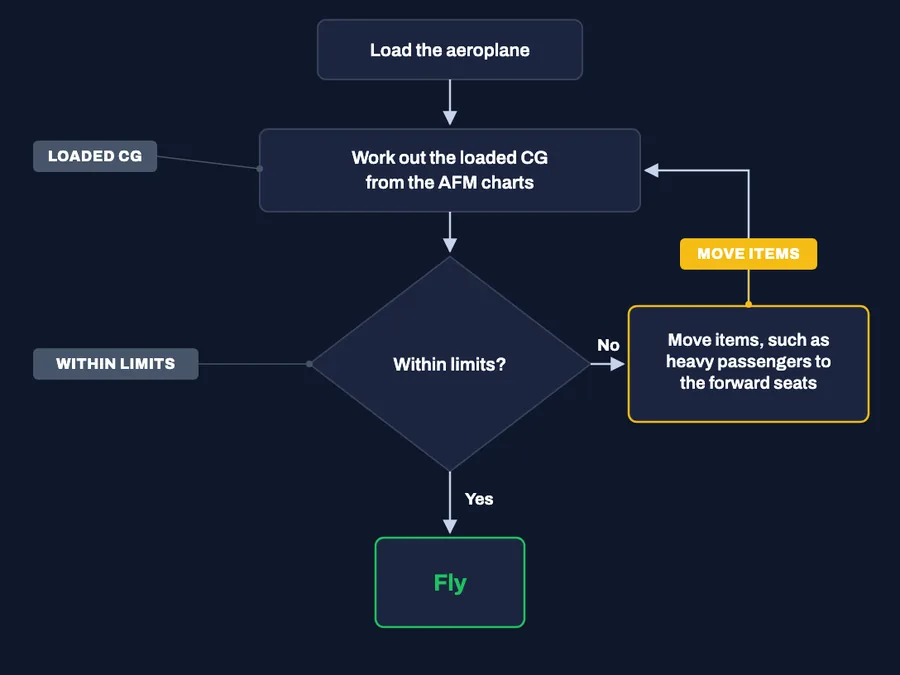
If the loading comes out tail heavy, the handbook's fix is the obvious one. Put the heavy passengers in the forward seats.
How far fuel burn moves the CG depends on where the tanks are. In most small aeroplanes the fuel is in the wings, very near the CG, so the loaded CG hardly moves as it burns.
Changes to the aeroplane itself move the CG too. Adding or removing equipment shifts it, and without up-to-date weight and balance records you have nothing to base the calculation on.
Checking the CG before you fly
In many modern aeroplanes you can't fill every seat, baggage compartment and tank and stay inside the weight and balance limits. With the maximum passenger load aboard, you'll often have to carry less fuel or less baggage.
Before any flight, work out the weight and balance with the manufacturer's procedure and the charts in the AFM. If the loaded CG isn't within limits, move items before you attempt the flight.
The Part 91 operating rules have no specific requirement for a weight and balance calculation before every flight. What 14 CFR 91.9 does require is that you, as pilot in command, comply with the AFM's operating limits. Those include weight and balance.
What this teaches
- Loading aft of the rearward CG limit reduces longitudinal stability.
- Stall recovery is degraded with an aft CG because elevator authority to lower the nose is reduced.
Where to read more
Everything above rests on these. They are the FAA's own publications, free to read.
Keep reading
- Free toolWeight & Balance Calculator
- Free toolDensity Altitude Calculator
- Aircraft dataAircraft Performance Library

Score the next flight before you go
FlightDecide reads the weather, the NOTAMs, your fuel and your weight and balance for the planned window, then scores them into a go / no-go call you can check against the raw data.
Get FlightDecide on the App StoreEducational content for pilots. It is advisory only and not a substitute for an official weather briefing, your POH, or your own judgment as pilot in command (14 CFR 91.3). The sources this explainer rests on are listed above.