Home › Explainers › Density altitude
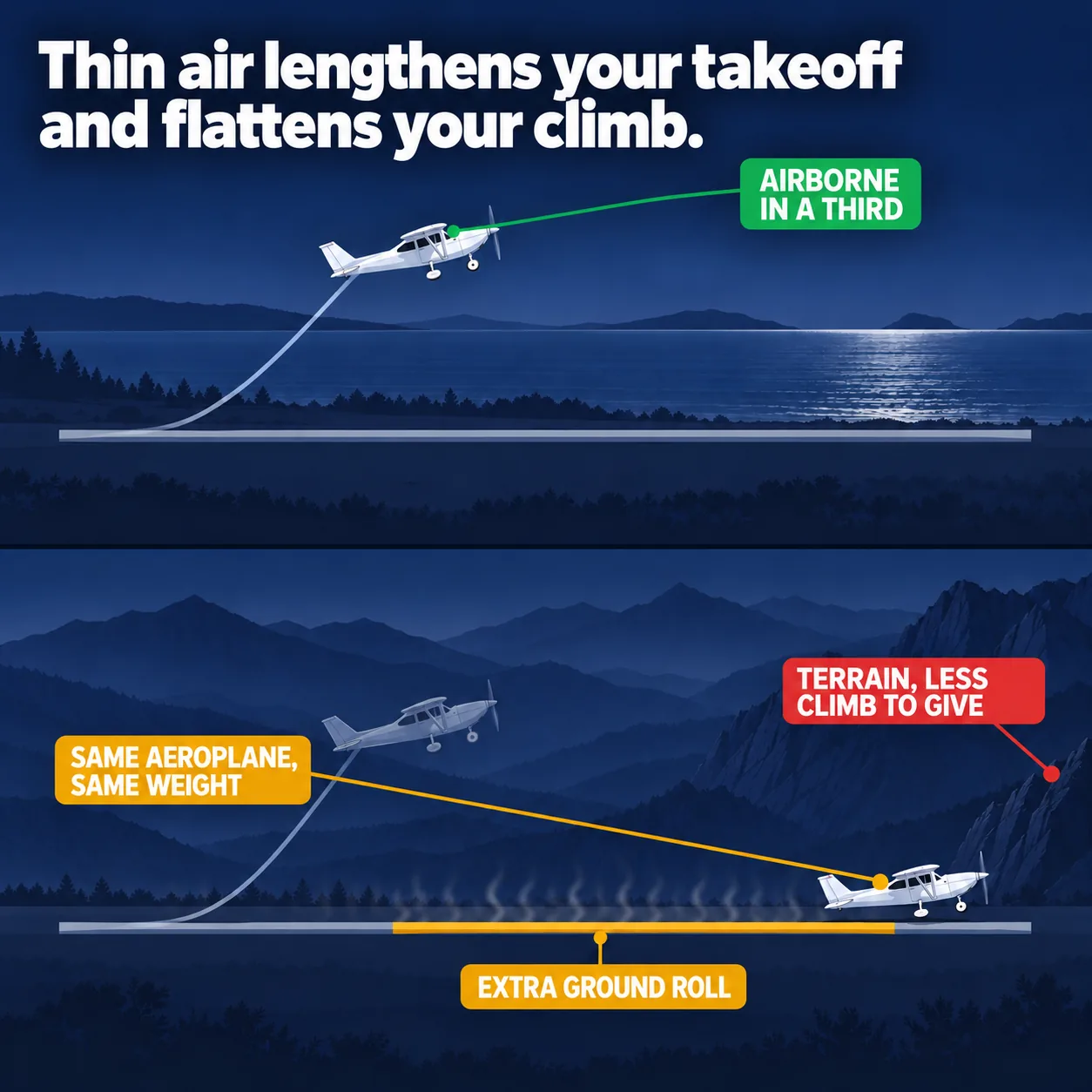
the same aeroplane uses far more runway to get airborne when the air is thin than when it is dense
What the picture shows
The labels printed on the illustration, in reading order.
- AIRBORNE IN A THIRD
- SAME AEROPLANE, SAME WEIGHT
- EXTRA GROUND ROLL
- TERRAIN, LESS CLIMB TO GIVE
What thin air does to the same aeroplane
Picture one aeroplane at one weight, flown by one pilot, on two different days. On the first it lifts off with plenty of runway left. On the second it rolls and rolls before it will fly.
The difference is the air. Air density, the amount of air packed into a given space, sets how hard the air pushes back on the propeller and the wing.
Pilots put that density into a single number called density altitude. It is the height in the standard atmosphere, a reference model of pressure and temperature, where air is as dense as today's air. Your aeroplane performs as if it were at that height, whatever the field elevation says.
A high density altitude means thin air, and performance drops. A low density altitude means dense air, and performance improves.
How height and heat each thin the air
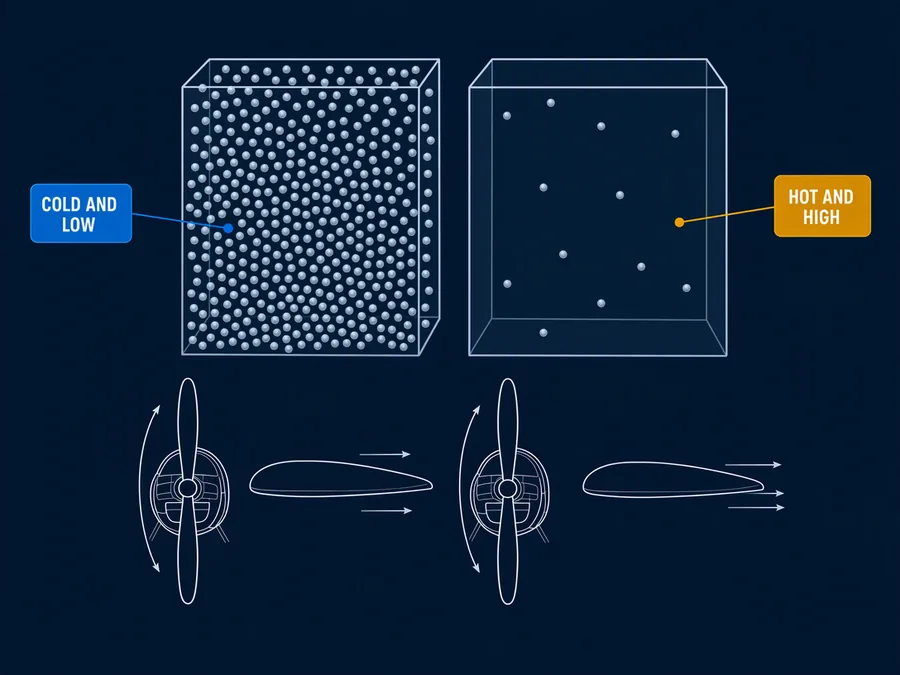
The higher you go, the less air there is above you pressing down. With less pressure on it, air spreads out, so each cubic foot holds less of it.
The standard atmosphere puts sea level at 29.92 inHg, inches of mercury, and 15.0 °C. By 5,000 feet the standard pressure is down to 24.89 inHg. That is why Denver starts with thinner air than New Orleans before the weather has any say.
Heat thins the air as well. Warm air expands and takes up more room, so the same space holds less of it. From one airport to another across the country, temperature is the biggest driver of density.
Pressure altitude is what your altimeter reads when you set it to 29.92 inHg. The FAA weather handbook takes a pressure altitude of 10,000 ft with the air at 20 °C. The density altitude there is 12,700 ft.
Humidity adds a little on top. Water vapour is lighter than dry air, so moist air is less dense, though the handbooks treat the effect as small.
| Altitude (ft) | Pressure (inHg) | Temperature (°C) |
|---|---|---|
| 0 | 29.92 | 15.0 |
| 2,000 | 27.82 | 11.0 |
| 5,000 | 24.89 | 5.1 |
| 7,000 | 23.09 | 1.1 |
| 10,000 | 20.57 | −4.8 |
Why the ground roll grows
Thin air hits the aeroplane in three ways at once. The engine takes in less air, so it makes less power. The propeller has less air to push back, so it makes less thrust.
The wing loses out too. Lift comes from air pressing on the wing, and lighter air presses less at the same speed.
Here is the part that catches pilots out. Your airspeed indicator shows nothing unusual, and you rotate at the usual indicated airspeed. Your true airspeed, your real speed through the air, is higher.
A higher true airspeed means a higher groundspeed at liftoff. So the aeroplane has to run faster along the runway before it will fly. It does that with less thrust to speed it up, which adds still more runway.
None of this needs a heavier load or a sloppier technique. The aeroplane and the pilot are exactly as they were. Only the air is different.
How much longer, in the handbook's example
The Pilot's Handbook of Aeronautical Knowledge, FAA-H-8083-25, works through one case. The altimeter, set to 29.92 inHg, shows a pressure altitude of 5,000 feet.
On a standard temperature day, the example has the POH, the pilot's operating handbook, calling for a ground run of 790 feet. On a standard day, pressure altitude and density altitude sit at the same level.
Now make the day 20 °C warmer than standard. The warm air expands, and the density altitude rises above 7,000 feet. The ground run in the example comes out closer to 1,000 feet.
Same runway, same aeroplane, same pilot. Those are the handbook's example figures, and your own aeroplane's numbers come from the manufacturer's performance charts.
| Temperature | Density altitude | Ground run |
|---|---|---|
| Standard, at 5,000 ft pressure altitude | Same as pressure altitude | 790 ft |
| 20 °C above standard, at 5,000 ft pressure altitude | Above 7,000 ft | Closer to 1,000 ft |
Why rising ground past the runway matters more
Getting off the ground is only half the job. Once airborne, you still have to climb away from whatever lies past the departure end.
Thin air cuts your rate of climb, because the engine and propeller have less to give. You also fly the climb at the usual indicated airspeed, which is a faster true airspeed. Covering more ground each minute while gaining less height gives a shallower climb angle.
On a hot day at a high field, both effects land together. You leave the ground later, further down the runway, then climb more gently from that later point. Hills you clear easily on a cold morning sit closer to your path.
So a runway that is long enough is not the same as a departure that works. The climb out over the ground beyond it needs checking against the same conditions.
Working out density altitude before you go
You start with pressure altitude. Set 29.92 inHg on the altimeter and read it, or correct field elevation for the current altimeter setting.
The handbook's worked case is a sea level field with an altimeter setting of 29.7. Its table gives a correction of 205 feet, so the pressure altitude is 205 feet.
Next you correct that for temperature. A flight computer does it from pressure altitude and outside air temperature. The density altitude chart in chapter 11 does the same job on paper.
There is no rule of thumb or chart for humidity. On a warm, damp day, expect less performance than your dry-air numbers show.
What this teaches
- Heat and elevation both thin the air, and thin air reduces the thrust the propeller makes and the lift the wing makes at a given speed.
- Takeoff distance therefore grows with density altitude while the aircraft, its weight and the pilot's technique are all unchanged.
- Rising terrain beyond the runway matters more on a thin-air day, because the climb gradient available is reduced at the same time as the ground roll is lengthened.
Where to read more
Everything above rests on these. They are the FAA's own publications, free to read.
- Pilot's Handbook of Aeronautical Knowledge (FAA-H-8083-25), Chapter 11see Chapter 11
- Aviation Weather Handbook (FAA-H-8083-28), Chapter 8see Chapter 8
Keep reading
- Free toolDensity Altitude Calculator
- Pilot guideHow to Read a TAF
- Free toolWeight & Balance Calculator

Score the next flight before you go
FlightDecide reads the weather, the NOTAMs, your fuel and your weight and balance for the planned window, then scores them into a go / no-go call you can check against the raw data.
Get FlightDecide on the App StoreEducational content for pilots. It is advisory only and not a substitute for an official weather briefing, your POH, or your own judgment as pilot in command (14 CFR 91.3). The sources this explainer rests on are listed above.