Home › Explainers › The fuel you cannot use
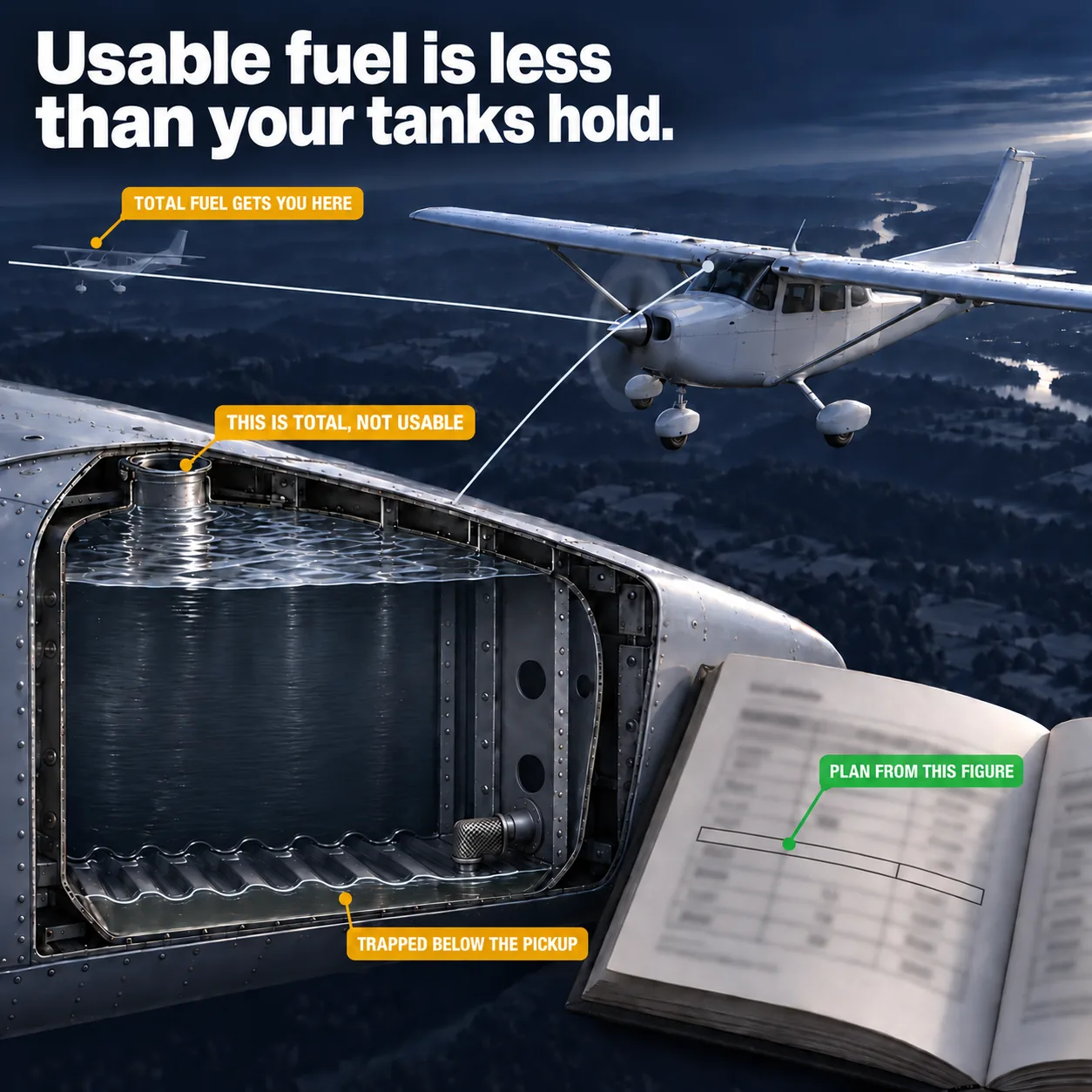
Usable fuel is less than total fuel, and the difference is a published number rather than a rounding error.
What the picture shows
The labels on the illustration, and what each one is pointing at.
- THIS IS TOTAL, NOT USABLEThe brimmed fuel surface where it meets the filler neck at the top of the cut-away tank bay.
- TRAPPED BELOW THE PICKUPThe thin separate band of fuel lying in the floor corrugations beneath the fuel pickup.
- TOTAL FUEL GETS YOU HEREThe translucent dimmed ghost aeroplane further along the track line.
- PLAN FROM THIS FIGUREThe ruled line in the fuel table on the open flight manual page.
What a full tank does not tell you
You fill the tanks to the top of the filler neck and cap them. The number printed on the tank, or on the fuel gauge placard, is the total the tanks hold. Some of that fuel will never reach the engine.
That leftover share is called unusable fuel, the fuel that stays in the tanks and lines and cannot be relied on in flight. Whatever is left after you take it away is usable fuel, the fuel the engine can actually burn.
Pilots often treat the gap between the two as a rounding error. It is not. The manufacturer measures it and publishes it for your aircraft type. A full tank tells you what you carry, and the usable figure tells you what you can burn.
Why some fuel never reaches the engine
Fuel has a long way to travel before it burns. In a fuel-injected engine it leaves the tank and passes through an engine-driven fuel pump. Then it goes to a fuel-air control unit, which does the job a carburetor would do.
From there the fuel runs to a fuel manifold, the valve that splits it between cylinders. Discharge nozzles in each cylinder head then spray it into the intake ports. An auxiliary fuel pump backs up the engine-driven pump for starting and emergencies.
The whole chain draws from the tank through an outlet called the pickup. Fuel lying below that outlet, or trapped in the shape of the tank floor, cannot be drawn into the lines. It is still fuel, and it still shows as part of the total, but the engine cannot use it.
Where the usable number comes from
You do not work out unusable fuel yourself. The manufacturer establishes it, and it is written in the approved flight manual for your aircraft. That manual is called the airplane flight manual (AFM) or the pilot's operating handbook (POH).
This is the same place the manufacturer publishes other limits you must respect. The fore and aft limits for the center of gravity, the balance point of the loaded aircraft, sit in the AFM or POH. They also appear in the Type Certificate Data Sheet (TCDS), the aircraft's official specification.
Look in the fuel section of your AFM or POH. You will find total capacity and usable capacity listed as separate figures. Two aircraft that look alike on the ramp can carry different numbers, so read the manual for the one you are flying.
What the unusable fuel still costs you
Unusable fuel gives you no range, but it does not weigh nothing. Gasoline weighs 6 pounds per gallon. Every gallon trapped in the tank is 6 pounds you carry for the whole flight.
Weight matters because too much of it hurts nearly every part of performance. An overloaded aircraft needs a longer takeoff run and climbs more slowly. It also stalls at a higher speed and needs a longer landing roll.
During a flight, burning fuel is normally the only change in weight. As the usable fuel goes, the aircraft gets lighter and performs better. The unusable fuel stays aboard, so it counts as weight from engine start to shutdown.
Where fuel sits also affects balance. If you feed the engine unevenly from tanks on one side, the aircraft becomes wing-heavy. Holding it level with trim or control pressure adds drag and wastes fuel you had planned to use.
What happens when the plan uses total fuel
Picture two plans for the same trip. One divides the total capacity by the fuel burn. The other divides the usable capacity. The first plan promises you minutes of flight that the tanks cannot deliver.
When the usable fuel runs out, the engine stops getting fuel even though the tanks are not dry. That is fuel starvation, the engine quitting because fuel no longer reaches it. The gauge and the tank may both suggest fuel is still aboard.
Restarting is not a sure thing either. Fuel-injected engines have a known weakness here. Restarting one that quit from fuel starvation brings its own problems, so an engine that stops this way does not reliably come back.
How to plan from the usable figure
Start every fuel calculation with the usable capacity from the AFM or POH, never the total. If the tanks are not full, work out how much usable fuel is actually aboard. Only that quantity goes into your time and range sums.
Treat the usable figure as a ceiling, not a target. Your plan should land with fuel still in the tanks, including the reserve the regulations require. Those reserve rules come from the regulations, and the source here does not give their figures.
Carrying less fuel to save weight is a fair choice, but it trades away range. If you remove fuel to get under a weight limit, redo the fuel plan with the smaller usable quantity. Then check the new figure still covers the trip and the reserve.
What this teaches
- An aircraft's total fuel capacity includes an unusable quantity that cannot be relied on in flight.
- Fuel planning uses the usable figure from the approved flight manual.
Where to read more
Everything above rests on these. They are the FAA's own publications, free to read.
- Pilot's Handbook of Aeronautical Knowledge (FAA-H-8083-25), Chapter 10see Chapter 10
- Pilot's Handbook of Aeronautical Knowledge (FAA-H-8083-25), Chapter 7see Chapter 7
Keep reading
- Free toolFuel Burn & Endurance Calculator
- Free toolWeight & Balance Calculator
- Aircraft dataAircraft Performance Library

Score the next flight before you go
FlightDecide reads the weather, the NOTAMs, your fuel and your weight and balance for the planned window, then scores them into a go / no-go call you can check against the raw data.
Get FlightDecide on the App StoreEducational content for pilots. It is advisory only and not a substitute for an official weather briefing, your POH, or your own judgment as pilot in command (14 CFR 91.3). The sources this explainer rests on are listed above.