Home › Explainers › Ground effect in the flare
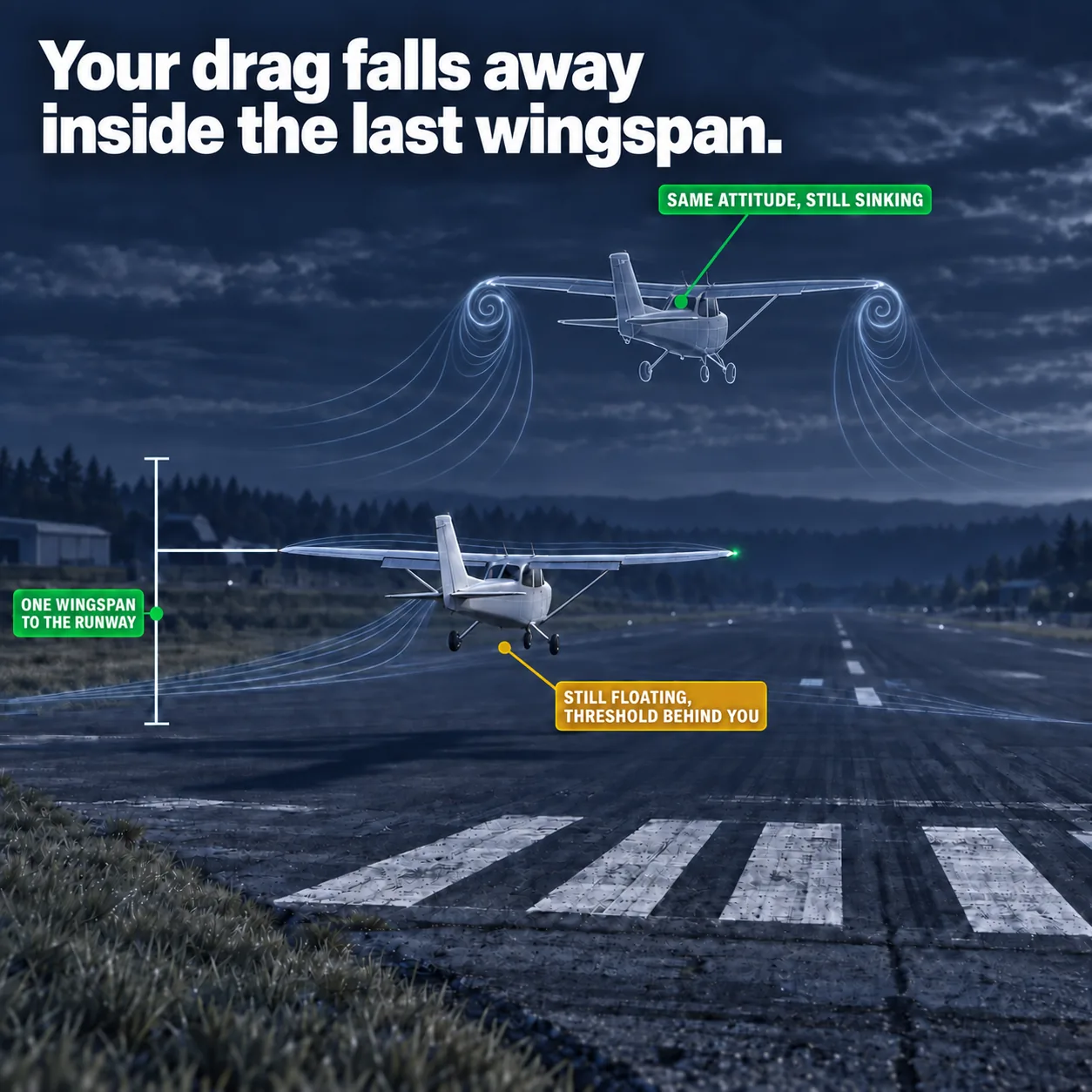
Within about one wingspan of the surface induced drag falls away, so the aeroplane floats on air that has nowhere to go.
What the picture shows
The labels on the illustration, and what each one is pointing at.
- ONE WINGSPAN TO THE RUNWAYThe thin vertical dimension line running from the low aircraft's left wingtip down to the asphalt.
- STILL FLOATING, THRESHOLD BEHIND YOUThe band of daylight between the low aircraft's main wheels and the runway centreline.
- SAME ATTITUDE, STILL SINKINGThe pale ghost outline higher up and the two tight tip vortices trailing beneath it.
What you feel just before touchdown
You've closed the throttle and eased the nose up for the flare, the gentle pitch-up just before touchdown. Now you're waiting for the wheels to touch, but the runway keeps sliding past and the airplane keeps flying just above it. It doesn't seem to want to come down.
Pilots have noticed this since the first flights, and it feels like a cushion of air trapped under the wing. Its name is ground effect, the change in airflow around an airplane flying close to the ground or water.
Ground effect normally reaches up to about one wingspan above the surface. Inside that height the wing loses part of its induced drag, the drag that comes with making lift. With less drag to slow it, the airplane gives up its speed slowly and floats.
Where induced drag comes from
A wing holds the airplane up by pushing air downward. The air streaming down behind the wing is called downwash, and the harder the wing works, the more of it there is.
The air under the wing is at higher pressure than the air above it. Near each tip it flows sideways around the edge and rolls up into a spinning tube called a wingtip vortex. Making the downwash and the vortices takes energy, and that energy is paid for as induced drag.
Slow flight makes it worse. To hold the airplane up at lower speed you need a higher angle of attack, the angle between the wing and the oncoming air. A higher angle means a bigger pressure difference, stronger vortices and more induced drag.
Induced drag rises as the inverse square of airspeed, so slowing down makes it grow fast. At high speed, parasite drag, the drag of moving the airframe itself through the air, makes up most of the total. In the flare you are slow, so induced drag is the part that dominates.
What the runway does to the airflow
Now bring that wing down near the runway. The air it pushes down has nowhere to go, because the surface blocks its path downward. The ground is interfering with the airflow, and that interference is ground effect.
That blocked flow weakens the upwash, the air rising to meet the front of the wing. It weakens the downwash behind the wing and the wingtip vortices too.
Smaller vortices change how lift is spread along the span, and induced drag falls. The wing now needs a lower angle of attack to make the same lift. Hold the old angle and it makes more lift than it did.
How close the wing has to be
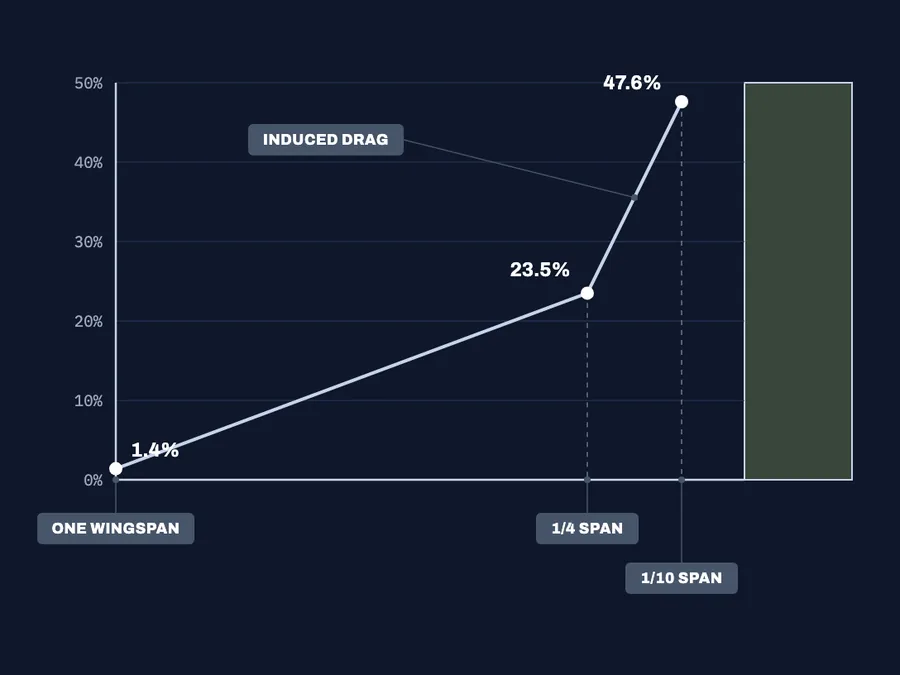
As you descend through that last wingspan, ground effect grows, and most of it arrives very close to the runway. The Pilot's Handbook of Aeronautical Knowledge gives the figures.
With the wing one wingspan above the ground, induced drag drops by only 1.4 percent. At 1/4 of the span the drop is 23.5 percent. At 1/10 of the span it is 47.6 percent, close to half.
The Airplane Flying Handbook rounds those two lower figures to about 25 percent and about 50 percent. Either way, the big saving only comes with the wing very near the surface.
So one wingspan marks where ground effect can first be detected, and the lower heights show where it does real work. Because the saving sits so low, you notice it most just after lift-off and just before touchdown.
Why extra speed becomes a long float
Back in the flare, you hold a steady nose-up attitude at low speed, just off the runway. Those are exactly the conditions where ground effect is strongest.
Thrust required, the push needed to hold a speed in level flight, is parasite drag and induced drag added together. Ground effect cuts the induced part, so thrust required drops sharply at low speed.
With the power off, drag is what slows you down. Take a big share of it away and the airplane loses speed slowly. Any extra speed you carry into the flare can then become a long float down the runway.
The lift changes too. If the wing arrives in ground effect at the same angle of attack, it makes more lift and the airplane can float.
So as you near the ground at the end of the approach, you take some power off. Leave it in and the airplane will tend to climb.
Why a slow lift-off can settle back
On takeoff the same physics runs the other way. The roll, the lift-off and the start of the climb all happen inside ground effect, where induced drag is reduced. That can make the airplane seem ready to fly well below its recommended takeoff speed.
Your instruments read differently here too. Ground effect usually raises the pressure at the static source, the port that feeds the airspeed indicator and altimeter, so both read slightly low. You can be airborne at an indicated airspeed below the one normally needed.
Climb out of ground effect and all of this reverses. The wing needs a higher angle of attack for the same lift, and induced drag and thrust required both rise. The nose tends to pitch up, stability decreases, and the airspeed indicator reads higher as static pressure falls.
If you lifted off short of speed, that extra drag arrives as you leave ground effect. Your climb will be much weaker than at Vy, the best rate of climb speed, or even Vx, the best angle of climb speed.
The worst case is a heavy airplane on a hot day at high density altitude, where the air is thin. There the airplane can lift off yet be unable to climb out of ground effect and settle back onto the runway. So you never force it into the air before the manufacturer's recommended takeoff speed.
Using ground effect on purpose
Ground effect also has its uses. With a long enough runway or no obstacles, the reduced drag can help the airplane accelerate after lift-off.
A soft-field takeoff is built around it. Tall grass, soft sand, mud and snow drag at the wheels, so you hold the nose high and let the wing lift the airplane off early. It leaves the ground below a safe climb speed, held up by ground effect.
Once airborne, you lower the nose gently and let it accelerate with the wheels just clear of the surface. If it rises out of ground effect too soon, it tends to settle back even at full power. So you keep it in ground effect until it reaches at least Vx.
Some airplanes tend to lift off well before Vx on a short field. It is better to let one lift off and hold it level, wheels just clear, until it reaches Vx. Pinning it to the runway with forward pressure overloads the nosewheel and slows the acceleration.
What this teaches
- Within about one wingspan of the surface, ground effect reduces induced drag and the thrust required to hold a low airspeed in level flight.
- The reduced drag is why an aircraft floats in the flare and why it can lift off below normal flying speed and settle back.
Where to read more
Everything above rests on these. They are the FAA's own publications, free to read.
- Pilot's Handbook of Aeronautical Knowledge (FAA-H-8083-25), Chapter 5see Chapter 5
- Airplane Flying Handbook (FAA-H-8083-3), Chapter 6Chapter 6 as a PDF · the whole handbook
Keep reading
- Free toolFuel Burn & Endurance Calculator
- Free toolDensity Altitude Calculator
- Free toolWeight & Balance Calculator

Score the next flight before you go
FlightDecide reads the weather, the NOTAMs, your fuel and your weight and balance for the planned window, then scores them into a go / no-go call you can check against the raw data.
Get FlightDecide on the App StoreEducational content for pilots. It is advisory only and not a substitute for an official weather briefing, your POH, or your own judgment as pilot in command (14 CFR 91.3). The sources this explainer rests on are listed above.