Home › Explainers › How the pitot tube works
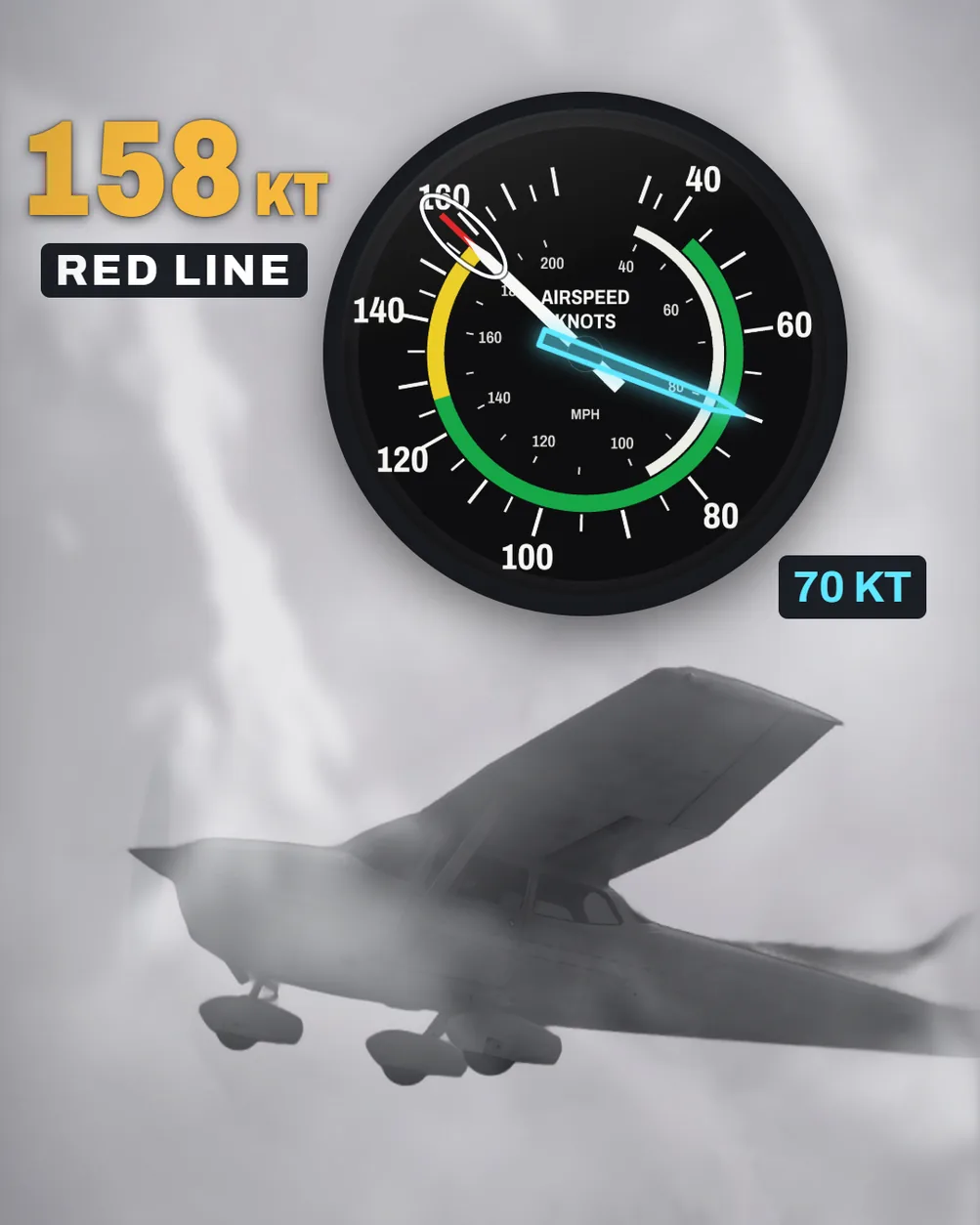
Your airspeed needle is only as honest as a tube under the left wing and a small hole in the side of the fuselage.
What the picture shows
The labels on the illustration, and what each one is pointing at.
- 158 KTWhat the needle reads, 158 KIAS, after a 1,000 ft climb with the tube and its drain hole sealed at 70 KIAS (computed in the standard atmosphere).
- RED LINEThe 172P's red line at 158 knots; the dial's printed red mark is ringed in white.
- 70 KTThe airplane's real speed, 70 KIAS, unchanged through the climb, drawn as a glowing cyan outline needle that no real instrument has. The climb in cloud is shortened in time and the picture is not to scale.
The short version
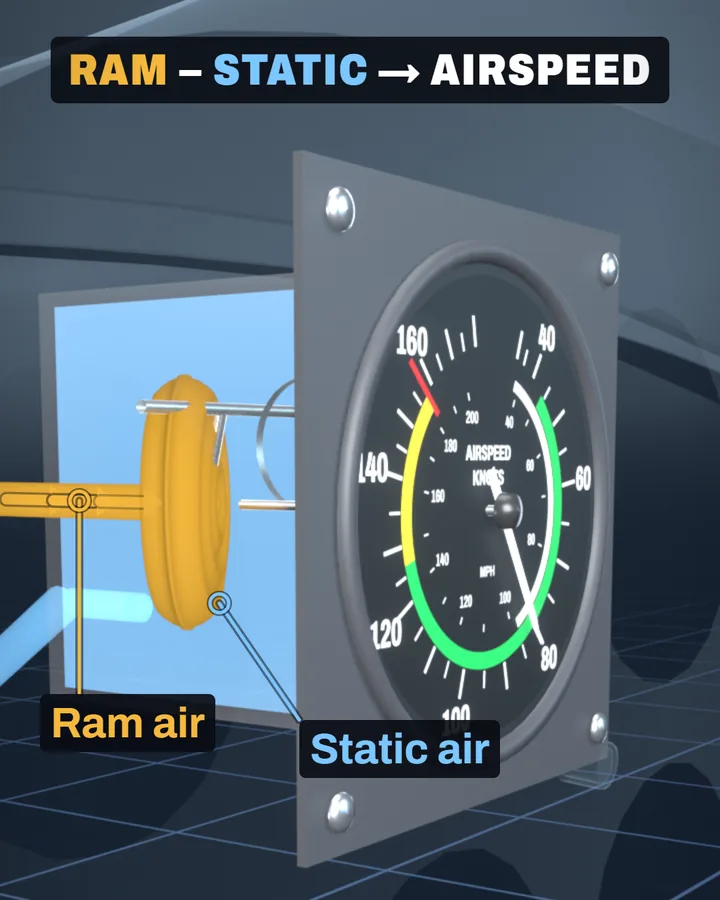
The airspeed indicator compares two pressures. Air rammed into the pitot tube under the left wing fills a diaphragm, and outside air from a static port fills the case around it. The needle shows the difference between them.
Block the tube's front with its drain hole clear and the needle falls to zero. Block the drain too and the needle follows altitude. Sealed at 70 KIAS (knots indicated airspeed), a 1,000 ft climb reads about 158, the 172P's red line.
How the needle reads two pressures
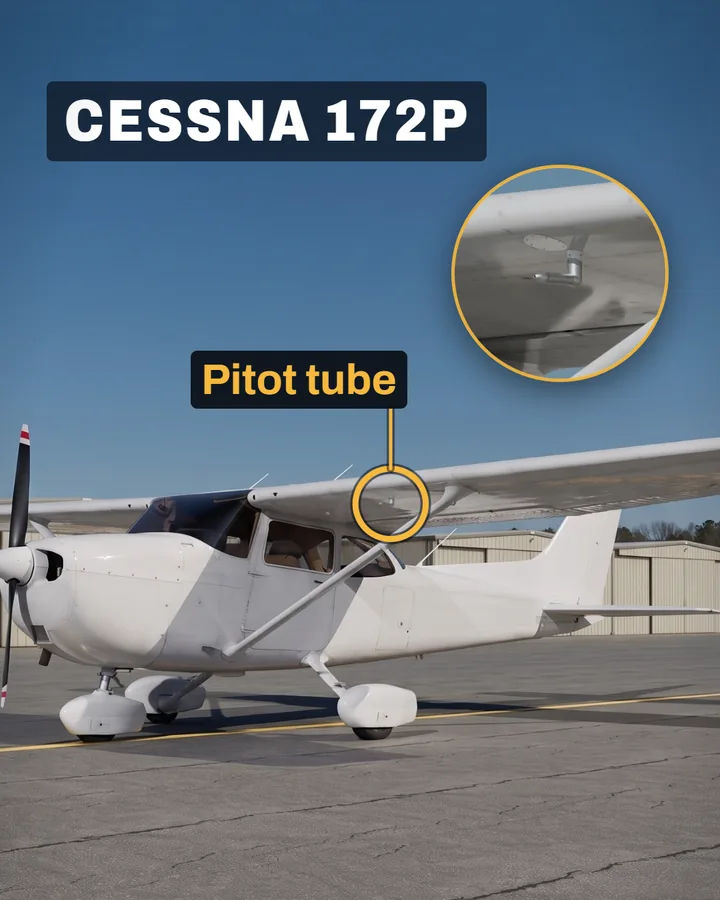
On the Cessna 172P, the pitot tube hangs under the left wing. A pitot tube has a front opening and a small drain hole for moisture. The static port is a small hole low on the left side of the forward fuselage.
The front opening catches ram air at total pressure, the outside air's static pressure plus dynamic pressure, the extra pressure from motion.
A line carries it into a thin diaphragm inside the airspeed indicator. The case around it holds static pressure from the port, so the static part cancels and only dynamic pressure pushes. Fly faster and it grows. The diaphragm swells, and a linkage turns the needle.
A blocked front reads zero
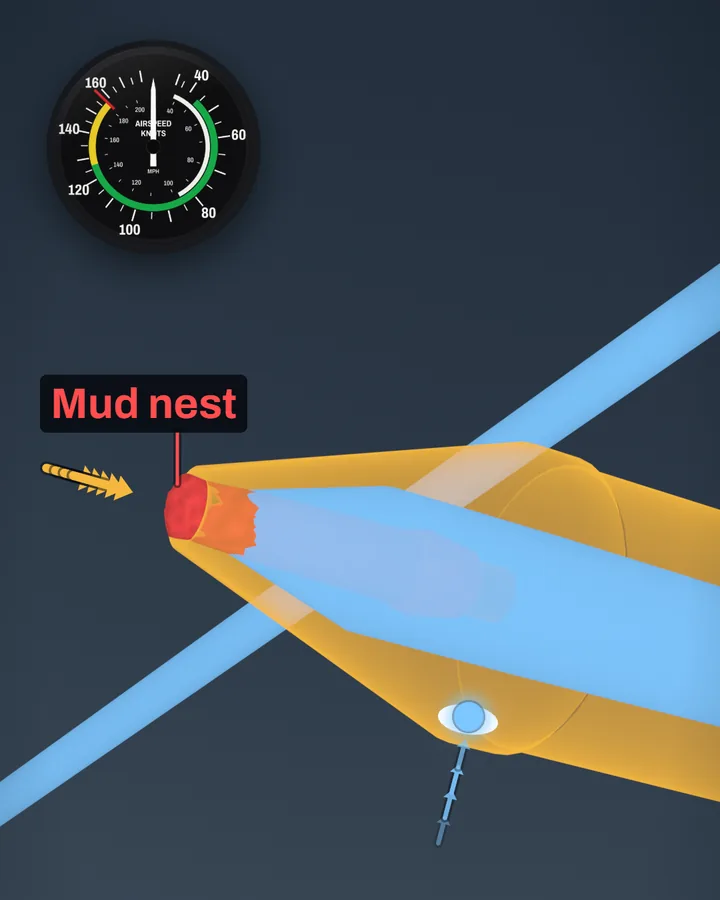
Ice, dirt or insects can block a pitot tube. A nest in the front can leave the drain hole as the only opening. The air inside vents through the drain to outside pressure. Both sides of the diaphragm match, so the needle reads zero.
At Brisbane Airport, 3D-printed replica probes, not the airplanes' real ones, were watched for 39 months. Mud-nesting keyhole wasps fully blocked them 93 times, the first within two weeks. Even the first mud upsets the airspeed reading.
Ice on both holes makes an altimeter
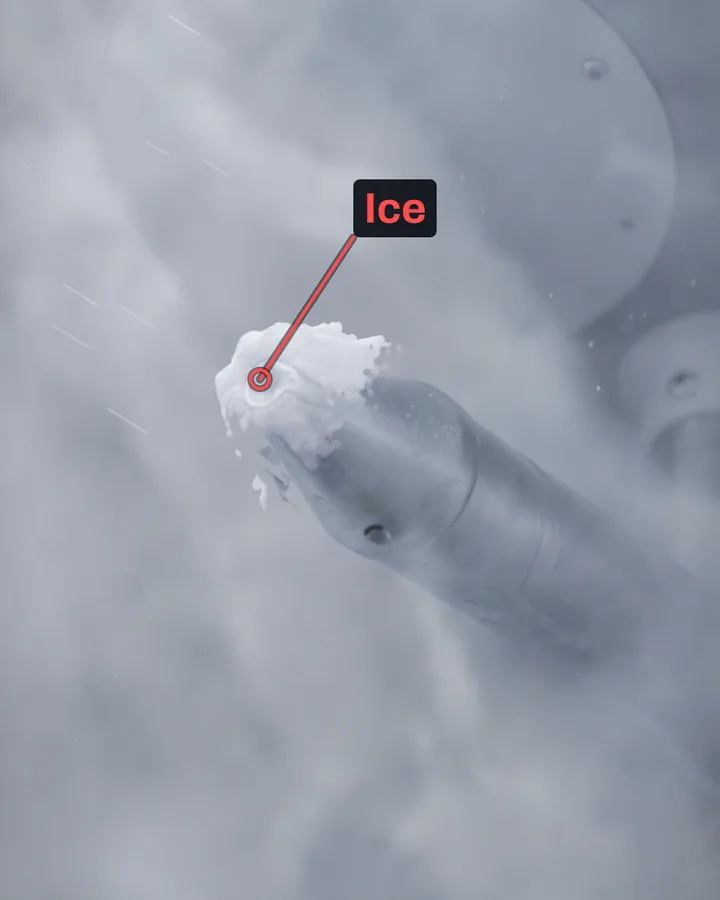
In visible moisture, ice can seal the drain hole as well as the front. The air in the tube is then trapped, and speed changes no longer reach the needle.
Now climb. The static pressure in the case falls while the trapped pressure stays, so the diaphragm swells and the needle rises. Descend and it falls. It now works like an altimeter.
In the standard atmosphere, a 1,000 ft climb from 3,000 ft lowers the case pressure by about an inch of mercury. The trapped pressure stays put, and the diaphragm reads that extra inch as speed.
That 158 assumes a perfect seal and trapped air that keeps its temperature. Sealed at sea level, the same climb reads about 164, and from 6,000 ft about 152. Let the trapped air cool by 1 °C and it reads about 152.
The 172P POH's inadvertent icing checklist starts with pitot heat on (if installed), then turn back or change altitude. Heat keeps the tube working in possible icing conditions, but the POH prohibits flight into icing conditions.
Three mistakes a blocked tube punishes
Remove the pitot tube cover and check the tube's front opening and drain hole on every preflight. A cover keeps bugs out of a parked airplane's tube.
Check the static source opening too. A blocked static port makes the airspeed read low above the altitude where it blocked, and high below it. The altimeter freezes and the vertical speed indicator reads zero. Some 172Ps have an alternate static source valve below the throttle, and POH Section 5 gives its effect on airspeed.
Watch the airspeed rise as the takeoff roll begins. At rest, a blocked tube reads zero too. A needle still at zero on the roll is abnormal, and the Airplane Flying Handbook says abnormal situations can require rejecting the takeoff while still on the runway.
Check yourself
1. The airspeed stays at zero as your takeoff roll begins, so which blockage fits?
2. Sealed at 70 KIAS at 3,000 ft, what does the needle read after a 1,000 ft climb at the same speed?
3. You add power in level flight and the needle holds a normal-looking speed without moving, so which blockage fits?
4. Which openings do you check on the preflight so the airspeed indicator works?
Answers
1. The tube's front opening, whether or not its drain hole is clear, because no ram air reaches the diaphragm.
2. About 158 KIAS, the red line, because the case pressure falls while the trapped pressure stays.
3. Both of the tube's openings. Trapped pressure ignores speed, and level flight holds the altitude too.
4. The tube's front opening and drain hole, with the cover off, and the static source opening.
What this teaches
- On the Cessna 172P the pitot tube is mounted on the lower surface of the left wing and the static port on the lower left side of the forward fuselage, and the airspeed indicator needs both.
- Pressure from the pitot tube fills a diaphragm inside the airspeed indicator, the case around it is kept at static (outside) pressure from the static port, and the needle shows the difference, the dynamic pressure that grows with speed.
- Moisture including ice, dirt or insects can block the tube; at Brisbane Airport, mud-nesting keyhole wasps fully blocked 3D-printed replica pitot probes 93 times in 39 months, and the first mud in a probe is enough to upset the airspeed reading.
- With the front opening and the drain hole both blocked, the pressure in the tube is trapped and, with the static port clear, the airspeed indicator works like an altimeter: it reads higher in a climb and lower in a descent, whatever the real speed.
- Computed in the standard atmosphere, a tube sealed at 70 KIAS at 3,000 ft reads about 158 KIAS after a 1,000 ft climb with no change in real speed; 158 KIAS is the 172P's red line.
Where to read more
Everything above rests on these. They are the FAA's own publications, free to read.
- Pilot's Handbook of Aeronautical Knowledge (FAA-H-8083-25), Chapter 8see Chapter 8
- Instrument Flying Handbook (FAA-H-8083-15), Chapter 5see Chapter 5
- Airplane Flying Handbook (FAA-H-8083-3), Chapter 6Chapter 6 as a PDF · the whole handbook
- Cessna 172P POH pitot-static system
- House, Ring and Shaw (2020), keyhole wasps and pitot probes, PLOS ONE 15(11) e0242063
Keep reading
- ExplainerHow the stall horn works
- Aircraft dataAircraft Performance Library
- Free toolFuel Burn & Endurance Calculator

Score the next flight before you go
FlightDecide reads the weather, the NOTAMs, your fuel and your weight and balance for the planned window, then scores them into a go / no-go call you can check against the raw data.
Get FlightDecide on the App StoreEducational content for pilots. It is advisory only and not a substitute for an official weather briefing, your POH, or your own judgment as pilot in command (14 CFR 91.3). The sources this explainer rests on are listed above.