Home › Explainers › IMSAFE and PAVE, explained
The short version
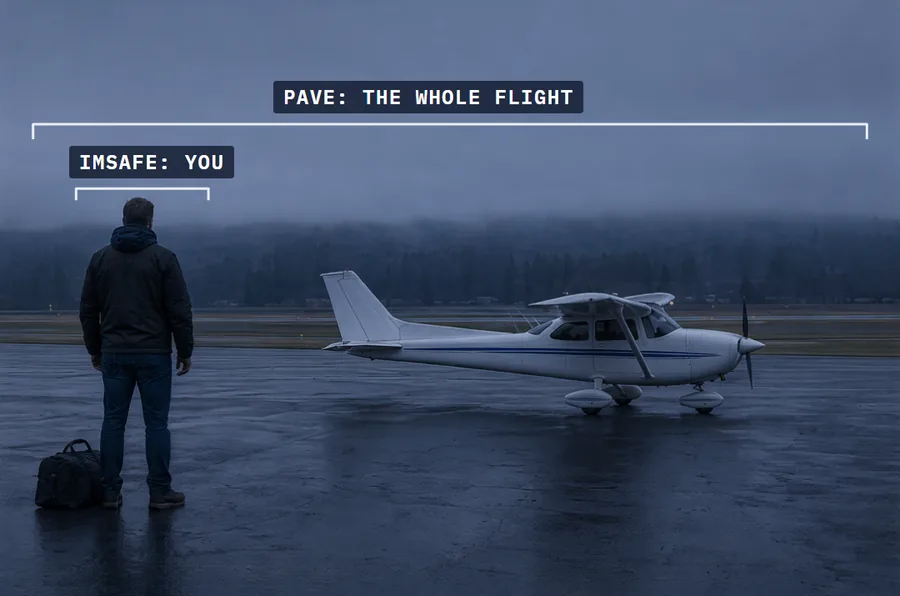
An impaired pilot contributes to many more accidents than a failed aircraft system, so your preflight starts with you. IMSAFE checks your fitness, and PAVE sorts the whole flight's risks into four buckets.
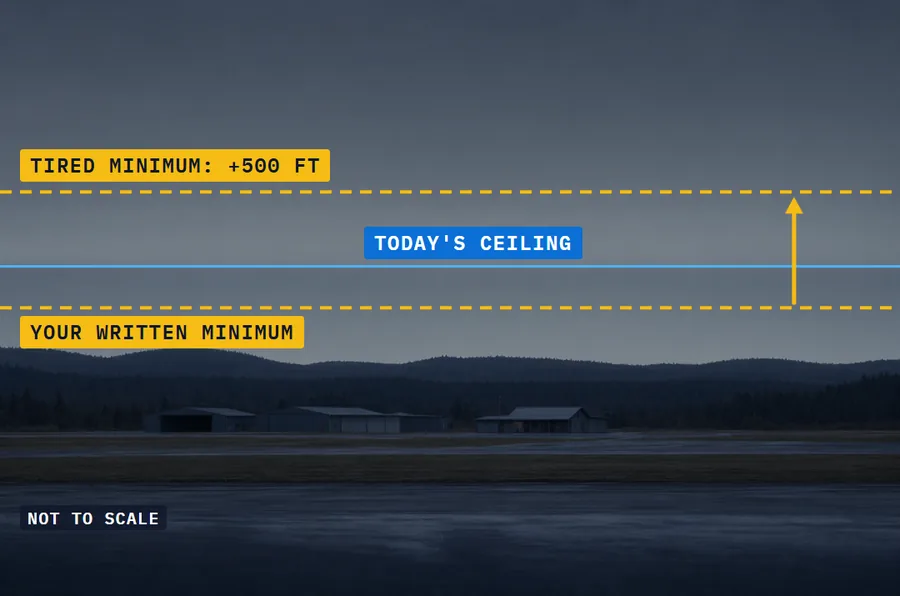
Personal minimums, your own limits, are written before the day and tighter than the regulations. When you're otherwise fit to fly but face a PAVE hazard, add at least the margins below.
| Minimum | Adjust it by |
|---|---|
| Ceiling | Adding at least 500 feet |
| Visibility | Adding at least 1/2 mile |
| Runway length | Adding at least 500 feet |
| Winds | Subtracting at least 5 knots |
Why you preflight yourself first
Human factors, such as fatigue and stress, are a primary contributor to more than 70 percent of aircraft accidents. IMSAFE covers the ones you carry, from illness and medication through stress, alcohol, fatigue and emotion. Some versions fold emotion into the S and use the E for eating.
Even mild symptoms can make you the hazard, so the safest rule is not to fly ill. Prescription and over-the-counter medicines, and the conditions they treat, can degrade you. The law grounds you while a drug affects you, and it's safest to fly on none unless the FAA approves it.
Stress from work, money, health or family hurts concentration, yet no regulation grounds you for it. When troubles run heavier than usual, consider delaying the flight until they're resolved.
As little as one ounce of liquor, one bottle of beer or four ounces of wine can impair your flying skills. You may not act as a crewmember within 8 hours of drinking, under the influence, or at an alcohol concentration of 0.04 or greater. A moderate amount can outlast 8 hours, so the better rule is at least 12 to 24 hours, depending on how much you drank.
Fatigue can hide until you make serious errors, and with stress it can be an extremely hazardous combination. After an upsetting event, wait until you've recovered, since emotion can pull your focus.
How PAVE covers the whole flight
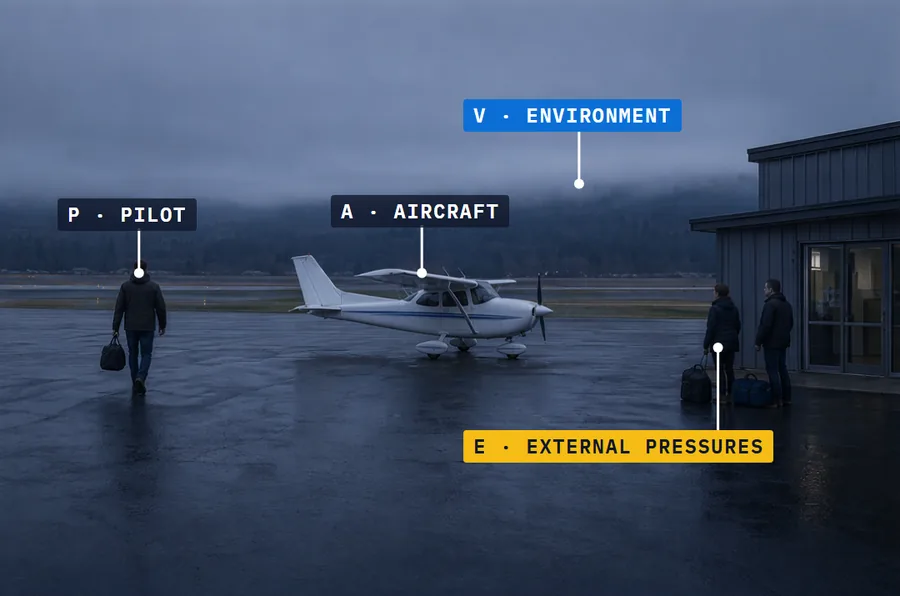
Running all four buckets before a flight catches most hazards you'll normally meet. P is you, the pilot in command, judged on experience, recent flying and your IMSAFE answers.
A asks whether the airplane suits the trip in equipment, runway margin, load, altitude and fuel with reserves. V, the environment, covers weather, terrain, airports, airspace, temporary flight restrictions and night.
E, external pressures, are influences outside the flight that push you to finish it, often at the cost of safety. They include someone waiting, a passenger you don't want to let down, and get-home-itis.
Manage this bucket above the others, since it alone can blind you to the other three. It adds time pressure and figures into a majority of accidents.
Minimums you write before the day
Your airplane's flight manual lists a 15 knot maximum crosswind component, and you have flown 10 knots of direct crosswind. Ten knots stays your limit until more training with an instructor. Personal minimums are limits like that one, fitted to your own experience and proficiency.
A six-step worksheet, starting with the weather, builds them. Written down, they let you call a no-go or divert instead of departing uneasy.
You plan a night cross-country to an unfamiliar airport, leaving after a full workday. Each hazard can take its own margin. Here the suggested raise is 1,000 feet of ceiling, one mile of visibility and 1,000 feet of runway length.
| Bucket | If you are facing |
|---|---|
| Pilot | Stress or fatigue, or lack of currency (not having flown for several weeks) |
| Aircraft | An unfamiliar airplane or an aircraft with unfamiliar avionics or other equipment |
| Environment | Unfamiliar airports and airspace, different terrain or other unfamiliar features |
| External pressures | "Must meet" deadlines, pressures from passengers |
Two mistakes that undo the check
Leave your minimums alone once a specific flight is on the line. Adjust them later, one value at a time, and see an instructor before any big change.
Tell your passengers, and whoever waits, that you may be late. Being ready to accept a delay is the key, so plan for an extra fuel stop, a backup airline seat or time to drive.
Check yourself
1. Your last beer was a little over 8 hours before your planned takeoff. What does the better rule tell you to do?
2. After 4 hours of sleep, your boss asks you to fly to a meeting 750 miles away. With the weather marginal and not expected to improve, which PAVE buckets flag?
3. You haven't flown for several weeks, and today's ceiling sits right at your written minimum. What happens to that minimum?
Answers
1. Wait at least 12 to 24 hours, depending on how much you drank. Eight hours meets only the time limit.
2. P, V and E all flag, so stay down. A pilot in this spot declined, and the boss later agreed.
3. Stay down. Several weeks without flying is a P hazard, so your minimum rises above today's ceiling.
Where to read more
Everything above rests on these. They are the FAA's own publications, free to read.
- Pilot's Handbook of Aeronautical Knowledge (FAA-H-8083-25), Chapter 2
- Risk Management Handbook (FAA-H-8083-2), Chapters 1, 2 and 3
- Aeronautical Information Manual, paragraph 8-1-1
- 14 CFR 91.17the regulation itself, on eCFR
Keep reading
- Free toolCrosswind Calculator
- Free toolFuel Burn & Endurance Calculator
- Pilot guidePersonal Minimums: How to Set Yours

Score the next flight before you go
FlightDecide reads the weather, the NOTAMs, your fuel and your weight and balance for the planned window, then scores them into a go / no-go call you can check against the raw data.
Get FlightDecide on the App StoreEducational content for pilots. It is advisory only and not a substitute for an official weather briefing, your POH, or your own judgment as pilot in command (14 CFR 91.3). The sources this explainer rests on are listed above.