Home › Explainers › The room VFR leaves around a cloud
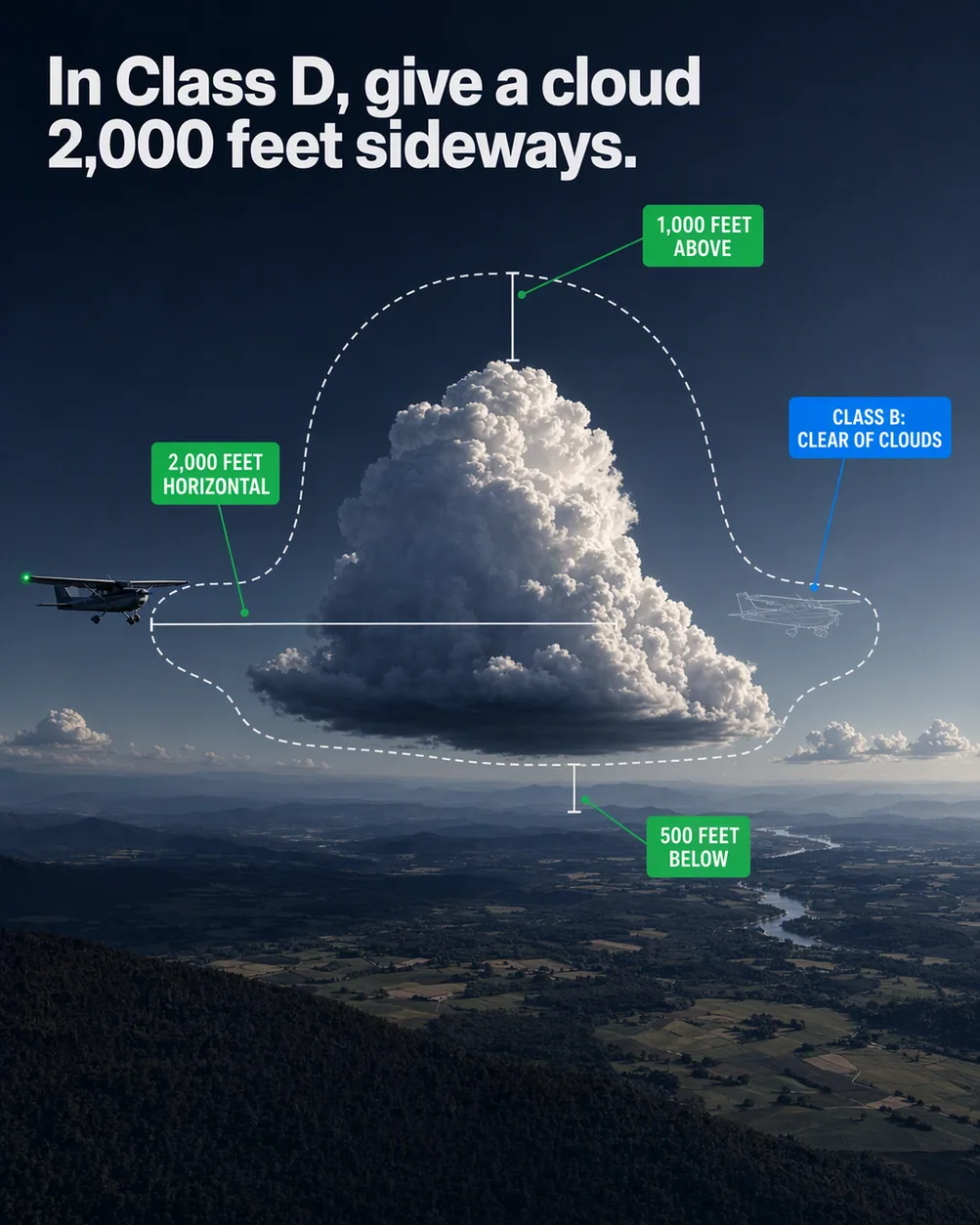
The required clearance is a set of distances that differ by airspace class, and in the classes that have them the horizontal figure is the largest.
What the picture shows
The labels on the illustration, and what each one is pointing at.
- 2,000 FEET HORIZONTALThe middle of the long horizontal dimension line running from the cloud's left flank out to the dashed boundary where the solid aircraft sits.
- 1,000 FEET ABOVEThe vertical dimension line rising from the cloud's sunlit top to the dashed boundary above it.
- 500 FEET BELOWThe short vertical dimension line dropping from the cloud's shadowed base to the dashed boundary beneath it.
- CLASS B: CLEAR OF CLOUDSThe pale ghost aircraft just clear of the cloud's right flank, inside the dashed boundary.
What cloud clearance asks you to keep
Picture yourself flying VFR, under visual flight rules, in Class D airspace. A single cloud sits ahead of you and a little to the left.
The sky is split into lettered airspace classes, and the weather rules are written class by class. In Class D, the rule for that cloud is a set of three distances.
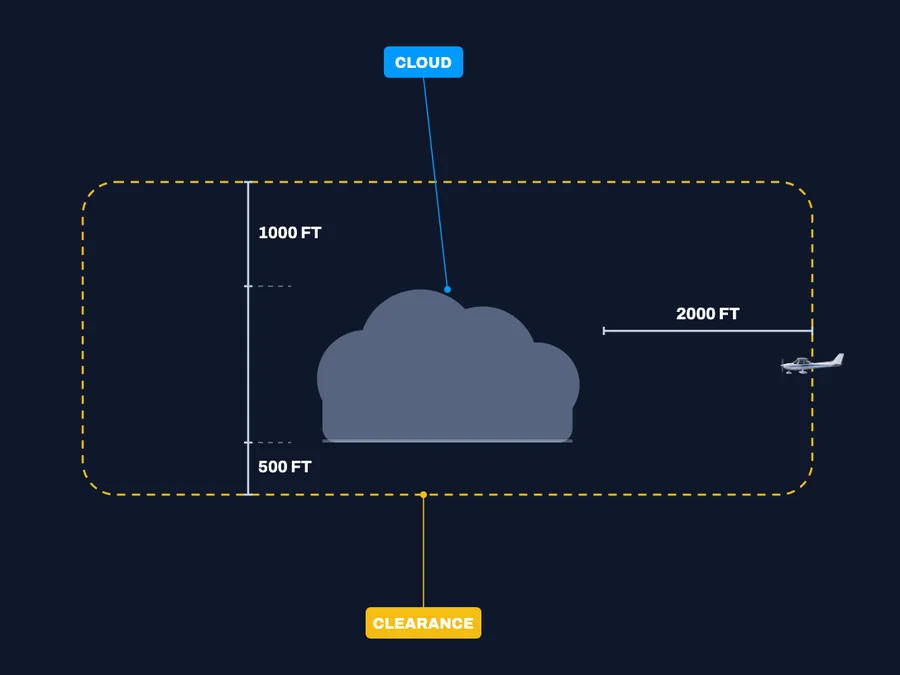
You stay at least 500 feet below the cloud, 1,000 feet above it and 2,000 feet away from it horizontally. Break any one of the three and you are closer than the rule allows.
Think of it as a buffer the cloud carries around with it. It's thin underneath, thicker on top and widest out to the sides.
The figures come from 14 CFR 91.155, the basic VFR weather minimums. Its table pairs each airspace class and altitude band with two things. One is a flight visibility, how far you must be able to see, and the other is a distance from clouds.
Classes C, D and E share one set
The 500, 1,000 and 2,000 set belongs to more than Class D. Class C uses the same three figures. So does Class E, as long as you're below 10,000 feet MSL, meaning measured from mean sea level.
All three also ask for 3 statute miles of flight visibility. One set of numbers carries you from Class C through Class D and out into low Class E.
In each of them the horizontal figure is the largest. At 2,000 feet, it's more than the distances above and below added together.
Level flight shows why that matters. Hold your altitude and fly toward a cloud, and only the horizontal gap is shrinking. The vertical figures only come into play when you climb, descend, or pass over or under it.
So the 2,000 feet is the number you spend first in cruise. That's why the short version for Class D is to give a cloud 2,000 feet sideways.
| Airspace | Flight visibility | Distance from clouds |
|---|---|---|
| Class A | Not applicable | Not applicable |
| Class B | 3 statute miles | Clear of clouds |
| Class C | 3 statute miles | 500 feet below, 1,000 feet above, 2,000 feet horizontal |
| Class D | 3 statute miles | 500 feet below, 1,000 feet above, 2,000 feet horizontal |
| Class E, less than 10,000 feet MSL | 3 statute miles | 500 feet below, 1,000 feet above, 2,000 feet horizontal |
| Class E, at or above 10,000 feet MSL | 5 statute miles | 1,000 feet below, 1,000 feet above, 1 statute mile horizontal |
How Class E changes above 10,000 feet
Climb to 10,000 feet MSL or higher in Class E and the buffer grows on every side except the top. It becomes 1,000 feet below, 1,000 feet above and 1 statute mile horizontal.
The visibility you need goes up as well, from 3 statute miles to 5 statute miles. Up there you must see farther and keep farther away, both at once.
The sideways figure is still the biggest, since a statute mile is well beyond 1,000 feet. That holds in every row of the table that gives distances at all.
At the bottom edge of Class E, one short rule settles which row you use. Fly right at its floor, called the base altitude, and you count as being in the airspace directly underneath.
What clear of clouds means in Class B
Now put the same cloud inside Class B, the airspace that generally surrounds the nation's busiest airports. The requirement here is to remain clear of clouds, with no number attached.
There's no 500 feet below, no 1,000 feet above and no 2,000 feet sideways. You keep out of the cloud itself, and you still need 3 statute miles of flight visibility.
Class B isn't the only place the table uses those words. Class G uses them too, low down and by day, and the last section comes back to that.
Class A is the one class with no cloud figure of any kind. Both of its columns simply read not applicable.
Class B also has an entry rule the weather table doesn't show. You need an ATC clearance, meaning permission from air traffic control, before you go in. Once inside, VFR pilots get sequencing and separation, meaning controllers order them and keep them apart from other aircraft.
When a Class B clearance points at cloud
Inside Class B, a controller may assign you a route, a heading or an altitude. Picture one of those pointing straight at a cloud.
Being separated from traffic doesn't change the cloud rule. The AIM, the Aeronautical Information Manual, says the separation service leaves the 91.155 weather minimums as your responsibility. In Class B, that minimum is clear of clouds.
So spotting the problem is your job. If an assigned route, heading or altitude would put you in cloud, tell approach control. Get a revised clearance or instruction and fly that instead.
The separation itself depends on radar. If the radar goes out, the service is suspended and you are told, but clear of clouds still applies.
Class G changes with height and daylight
Class G is the one class where the cloud rule depends on your height above the ground and on whether it's day or night. The table splits it at 1,200 feet above the surface, whatever your MSL altitude.
Down low, at 1,200 feet or less above the surface, an airplane by day needs 1 statute mile of visibility. It only has to stay clear of clouds. At night the full set comes back, 500 feet below, 1,000 feet above and 2,000 feet horizontal, with 3 statute miles.
One night exception sits right beside the runway, still below 1,200 feet over the surface. In an airport traffic pattern within 1/2 mile of the runway, an airplane may fly clear of clouds. That holds when visibility is under 3 statute miles but not below 1 statute mile.
Above 1,200 feet over the surface and below 10,000 feet MSL, the 500, 1,000 and 2,000 set applies day and night. Only the visibility changes, 1 statute mile by day and 3 statute miles at night.
Once you're also at 10,000 feet MSL or higher, Class G matches high Class E. You need 5 statute miles, 1,000 feet below and above, and 1 statute mile sideways.
| Class G band | Flight visibility | Distance from clouds |
|---|---|---|
| 1,200 feet or less above the surface, day | 1 statute mile | Clear of clouds |
| 1,200 feet or less above the surface, night | 3 statute miles | 500 feet below, 1,000 feet above, 2,000 feet horizontal |
| More than 1,200 feet above the surface, less than 10,000 feet MSL, day | 1 statute mile | 500 feet below, 1,000 feet above, 2,000 feet horizontal |
| More than 1,200 feet above the surface, less than 10,000 feet MSL, night | 3 statute miles | 500 feet below, 1,000 feet above, 2,000 feet horizontal |
| More than 1,200 feet above the surface, at or above 10,000 feet MSL | 5 statute miles | 1,000 feet below, 1,000 feet above, 1 statute mile horizontal |
What this teaches
- VFR cloud clearance requirements differ by airspace class and altitude.
- In Class C, Class D and Class E below 10,000 feet MSL the requirement is 500 feet below, 1,000 feet above and 2,000 feet horizontally.
- Class B is different: the requirement there is to remain clear of clouds, with no numeric separation.
Where to read more
Everything above rests on these. They are the FAA's own publications, free to read.
- 14 CFR 91.155the regulation itself, on eCFR
- Aeronautical Information Manual, paragraph 3-2-3Aeronautical Information Manual
Keep reading
- Pilot guideWhat NOTAMs to Check Before a Flight
- Pilot guideThe Go/No-Go Decision Framework
- Free toolVFR Nav Log Generator

Score the next flight before you go
FlightDecide reads the weather, the NOTAMs, your fuel and your weight and balance for the planned window, then scores them into a go / no-go call you can check against the raw data.
Get FlightDecide on the App StoreEducational content for pilots. It is advisory only and not a substitute for an official weather briefing, your POH, or your own judgment as pilot in command (14 CFR 91.3). The sources this explainer rests on are listed above.