Home › Explainers › Stall speed rising with bank angle
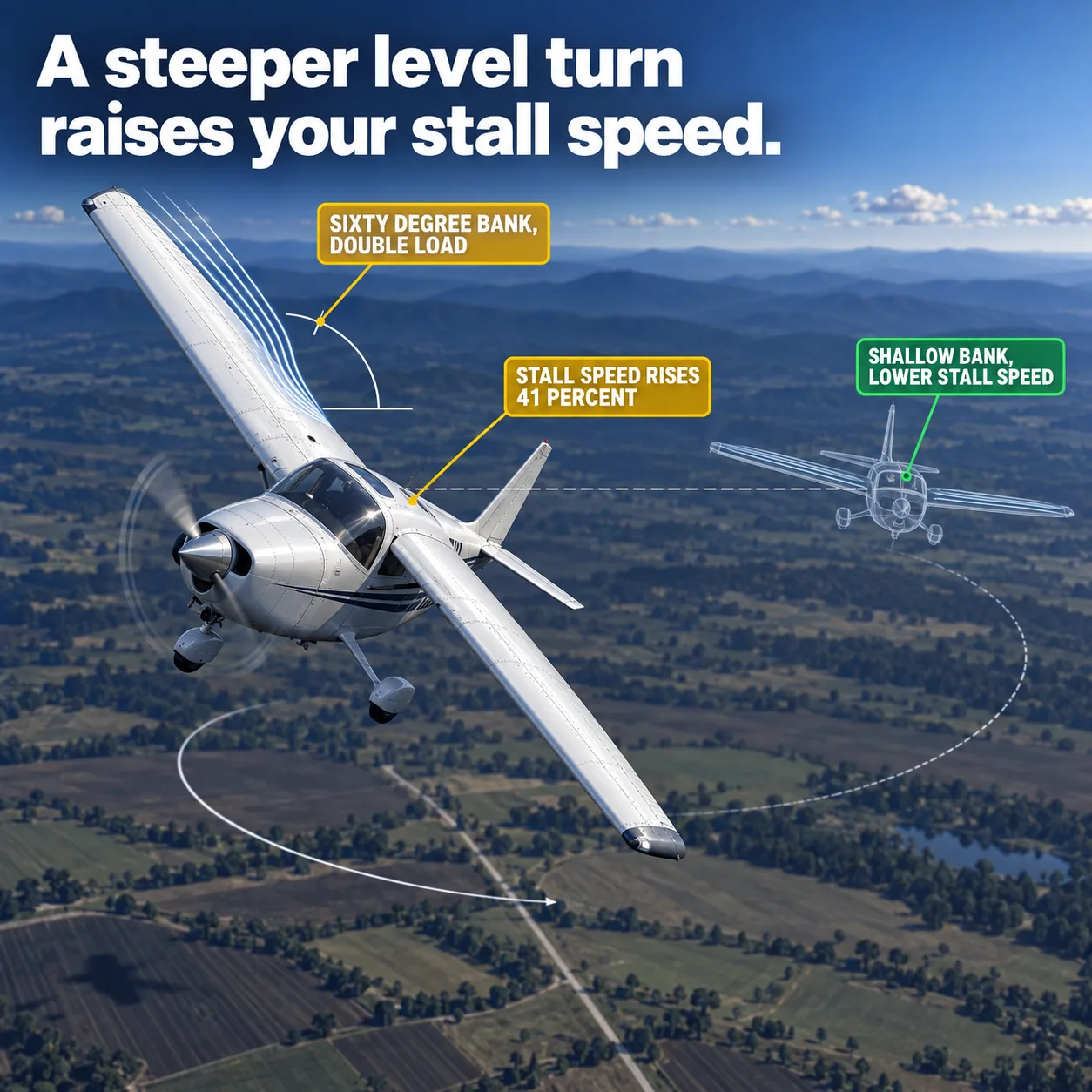
A level turn raises load factor and the stall speed rises with the square root of it, so a steep turn stalls at a higher speed.
What the picture shows
The labels on the illustration, and what each one is pointing at.
- 60 DEGREES OF BANKThe banked aeroplane's raised wingtip against the tilted horizon.
- 2 G ON THE NEEDLEThe needle of the small round accelerometer face at lower right.
- STALL SPEED UP 41 PERCENTThe upper amber stall mark on the small airspeed dial at lower right.
- 1 G, WINGS LEVELThe ghost aeroplane's level wings.
Why a steep turn stalls sooner
Picture yourself holding altitude at a steady airspeed and rolling into a 60 degree bank. The airspeed has not changed. Yet the airplane is now closer to a stall than it was a moment ago.
The reason is the extra work the wing is doing. In a level turn it has to hold up the airplane's weight and pull it around the corner at the same time. The steeper the bank, the harder the wing works.
That extra work has a name, load factor, and the stall speed rises with it. At 60 degrees of bank, the FAA's Airplane Flying Handbook puts the rise at 41 percent over the wings level stall speed.
What load factor means
Load factor is the load the wing carries compared with the airplane's weight. Flying straight and level, the wing carries exactly the weight, and that is 1G. At 2G the wing is carrying twice the weight.
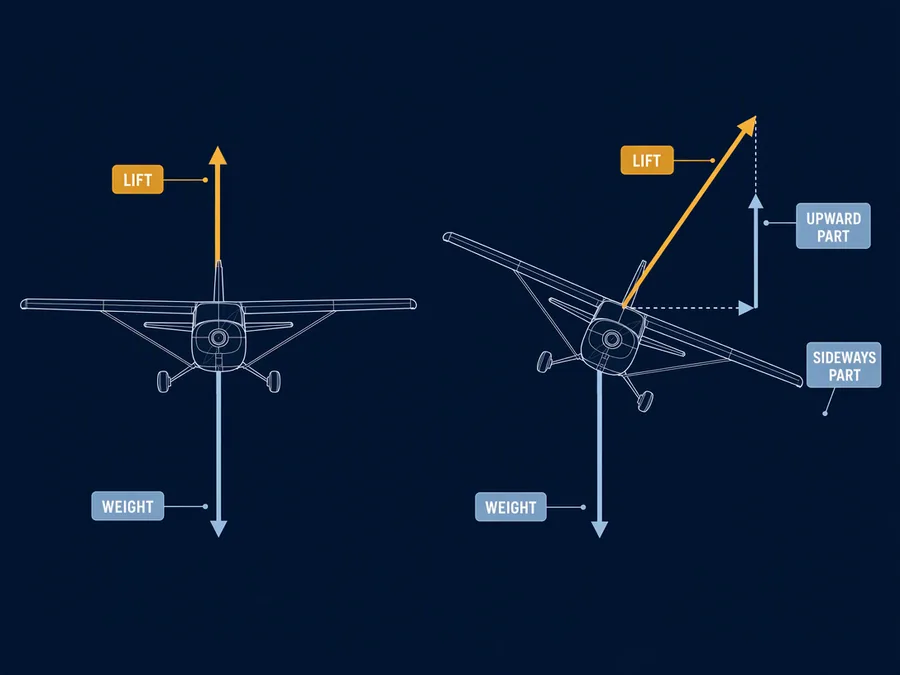
In a turn, the wing's lift tilts with the airplane. Part of it now points toward the center of the turn and pulls you around. Only the rest is left pointing up against the weight.
To stay level, you ask the wing for more lift in total. The more you bank, the more of that lift goes sideways, and the more total lift you need. So in a level turn, load factor grows with bank angle.
In a coordinated, level 60 degree bank, the load factor is 2G. Coordinated means the ball in the slip/skid indicator is centered. The wing is now holding up twice the airplane's weight at the same airspeed.
How the square root sets the number
Stall speed does not rise at the same rate as load factor. It rises with the square root of the load factor. So when the load doubles, the stall speed goes up by 41 percent rather than doubling.
That softens the jump, but only a little. A 41 percent rise is a big change to a number that is easy to treat as fixed.
Take the wings level stall speed you learned for your own airplane. In a coordinated, level 60 degree bank, the stall comes at that figure plus 41 percent. The handbook gives no stall speed for any one airplane, so do the sum with yours.
| Condition | Load factor | Stall speed |
|---|---|---|
| Wings level | 1G | The 1G stall speed |
| Coordinated, level 60 degree bank | 2G | 41 percent above the 1G stall speed |
Why the stall follows angle of attack
To make that extra lift at the same airspeed, you raise the angle of attack. Angle of attack is the angle at which the wing's chord, a straight line from leading to trailing edge, meets the oncoming air.
As that angle grows, lift grows and so does drag. Each wing has a limit to that angle. Beyond it, the airflow separates from the top surface, lift drops and drag climbs. That is a stall.
The handbook is firm here. A stall comes from exceeding that limiting angle, not from a lack of airspeed. Stall speed is only the airspeed at which you reach the limit under one set of conditions.
In a 2G turn you are already holding a higher angle of attack than you did wings level. You sit closer to the limit, and so closer to the higher stall speed. That is why the handbook says you can stall at any airspeed, in any attitude and at any power setting.
Load factor is one of several things that set stall speed. Gross weight, center of gravity and flap setting move it too. Stall speed is not a constant, and the handbook wants you to understand what moves it.
What changes when you are already slow
In slow flight practice you fly a target speed just above the stall warning. The handbook suggests 5 to 10 knots above the 1G stall speed. That margin is measured against a wings level stall.
At that speed, any further increase in angle of attack or load factor, or any cut in power, brings a stall warning. Rolling into a steeper bank is exactly that kind of load factor increase.
Put the two numbers side by side. Your margin was 5 to 10 knots over the 1G stall speed. Steepen the bank and the stall speed itself climbs toward the speed you are flying.
Reduced airspeeds are normal on takeoff and departure, and on approach and landing. Those are also the phases flown close to the ground. A turn there adds load factor to a speed that was already low.
What the airplane tells you first
A stall warning comes before the stall itself. It shows up as buffet, a shaking you feel through the airframe, or as the stall horn sounding.
The handbook says to react to and correct for any stall indication. A stall can lead to loss of control if the angle of attack is not reduced.
The stall speeds you learn for your airplane are 1G figures for one weight and configuration. In a steep level turn, the warning arrives at a speed that would give you room to spare wings level. Knowing why keeps it from being a surprise.
The aim, in slow flight and in turns, is to maneuver without setting off the stall warning at all. Knowing that 60 degrees of bank means 2G and a 41 percent higher stall speed is what lets you do it.
What this teaches
- In a level turn load factor increases with bank angle.
- Stall speed increases with the square root of the load factor, so a 60 degree level turn doubles the load and raises the stall speed by about 41 percent.
Where to read more
Everything above rests on these. They are the FAA's own publications, free to read.
- Pilot's Handbook of Aeronautical Knowledge (FAA-H-8083-25), Chapter 5see Chapter 5
- Airplane Flying Handbook (FAA-H-8083-3), Chapter 5Chapter 5 as a PDF · the whole handbook
Keep reading
- Free toolWeight & Balance Calculator
- Free toolDensity Altitude Calculator
- Aircraft dataAircraft Performance Library

Score the next flight before you go
FlightDecide reads the weather, the NOTAMs, your fuel and your weight and balance for the planned window, then scores them into a go / no-go call you can check against the raw data.
Get FlightDecide on the App StoreEducational content for pilots. It is advisory only and not a substitute for an official weather briefing, your POH, or your own judgment as pilot in command (14 CFR 91.3). The sources this explainer rests on are listed above.