Home › Explainers › Which way the trim tab moves
The short version
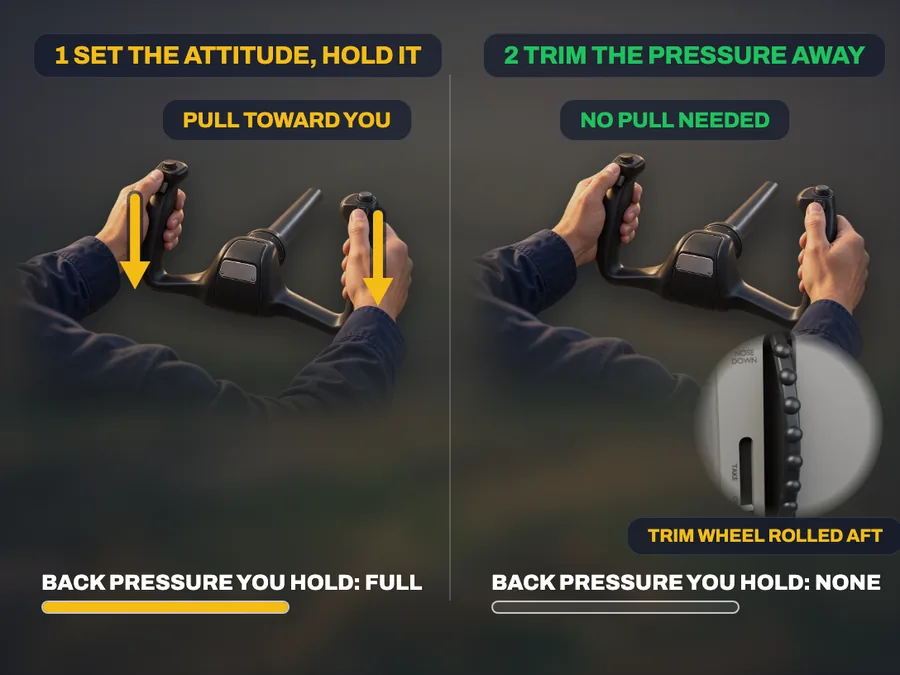
Trim takes a steady pressure off the controls, so the airplane keeps its attitude without your hand. In a Cessna 172S, rolling the trim wheel aft trims nose up, and rolling it forward trims nose down.
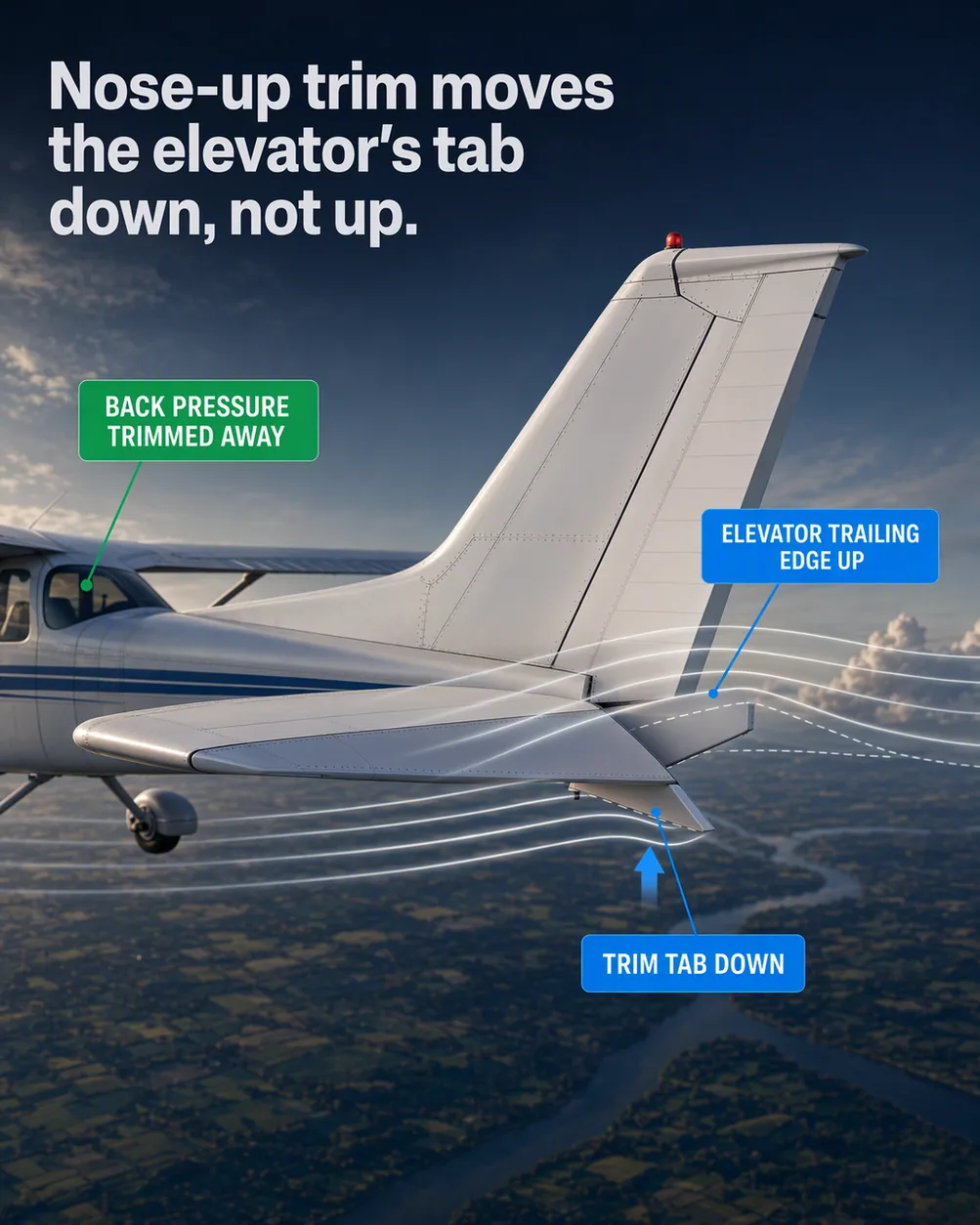
Nose-up trim lowers a small hinged tab on the elevator, the movable rear part of the horizontal tail that pitches the nose. Air striking the lowered tab keeps the elevator's back edge raised, so you no longer have to pull.
How a small tab moves the elevator
The most common setup on small airplanes is one trim tab hinged to the elevator's trailing edge, its back edge. Most are worked by a small upright wheel in the cockpit, with a position indicator for the tab.
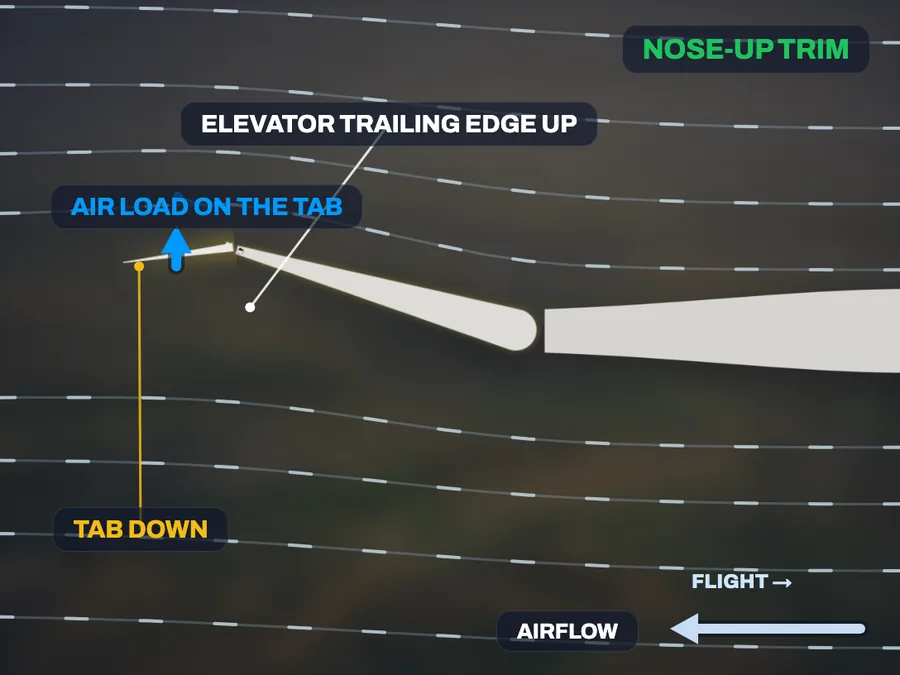
Trim nose up and the tab swings down into the air flowing under the tail. That air pushes on the tab and forces the elevator's trailing edge up, so the tail moves down and the nose rises.
Full nose-down trim does the reverse. The tab goes fully up, and the air over the tail tends to force the elevator's trailing edge down. The tail rises and the nose drops.
Trimmed and hands-off, the tab and the elevator sit deflected in opposite directions. From the cockpit, trimming still feels natural. Steady back pressure, a constant pull on the yoke, means you need nose-up trim.
Why the back pressure goes away
As the airspeed falls off while you set up a climb, the nose tends to sink unless you pull harder. Your hand is then holding the raised elevator against the moving air.
Move a control surface out of line with the airflow, even slightly, and the air pushes on it. That push is the force you feel on the controls.
Nose-up trim hands the job of holding the elevator up to the tab. Keep trimming until the airplane is balanced and the nose-heavy feel is gone. Your attention is then free for other tasks.
A stabilator's tab moves with it
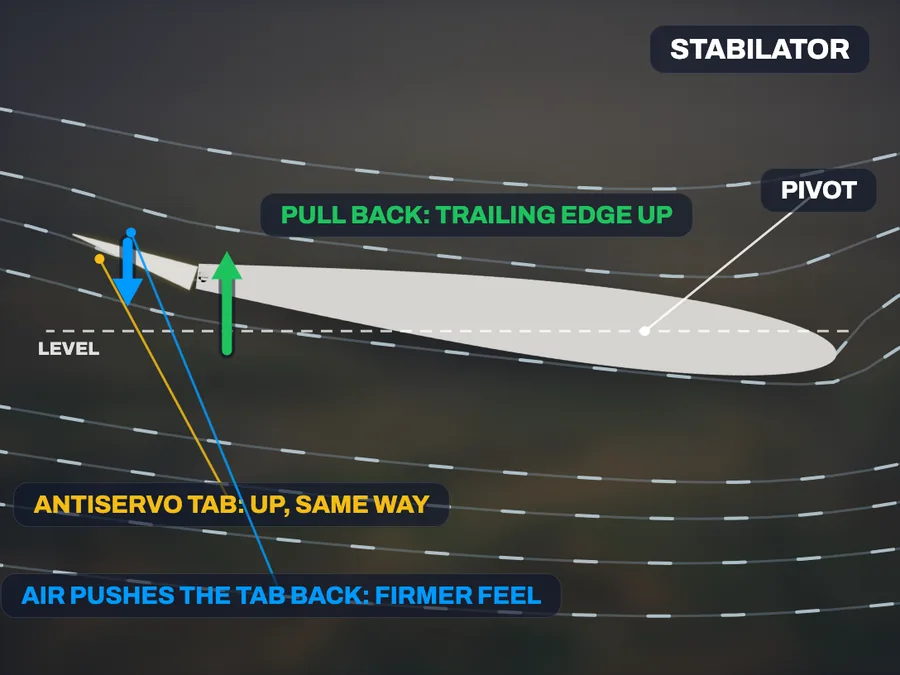
A Piper Cherokee has a stabilator instead, a one-piece horizontal tail that swings about a central pivot point. Pulling back raises its trailing edge and pitches the nose up.
Because the whole tail pivots, it is extremely sensitive to your inputs and to air loads. Its antiservo tab, which resists your force on the controls, moves the same way as the trailing edge it rides on. That makes the stabilator heavier to move and harder to overcontrol.
The same tab does a second job. Used as the trim, it relieves control pressure and holds the stabilator where you want it.
Three trim mistakes that bite
Set the attitude with the controls and hold it with pressure, and only then trim that pressure away. Trying to fly the airplane with the trim is a common fault, even among experienced pilots, and so is overcontrolling with it.
Retrim each time you change power, pitch attitude or configuration, such as flaps, because each brings new control pressures. In most airplanes, less power means less propeller air over the tail, and the nose tends to drop at once.
Be ready to push on the rollout from a steep turn you trimmed for. Past 30° of bank, trimming off some of the extra back pressure may help, depending on the turn and the force it needs. After the rollout, you may need forward pressure until the trim is reset.
Check yourself
1. Which way do you roll a 172S trim wheel when you are holding steady back pressure to keep a climb attitude?
2. After you set full nose-down trim, which way is the elevator trim tab deflected?
3. Which way does a Cherokee's antiservo tab move as you pull back and the stabilator's trailing edge rises?
4. What should you be ready to do as you roll out of a steep turn in which you trimmed off back pressure?
Answers
1. Aft. Steady back pressure calls for nose-up trim, and aft rotation of the 172S wheel trims nose up.
2. Fully up. The air over the tail then tends to force the elevator's trailing edge down, so the nose drops.
3. Up, with the trailing edge. That raises the force needed to move the stabilator and makes it less sensitive.
4. Be ready to hold forward pressure until you can retrim. The trim set for the turn is still in place after the wings are level.
Where to read more
Everything above rests on these sources.
- Pilot's Handbook of Aeronautical Knowledge (FAA-H-8083-25), Chapter 6
- Airplane Flying Handbook (FAA-H-8083-3), Chapter 3Chapter 3 as a PDF · the whole handbook
- Cessna 172S Pilot's Operating Handbookthe aircraft's own handbook
Keep reading
- Free toolFuel Burn & Endurance Calculator
- Free toolWeight & Balance Calculator
- Aircraft dataAircraft Performance Library

Score the next flight before you go
FlightDecide reads the weather, the NOTAMs, your fuel and your weight and balance for the planned window, then scores them into a go / no-go call you can check against the raw data.
Get FlightDecide on the App StoreEducational content for pilots. It is advisory only and not a substitute for an official weather briefing, your POH, or your own judgment as pilot in command (14 CFR 91.3). The sources this explainer rests on are listed above.