Home › Explainers › Inside the 172 engine and what low oil pressure means
The short version
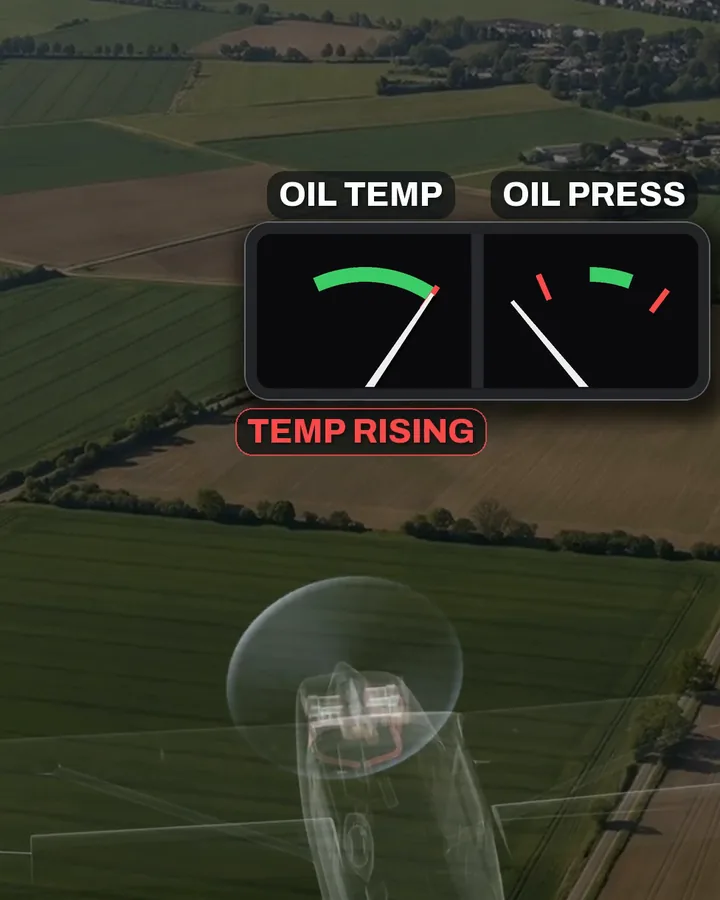
If the oil pressure in your 172 drops below its green arc, the normal range, in flight, check the oil temperature. A normal temperature may point to the gauge, its line or the relief valve, but it doesn't prove the engine is fine. Land at the nearest airport.
If the pressure is gone and the temperature is climbing, the engine may fail soon. Reduce power now, pick a landing spot and use only the power you need to reach it.
How the engine turns the propeller
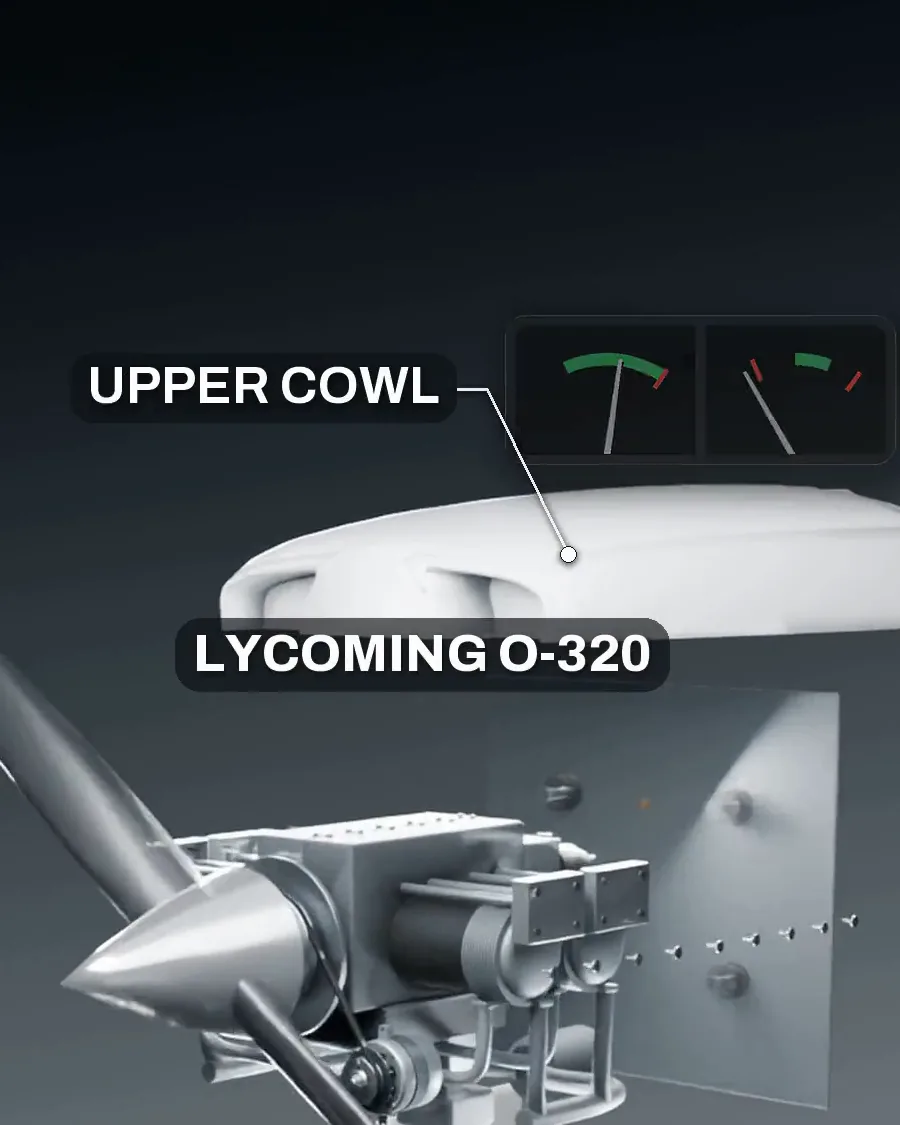
The 172P's Lycoming O-320 has four cylinders, laid flat in two opposed pairs and cooled by air. It is rated 160 horsepower at 2,700 revolutions per minute. Other 172 models have other engines and gauge markings, so check your own airplane's handbook.
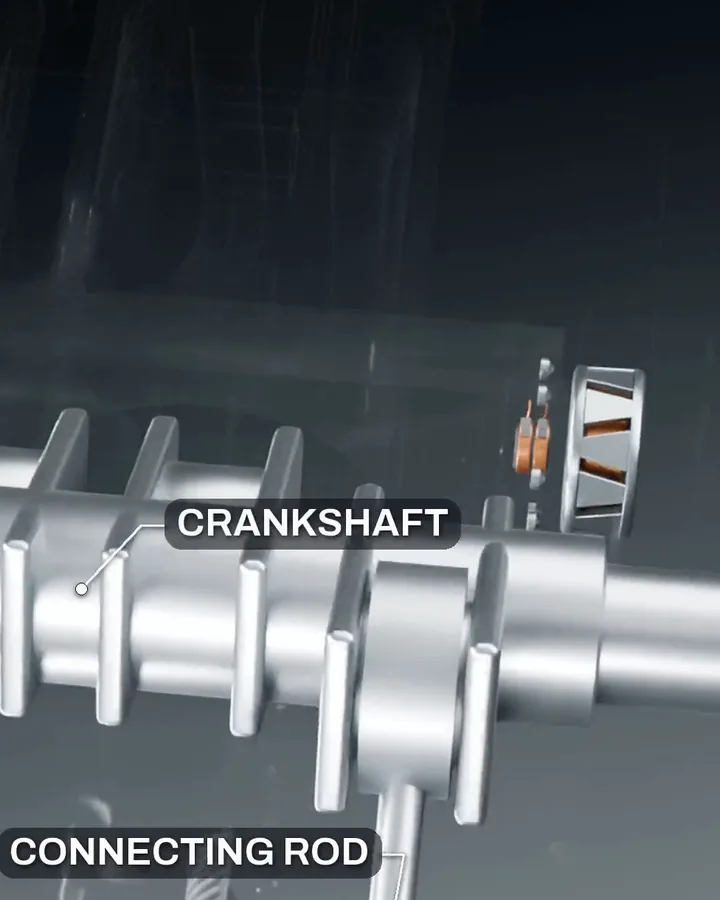
In each cylinder, the burning fuel and air push a piston, a sliding plug, toward the crankshaft, the engine's main turning shaft. Its connecting rod pushes on an offset part of the crankshaft, which turns the push into rotation. The engine is direct drive, so the crankshaft turns the propeller itself.
Above the crankshaft runs the camshaft. Through hollow tubes called pushrods, it opens each cylinder's valves, which let the fuel and air in and the burned gas out.
Where the oil goes
Two of oil's jobs matter here. It lubricates the moving parts, and it carries heat away from the cylinders.
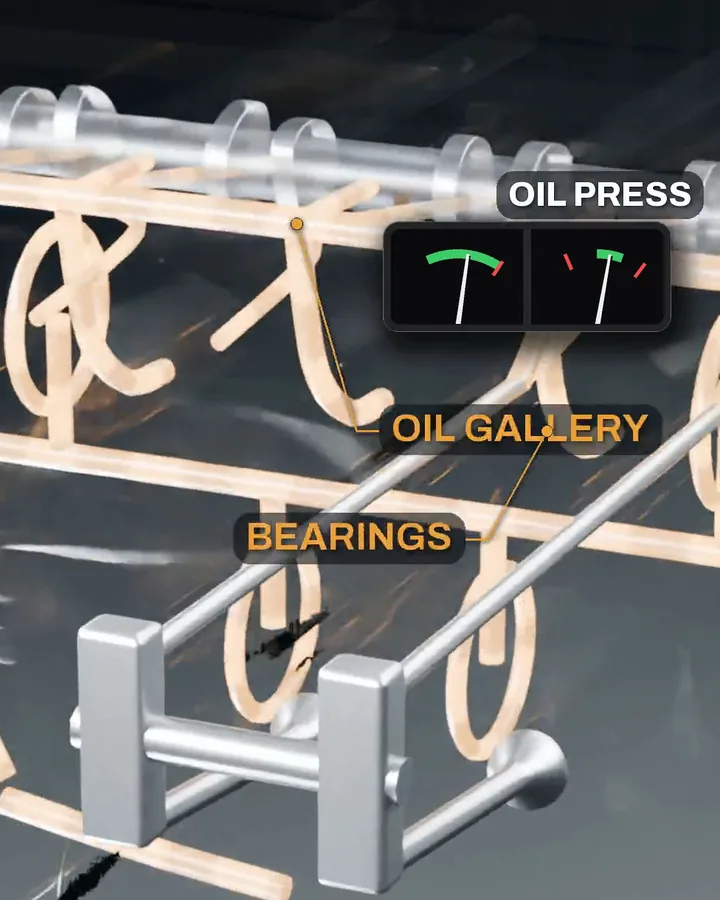
The engine-driven pump draws it from the sump, the oil reservoir at the bottom of the engine, through a screen. Cold oil goes straight to the filter, and hot oil goes through the cooler first.
A relief valve limits the pressure by spilling the extra oil back to the sump. The rest flows into the main oil gallery, the engine's main oil passage. From there it reaches the bearings, the smooth supports for the turning shafts, the camshaft and, through the hollow pushrods, the valves.
Then it drains back to the sump by gravity. So if the oil stops flowing, the parts rub, the heat stays in the engine and the temperature climbs.
What the two oil gauges tell you
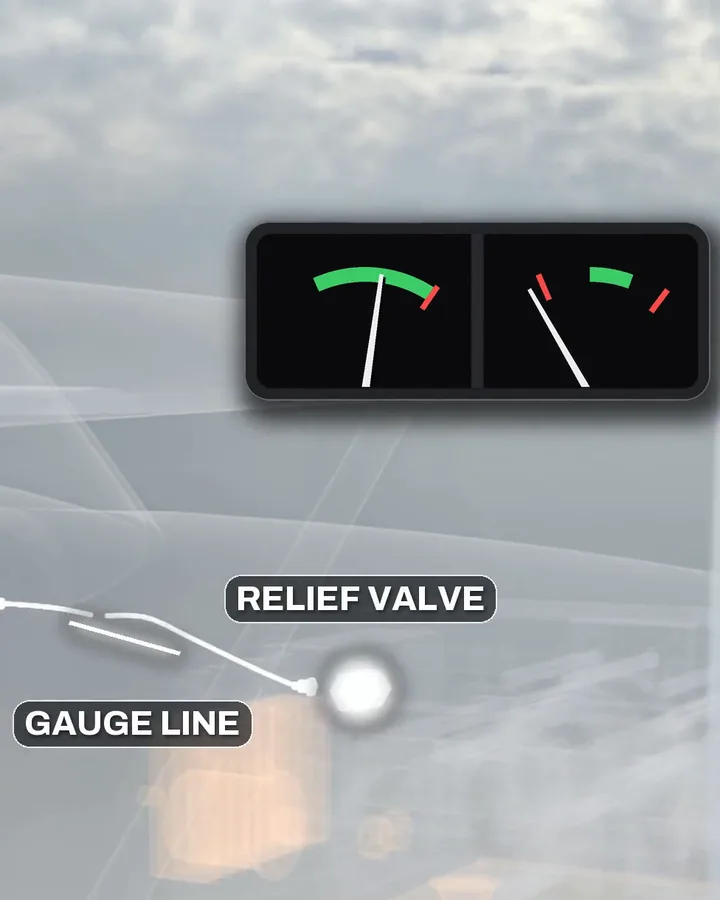
The oil pressure gauge reads straight from the engine through a line. It shows pressure, not how much oil is left. The oil temperature gauge beside it is your cross-check.
With a normal temperature, a faulty gauge can read low falsely, or a faulty relief valve can make the pressure really low. A leak in the gauge line isn't necessarily a reason to land at once. An orifice, a narrow restriction in that line, lets so little oil through that a leak can't drain the sump quickly.
If the pressure is gone and the temperature is rising, an engine failure may be close.
| Gauge | Marking | Value |
|---|---|---|
| Oil pressure | Minimum for idling (red line) | 25 PSI |
| Oil pressure | Normal range (green arc) | 60 to 90 PSI |
| Oil pressure | Maximum (red line) | 115 PSI |
| Oil temperature | Normal range (green arc) | 100 to 245 °F |
| Oil temperature | Maximum (red line) | 245 °F |
Three mistakes with low oil pressure
Keep watching the temperature after a normal first reading. Oil temperature changes more slowly than pressure, so a normal reading soon after the drop doesn't clear the engine.
Reduce power at once if the temperature climbs with the pressure gone, and get ready to land without engine power.
Land at the nearest airport even when the gauge looks like the culprit. Treat any abnormal reading as a reason to cut the flight short.
Check yourself
1. How can a faulty gauge and a faulty relief valve each show low oil pressure?
2. What does the orifice in the oil pressure gauge line do?
3. Why doesn't a normal oil temperature right after a pressure drop clear the engine?
4. What do you do when the oil pressure is gone and the temperature is climbing?
Answers
1. A faulty gauge can read low when the pressure is fine, and a faulty relief valve can make the pressure really low.
2. It lets so little oil through that a leaking gauge line can't drain the sump quickly.
3. Oil temperature changes more slowly than pressure, so keep watching it.
4. Reduce power now, pick a field and use only enough power to reach it.
Where to read more
Everything above rests on these sources.
- Pilot's Handbook of Aeronautical Knowledge (FAA-H-8083-25), Chapter 7
- Cessna 172P Pilot's Operating Handbook (1981)the aircraft's own handbook
- Lycoming O-320 Operator's Manual 60297-30
Keep reading
- ExplainerHow a carburetor works
- ExplainerHow magnetos work
- ExplainerHow fuel reaches the engine in a high-wing trainer

Score the next flight before you go
FlightDecide reads the weather, the NOTAMs, your fuel and your weight and balance for the planned window, then scores them into a go / no-go call you can check against the raw data.
Get FlightDecide on the App StoreEducational content for pilots. It is advisory only and not a substitute for an official weather briefing, your POH, or your own judgment as pilot in command (14 CFR 91.3). The sources this explainer rests on are listed above.
Picture credits: 3D model: “Cessna172” by KOG_THORNS (sketchfab.com), CC BY 4.0, modified.