Home › Explainers › Wake turbulence, explained
In: wake turbulence, the wake every wing trails as it makes lift: what it is (two counter-rotating vortices that roll up from the higher pressure under the wing into the lower pressure on top, trailing from the wingtips from the moment an airplane rotates until it touches down); whose is worst (heavy, clean and slow; the shorter your wingspan next to the generating airplane's, the harder its roll is to counter); where it goes (it sinks several hundred feet per minute behind and below the airplane, slowing and weakening; within 100 to 200 ft of the ground it spreads sideways at 2 or 3 knots and drifts with the wind; a light crosswind can hold the upwind vortex in the touchdown zone; a light quartering tailwind needs maximum caution); the numbers (sink rate, the drift near the ground, the 1 to 5 knot crosswind, parallel runways closer than 2,500 ft, the 2-minute wait after a low approach, missed approach or touch-and-go, VFR traffic 500 ft below); and what you do (landing behind a larger airplane, stay at or above its path and land beyond its touchdown point with enough runway left; departing behind one, rotate before its rotation point and climb above its path until clear; ask for more time before you taxi onto the runway). Out: ATC's IFR wake separation minima and the aircraft weight classes, en route wake events at altitude, helicopter wakes beyond a line on the page, and how to recover from an upset.
What the picture shows
The labels on the illustration, and what each one is pointing at.
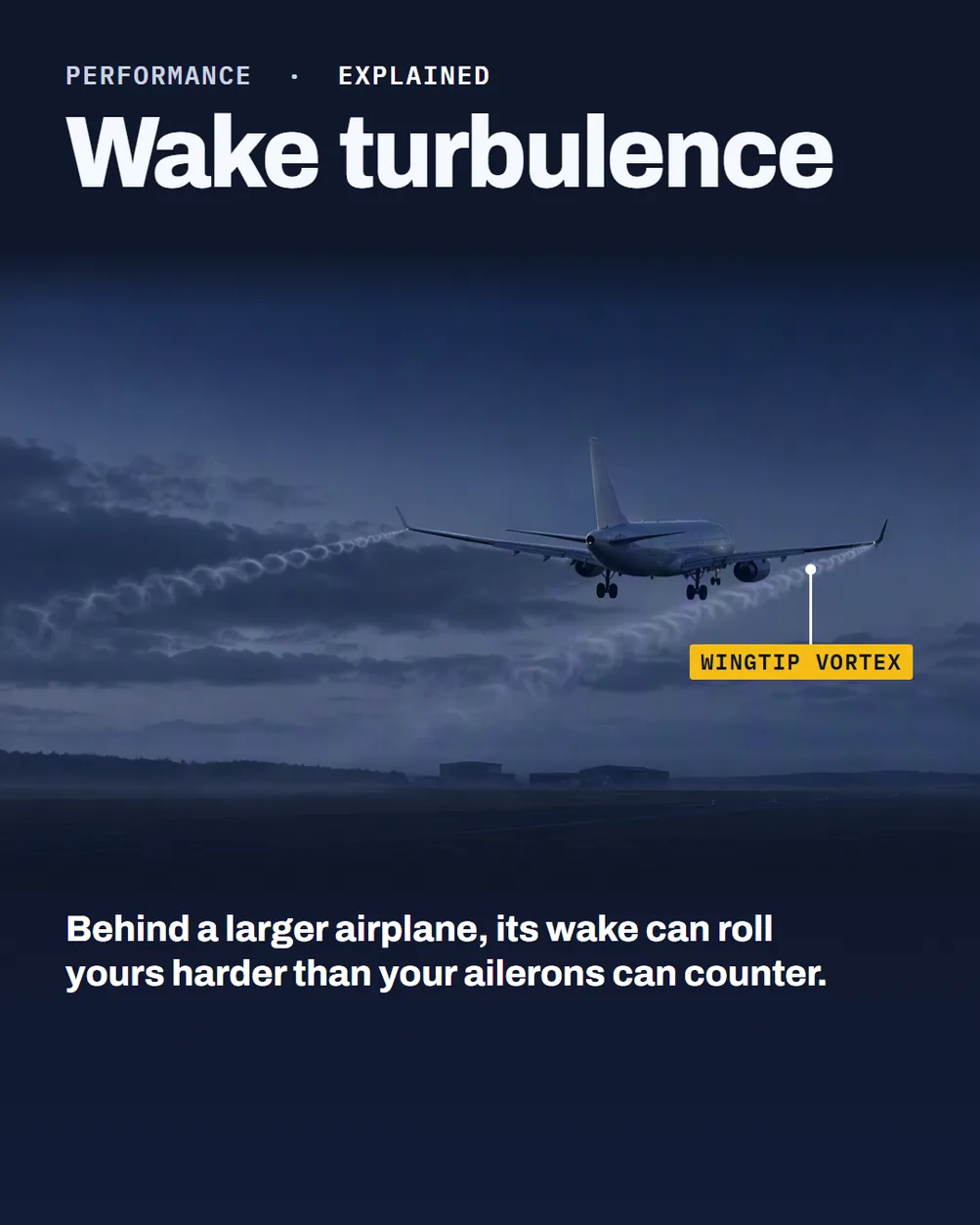
- WINGTIP VORTEXA large twin-engine airliner low on final approach over a misty airfield at dusk, a curling trail of mist streaming back and down from each wingtip; the right wingtip's trail is labelled as a wingtip vortex.
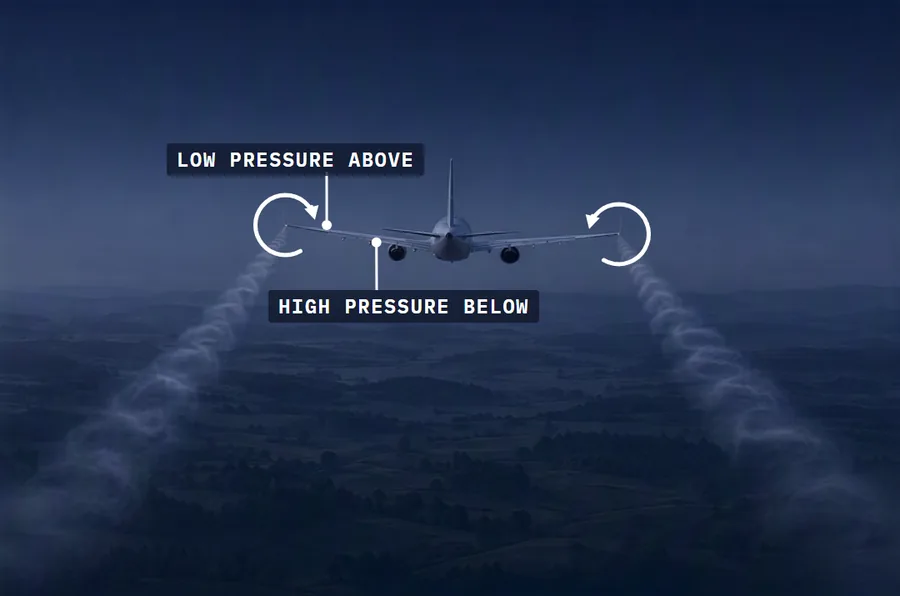
- LOW PRESSURE ABOVESeen from behind and a little above, a large airliner flying away over dim country at dusk, a thin corkscrew of mist trailing back from each wingtip, with white arrows curling outward, up and around each tip from under the wing to over it (clockwise at the left tip, anticlockwise at the right), and two labels with leader lines to the top and the underside of the left wing.
- HIGH PRESSURE BELOWSeen from behind and a little above, a large airliner flying away over dim country at dusk, a thin corkscrew of mist trailing back from each wingtip, with white arrows curling outward, up and around each tip from under the wing to over it (clockwise at the left tip, anticlockwise at the right), and two labels with leader lines to the top and the underside of the left wing.
- HEAVY AND SLOWA heavy widebody airliner in a nose-high climb against a grey cloud layer at dusk, with its gear and flaps up; one tag points at the airliner, one at its clean wing.
- CLEANA heavy widebody airliner in a nose-high climb against a grey cloud layer at dusk, with its gear and flaps up; one tag points at the airliner, one at its clean wing.
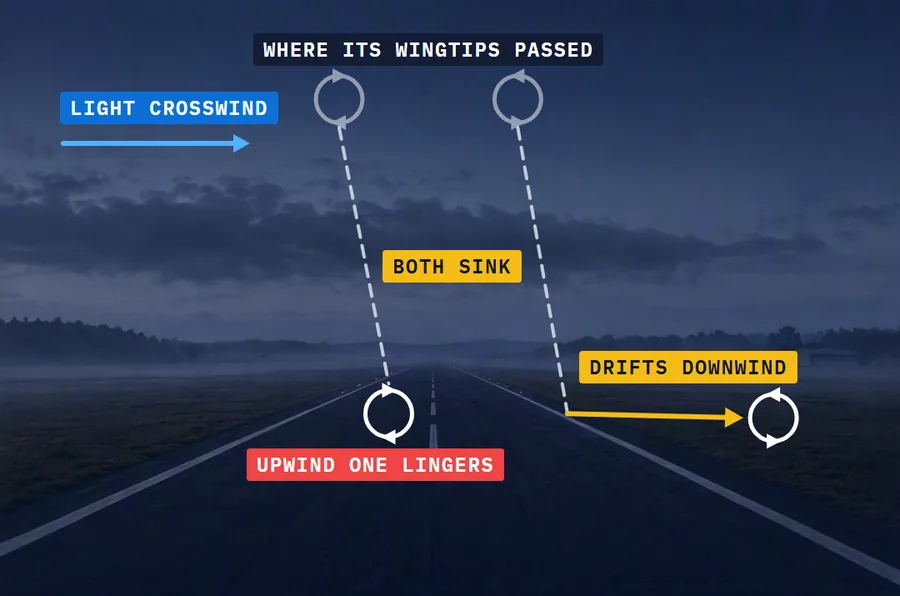
- WHERE ITS WINGTIPS PASSEDLooking down a runway from behind its threshold at dusk: two faded vortex symbols (each a ring with arrowheads showing its spin, clockwise on the left, anticlockwise on the right) mark where a larger airplane's wingtips passed over the centreline; both sink, drifting a little with a light crosswind from the left; near the ground the downwind (right) one moves off past the runway edge, while the upwind (left) one lingers over the runway.
- BOTH SINKLooking down a runway from behind its threshold at dusk: two faded vortex symbols (each a ring with arrowheads showing its spin, clockwise on the left, anticlockwise on the right) mark where a larger airplane's wingtips passed over the centreline; both sink, drifting a little with a light crosswind from the left; near the ground the downwind (right) one moves off past the runway edge, while the upwind (left) one lingers over the runway.
- DRIFTS DOWNWINDLooking down a runway from behind its threshold at dusk: two faded vortex symbols (each a ring with arrowheads showing its spin, clockwise on the left, anticlockwise on the right) mark where a larger airplane's wingtips passed over the centreline; both sink, drifting a little with a light crosswind from the left; near the ground the downwind (right) one moves off past the runway edge, while the upwind (left) one lingers over the runway.
- UPWIND ONE LINGERSLooking down a runway from behind its threshold at dusk: two faded vortex symbols (each a ring with arrowheads showing its spin, clockwise on the left, anticlockwise on the right) mark where a larger airplane's wingtips passed over the centreline; both sink, drifting a little with a light crosswind from the left; near the ground the downwind (right) one moves off past the runway edge, while the upwind (left) one lingers over the runway.
- LIGHT CROSSWINDLooking down a runway from behind its threshold at dusk: two faded vortex symbols (each a ring with arrowheads showing its spin, clockwise on the left, anticlockwise on the right) mark where a larger airplane's wingtips passed over the centreline; both sink, drifting a little with a light crosswind from the left; near the ground the downwind (right) one moves off past the runway edge, while the upwind (left) one lingers over the runway.
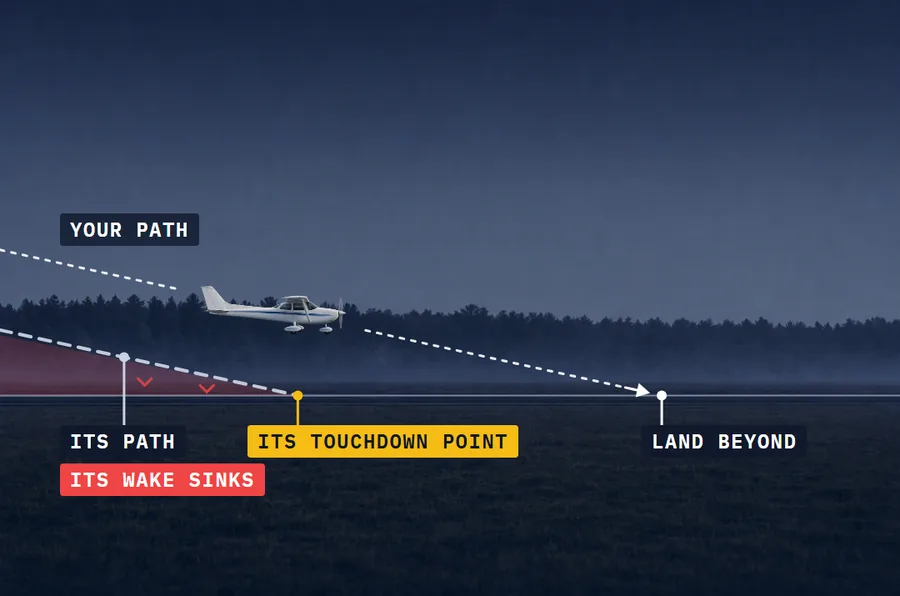
- ITS PATHA side view of an empty runway at dusk: a dashed line labelled ITS PATH traces the larger airplane's approach path down to its touchdown point, with a faint red wedge below and behind it, where its wake sinks; the house Cessna 172 flies on final on a straight path above and parallel to it, aiming at a point well beyond the touchdown point.
- ITS WAKE SINKSA side view of an empty runway at dusk: a dashed line labelled ITS PATH traces the larger airplane's approach path down to its touchdown point, with a faint red wedge below and behind it, where its wake sinks; the house Cessna 172 flies on final on a straight path above and parallel to it, aiming at a point well beyond the touchdown point.
- YOUR PATHA side view of an empty runway at dusk: a dashed line labelled ITS PATH traces the larger airplane's approach path down to its touchdown point, with a faint red wedge below and behind it, where its wake sinks; the house Cessna 172 flies on final on a straight path above and parallel to it, aiming at a point well beyond the touchdown point.
- ITS TOUCHDOWN POINTA side view of an empty runway at dusk: a dashed line labelled ITS PATH traces the larger airplane's approach path down to its touchdown point, with a faint red wedge below and behind it, where its wake sinks; the house Cessna 172 flies on final on a straight path above and parallel to it, aiming at a point well beyond the touchdown point.
- LAND BEYONDA side view of an empty runway at dusk: a dashed line labelled ITS PATH traces the larger airplane's approach path down to its touchdown point, with a faint red wedge below and behind it, where its wake sinks; the house Cessna 172 flies on final on a straight path above and parallel to it, aiming at a point well beyond the touchdown point.
The short version
Every wing that makes lift trails two vortices that spin opposite ways, from the moment the airplane rotates until it touches down. Behind a larger airplane they can roll yours harder than your ailerons can counter, and low down even a moment in one could be catastrophic.
So stay at or above a larger airplane's path, land beyond its touchdown point and lift off before its rotation point.
How it forms, and whose is worst
Lift comes from lower pressure over the wing and higher pressure under it. That difference rolls the air up at the rear of the wing into swirling air behind the wingtips. The wake becomes two counter-rotating vortices, with most of their energy within a few feet of each core. Seen from ahead or behind, the air turns outward, upward and around each tip.
Weight, speed, wingspan and wing shape set the strength. It grows as weight goes up and as speed comes down. A dirty configuration makes the wake decay sooner. So the strongest wake comes from an airplane that is heavy, clean and slow.
How well you fight the roll depends mostly on your wingspan and how quickly your controls respond. The shorter your wingspan next to the larger airplane's, the harder the roll is to counter. A helicopter departing or landing in forward flight trails a strong pair too.
Where the wake goes
Flight tests show the vortices from larger airplanes sink at several hundred feet per minute, slowing and weakening with time and distance. Higher than a wingspan above the ground they stay a bit less than a wingspan apart and drift with the wind.
Within 100 to 200 feet of the ground they tend to move sideways at 2 or 3 knots. A crosswind slows the upwind vortex and speeds the downwind one. So 1 to 5 knots across the runway can hold the upwind vortex in the touchdown zone for a while. A tailwind can move the wake forward into the touchdown zone. The light quartering tailwind needs maximum caution, because it can leave the wake along much of the final approach. Be particularly alert in calm wind, too.
Landing and departing behind one
Landing behind a larger airplane, stay at or above its final approach path. Note its touchdown point and land beyond it, with enough runway left to stop. With a parallel runway closer than 2,500 feet, expect drift to yours and fly the same way. Landing behind one that is taking off, note its rotation point and land well before it.
Departing behind one, rotate before its rotation point and climb above its path until you turn clear of its wake. After a larger airplane's low approach, missed approach or touch-and-go, wait at least 2 minutes before you take off or land. Stay at least three rotor diameters from a hovering helicopter.
Three mistakes with wake turbulence
Avoid the wake yourself, warning or not. A caution from tower is information, and accepting a visual approach or an instruction to follow traffic makes the wake avoidance yours.
Ask for time before you taxi onto the runway, instead of taking a clearance that comes too soon. You may request extra separation of 2 minutes. A takeoff clearance does not mean the wake has gone.
Move aside, preferably upwind, when a larger airplane passes above you on your track, because its wake can sink to VFR traffic 500 feet below. Tell ATC about any wake encounter.
Check yourself
1. A larger airplane ahead of you touches down near the 1,000-foot markers, so where do you aim?
2. A 3-knot wind blows across the runway just after it lands, so where can its wake be?
3. Departing after a business jet, you doubt you can stay above its climb path, so what do you ask for?
4. Holding short, you watch a larger airplane do a touch-and-go and tower clears you at once, so what now?
Answers
1. Beyond those markers, staying at or above its approach path and leaving enough runway to stop.
2. The upwind vortex can stay in the touchdown zone for a while, while the downwind one drifts away faster.
3. More time, such as 2 minutes, asked for before you taxi onto the runway.
4. Stay holding short and ask for at least 2 minutes. Its vortices settle and move sideways near the ground, so they can sit along the runway.
What this teaches
- Every aircraft generates wake turbulence while in flight. Wake turbulence is a function of an aircraft producing lift, resulting in the formation of two counter-rotating vortices trailing behind the aircraft.
- Wake turbulence can impose rolling moments exceeding the roll-control authority of encountering aircraft, causing possible injury to occupants and damage to aircraft. The usual hazard is induced rolling moments that can exceed the roll-control authority of the encountering aircraft; in rare instances a wake encounter could cause catastrophic inflight structural damage.
- Lift comes from a pressure differential over the wing surface: the lowest pressure occurs over the upper wing surface and the highest pressure under the wing. This pressure differential triggers the roll up of the airflow at the rear of the wing, resulting in swirling air masses trailing downstream of the wingtips; after the roll up is completed, the wake consists of two counter-rotating cylindrical vortices, with most of the energy within a few feet of the vortex core.
- The vortex circulation is outward, upward and around the wingtips when viewed from either ahead or behind the aircraft. At altitudes greater than a wingspan from the ground, the vortices remain spaced a bit less than a wingspan apart, drifting with the wind.
- An aircraft generates vortices from the moment it rotates on takeoff to touchdown, since trailing vortices are a by-product of wing lift. Prior to takeoff or touchdown, pilots should note the rotation or touchdown point of the preceding aircraft.
- Weight, speed, wingspan, and shape of the generating aircraft's wing all govern the strength of the vortex, and extending flaps or other wing configuring devices changes it. Vortex strength increases proportionately to an increase in operating weight or a decrease in aircraft speed. Since the turbulence from a 'dirty' aircraft configuration hastens wake decay, the greatest vortex strength occurs when the generating aircraft is heavy, clean, and slow.
- The ability of an aircraft to counteract the roll imposed by a wake vortex depends primarily on its wingspan and counter-control responsiveness. Counter control is usually effective and induced roll minimal when the encountering aircraft's wingspan and ailerons extend beyond the rotational flow field of the vortex; it is more difficult for aircraft with a short wingspan (relative to the generating aircraft) to counter the imposed roll.
- Flight tests have shown that the vortices from larger aircraft sink at a rate of several hundred feet per minute, slowing their descent and diminishing in strength with time and distance behind the generating aircraft. Pilots should fly at or above the preceding aircraft's flight path, altering course as necessary to avoid the area directly behind and below the generating aircraft.
- Avoid the area below and behind the wake-generating aircraft, especially at low altitude, where even a momentary wake encounter could be catastrophic.
- When the vortices of larger aircraft sink close to the ground (within 100 to 200 feet), they tend to move laterally over the ground at a speed of 2 or 3 knots.
- A crosswind decreases the lateral movement of the upwind vortex and increases the movement of the downwind vortex. Thus a light wind with a cross-runway component of 1 to 5 knots could result in the upwind vortex remaining in the touchdown zone for a period of time and hasten the drift of the downwind vortex toward another runway.
- A tailwind condition can move the vortices of the preceding aircraft forward into the touchdown zone, and the light quartering tailwind requires maximum caution. A light quartering tailwind presents the worst case, as the wake vortices could be present along a significant portion of the final approach and extended centerline, not just in the touchdown zone.
- Pilots should be particularly alert in calm wind conditions and situations where the vortices could remain in the touchdown area, drift from aircraft operating on a nearby runway, sink into the takeoff or landing path from a crossing runway, sink into the traffic pattern, or sink into the flight path of VFR aircraft operating on the hemispheric altitude 500 feet below.
- Landing behind a larger aircraft on the same runway: stay at or above the larger aircraft's final approach flight path, note its touchdown point, and land beyond it. Landing behind a larger aircraft when a parallel runway is closer than 2,500 feet: consider possible drift to your runway, stay at or above the larger aircraft's final approach flight path, and note its touchdown point.
- When landing beyond the point of landing of the preceding heavier aircraft, ensure you have adequate runway remaining if conducting a touch-and-go landing, or adequate stopping distance available for a full stop landing.
- Departing behind a larger aircraft: note the larger aircraft's rotation point and rotate prior to it, continue climbing above the larger aircraft's climb path until turning clear of its wake, and avoid subsequent headings which will cross below and behind it. Landing behind a departing larger aircraft on the same runway: note its rotation point and land well prior to it.
- Departing or landing after a larger aircraft executing a low approach, missed approach, or touch-and-go landing: because vortices settle and move laterally near the ground, the vortex hazard may exist along the runway and in your flight path, particularly in light quartering wind conditions. You should ensure that an interval of at least 2 minutes has elapsed before your takeoff or landing.
- Pilots may request additional separation (for example, 2 minutes instead of 4 or 5 miles) for wake turbulence avoidance. This request should be made as soon as practical on ground control and at least before taxiing onto the runway. The pilot in command of an aircraft is directly responsible for, and is the final authority as to, the operation of that aircraft.
- Tower gives VFR aircraft it is talking to, which in its opinion may be adversely affected by wake turbulence from a larger aircraft, the larger aircraft's position, altitude and direction of flight, followed by "CAUTION - WAKE TURBULENCE". Whether or not a warning or information has been given, the pilot is expected to adjust aircraft operations and flight path as necessary to preclude serious wake encounters, and a pilot who accepts a clearance to visually follow a preceding aircraft accepts responsibility for separation and wake turbulence avoidance.
- En route VFR, avoid flight below and behind a large aircraft's path; if a larger aircraft is observed above on the same track (meeting or overtaking), adjust your position laterally, preferably upwind. If persistent vortex turbulence is encountered, a slight change of altitude (upward) and lateral position (upwind) should provide a flight path clear of the turbulence.
- In forward flight, departing or landing helicopters produce a pair of strong, high-speed trailing vortices similar to the wingtip vortices of larger fixed-wing aircraft. Pilots of small aircraft should avoid operating within three rotor diameters of any helicopter in a slow hover taxi or stationary hover.
- Pilots should notify ATC when a wake event is encountered, and be as descriptive as possible (bank angle, altitude deviations, intensity and duration of the event).
- Controllers may anticipate separation and need not withhold a takeoff clearance for an aircraft departing behind a large, heavy, or super aircraft if there is reasonable assurance the required separation will exist when the departing aircraft starts takeoff roll.
Where to read more
Everything above rests on these. They are the FAA's own publications, free to read.
- Aeronautical Information Manual, paragraph 7-4-1Aeronautical Information Manual
- Aeronautical Information Manual, paragraph 7-4-2Aeronautical Information Manual
- Aeronautical Information Manual, paragraph 7-4-3Aeronautical Information Manual
- Aeronautical Information Manual, paragraph 7-4-4Aeronautical Information Manual
- Aeronautical Information Manual, paragraph 7-4-5Aeronautical Information Manual
- Aeronautical Information Manual, paragraph 7-4-6Aeronautical Information Manual
- Aeronautical Information Manual, paragraph 7-4-7Aeronautical Information Manual
- Aeronautical Information Manual, paragraph 7-4-8Aeronautical Information Manual
- Aeronautical Information Manual, paragraph 7-4-9Aeronautical Information Manual
- Pilot's Handbook of Aeronautical Knowledge (FAA-H-8083-25), Chapter 14see Chapter 14
Keep reading
- ExplainerGround effect in the flare
- Free toolCrosswind Calculator
- Free toolDensity Altitude Calculator

Score the next flight before you go
FlightDecide reads the weather, the NOTAMs, your fuel and your weight and balance for the planned window, then scores them into a go / no-go call you can check against the raw data.
Get FlightDecide on the App StoreEducational content for pilots. It is advisory only and not a substitute for an official weather briefing, your POH, or your own judgment as pilot in command (14 CFR 91.3). The sources this explainer rests on are listed above.