Home › Explainers › What makes the left engine critical
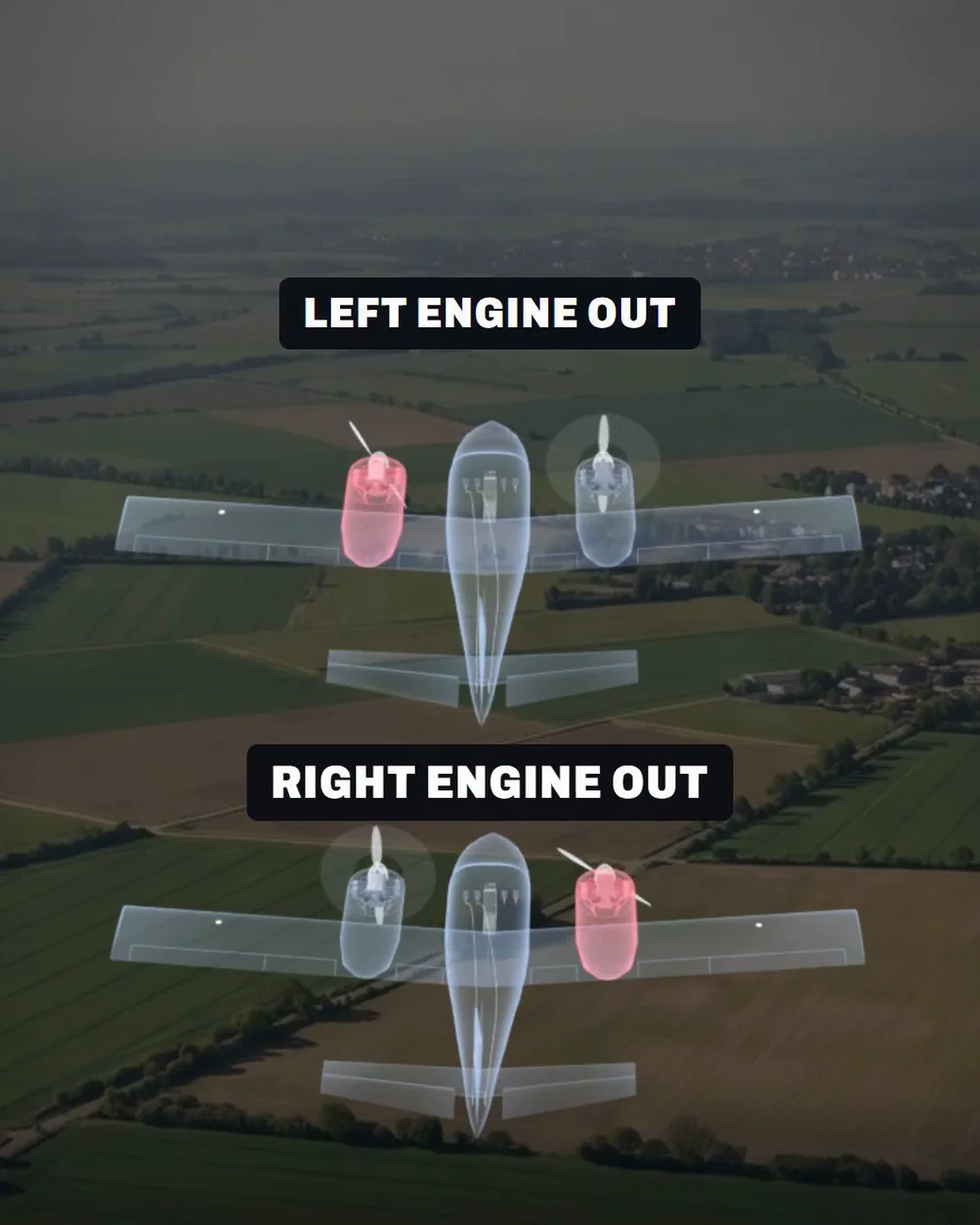
The short version
On most twins both propellers turn clockwise, seen from the pilot's seat. On those twins, losing the left engine is worse. Slow and nose high, each propeller pulls harder on its right side, an effect called P-factor.
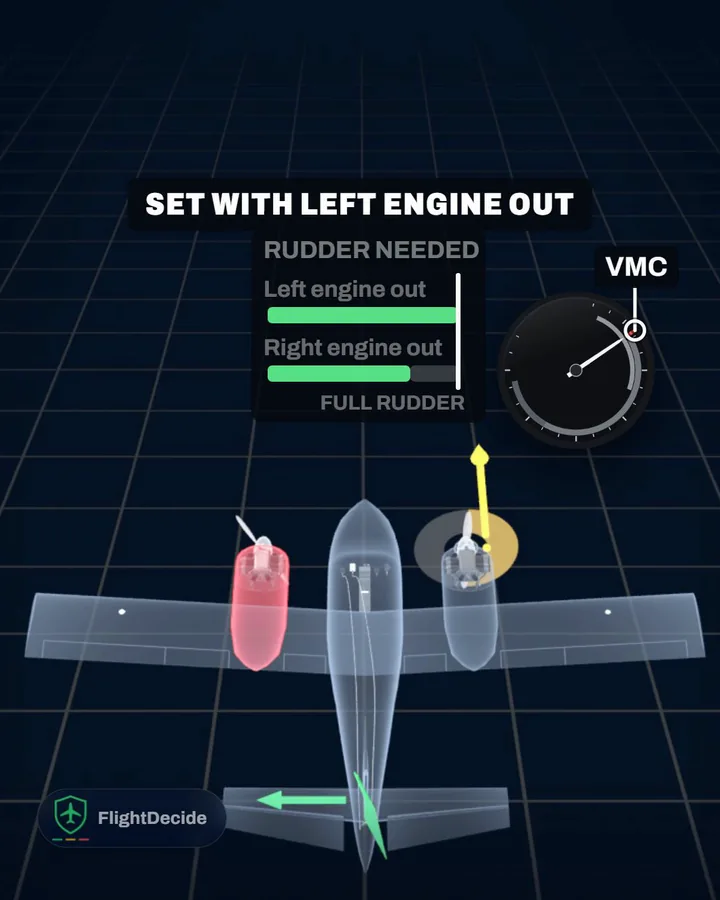
So the right engine's pull sits farther from the airplane's balance point. Lose the left engine, and that pull swings the nose hardest. That makes the left engine the critical engine, and a twin's VMC, its minimum control speed, is set with it dead.
What the critical engine is
The critical engine is the engine whose failure hurts directional control the most. Directional control means keeping the nose pointed where you want it.
With one engine dead, all the thrust pulls on one side. This one-sided pull is asymmetric thrust, and it yaws, or swings, the nose toward the dead engine. The question is which engine leaves the harder swing.
How P-factor moves each engine's thrust
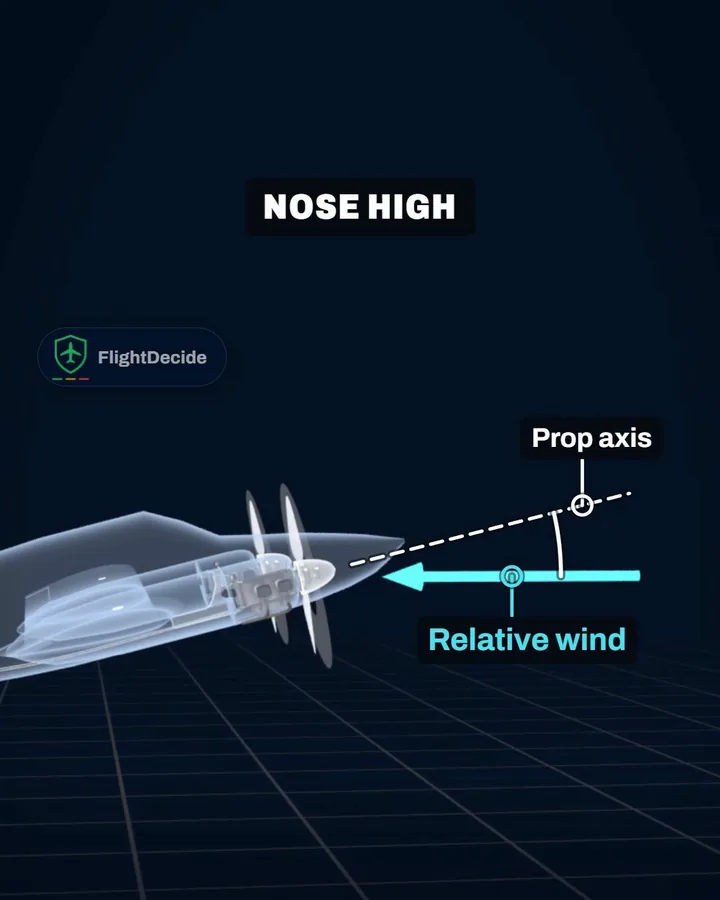
Slow and nose high, each propeller's shaft points a little above the flight path. So the air reaches the propeller disc, the circle the blades sweep, from slightly below.
As the propeller turns clockwise, the blade on the right side moves down into that upward-slanting air. It meets the air at a bigger angle of attack, the angle between the blade and the oncoming air. The blade going up on the left meets it at a smaller one.
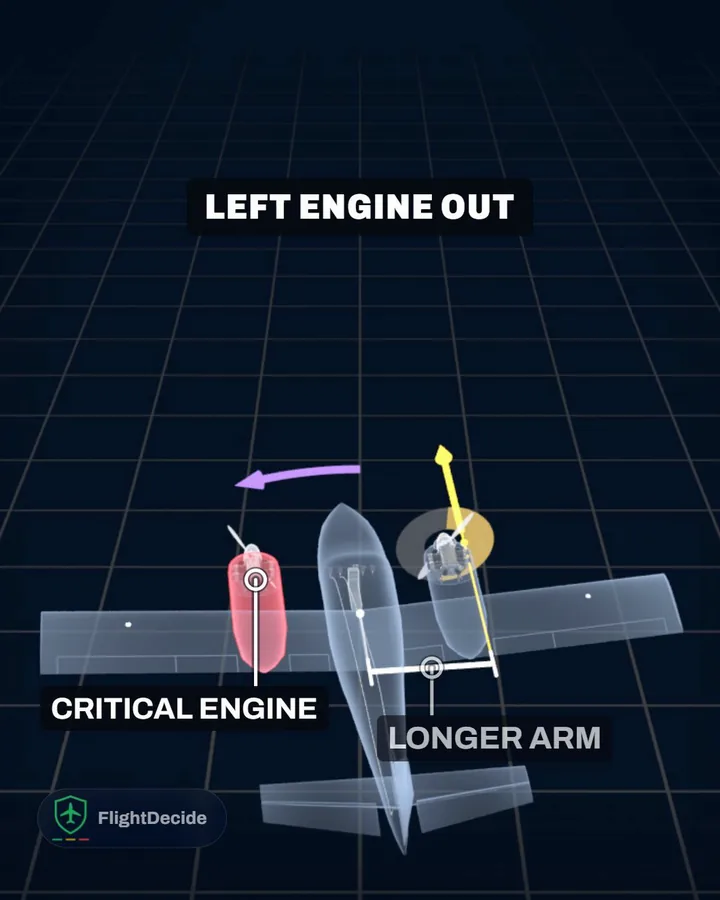
The descending blade takes the bigger bite and makes more thrust. So each engine's thrust shifts to the right of its hub. This is P-factor, and it is strongest slow and nose high, as right after takeoff.
Why the left engine's loss yaws harder
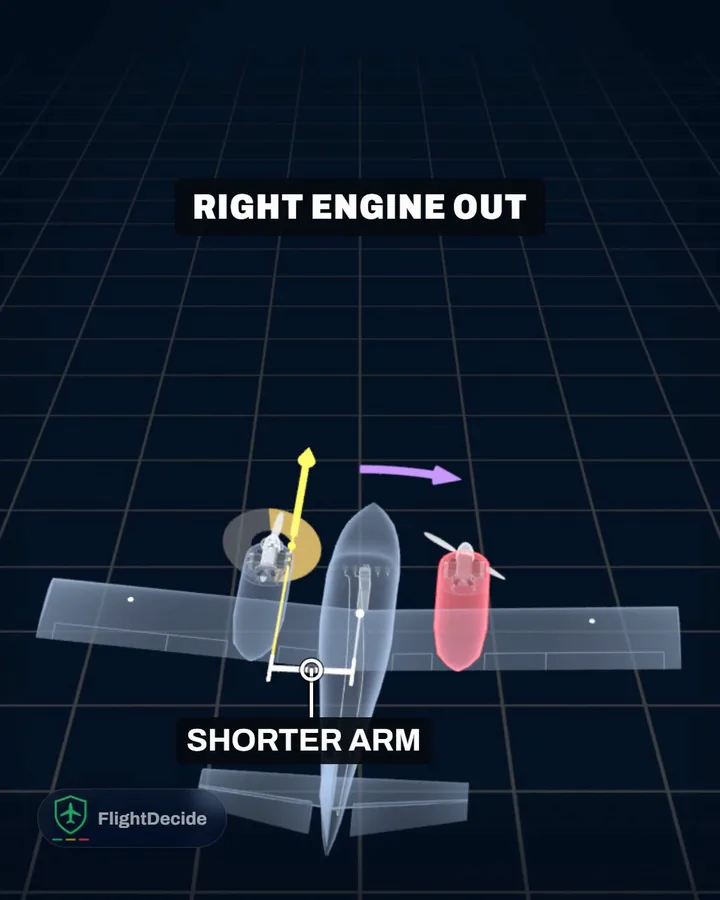
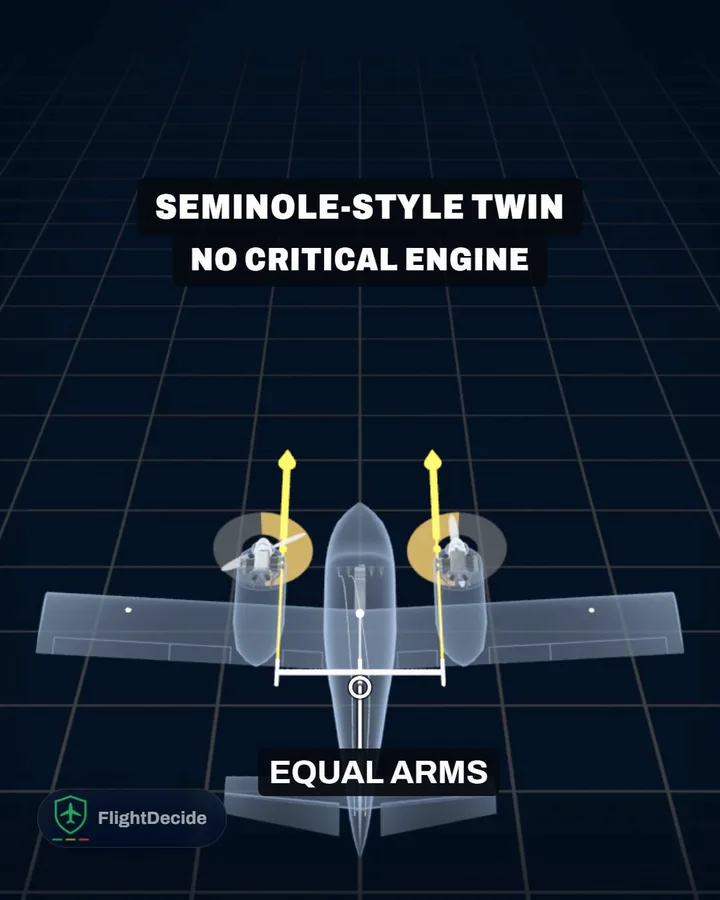
The arm is the sideways distance from the airplane's center of gravity, its balance point, to the line an engine's thrust acts along. With the thrust shifted right, the right engine's thrust moves outboard, away from the cabin, and the left engine's moves inboard, toward it. So the right engine's arm is longer.
Lose the left engine, and the right engine's thrust pulls on that longer arm. The pull is the same, but on a longer arm it turns the airplane harder, like a longer wrench. So the nose swings hardest toward the dead engine.
Lose the right engine instead, and the left engine's thrust works on a shorter arm, with a weaker swing.
| Engine lost | Remaining thrust | Swing toward the dead engine | Rudder needed |
|---|---|---|---|
| Left (critical) | Right engine, on the longer arm | Stronger | More |
| Right | Left engine, on the shorter arm | Weaker | Less |
Why the critical engine sets VMC
Whichever engine fails, you hold the airplane straight mainly with rudder on the good engine's side, plus a small bank toward the good engine.
The rudder also weakens as the airplane slows. The more rudder the yaw takes, the sooner the rudder reaches its stop. With the critical engine dead, the rudder runs out first, at the highest speed.
VMC is the slowest speed at which you can keep directional control after the critical engine suddenly fails, with the good engine at takeoff power. Most twins mark it with a red radial line on the airspeed indicator.
That red line holds only for the conditions it was set under, including up to 5 degrees of bank toward the good engine. Lower the nose promptly to hold the blue line, the best climb speed on one engine. If full rudder can't stop the yaw, reduce power on the good engine and lower the nose further.
Three mistakes about the critical engine
Stop the yaw with the rudder pedal on the good engine's side. The idle foot then points to the dead engine, which pilots remember as dead foot, dead engine. Close that engine's throttle before you shut anything down. If nothing changes, you found the dead engine. If the airplane sinks or the yaw changes, you closed the good one, so push that throttle back up.
Bank a few degrees toward the good engine rather than holding the wings level. With the wings level, the real VMC is much higher than the red line.
Check which way your twin's propellers turn. Some twins, such as the Piper Seminole, turn the right propeller counterclockwise. Each descending blade is then on the inboard side, so the arms match and there is no critical engine.
Check yourself
1. Slow and nose high, which side of a clockwise propeller's disc makes more thrust?
2. When two identical twins whose propellers both turn clockwise lose opposite engines at the same slow speed, which one needs more rudder?
3. When your left engine fails in the climb, which rudder pedal do you press?
4. Does a Seminole, with its right propeller turning counterclockwise, have a critical engine?
Answers
1. The right side, where the descending blade meets the air at a bigger angle of attack.
2. The one that lost its left engine, because the right engine's thrust then sits on the longer arm and yaws it harder.
3. The right pedal, on the good engine's side, so the idle left foot matches the dead left engine.
4. No, because both descending blades are inboard and the arms match.
Where to read more
Everything above rests on these sources.
- Airplane Flying Handbook (FAA-H-8083-3), Chapter 13Chapter 13 as a PDF · the whole handbook
- Pilot's Handbook of Aeronautical Knowledge (FAA-H-8083-25), Chapter 5
- Piper PA-44-180 Seminole Pilot's Operating Handbookthe aircraft's own handbook
Keep reading
- ExplainerVMC and the engine-out roll in a twin
- ExplainerWhat are left-turning tendencies
- ExplainerThe stall that turns into a spin

Score the next flight before you go
FlightDecide reads the weather, the NOTAMs, your fuel and your weight and balance for the planned window, then scores them into a go / no-go call you can check against the raw data.
Get FlightDecide on the App StoreEducational content for pilots. It is advisory only and not a substitute for an official weather briefing, your POH, or your own judgment as pilot in command (14 CFR 91.3). The sources this explainer rests on are listed above.