Home › Explainers › How a constant-speed propeller holds its RPM
The short version
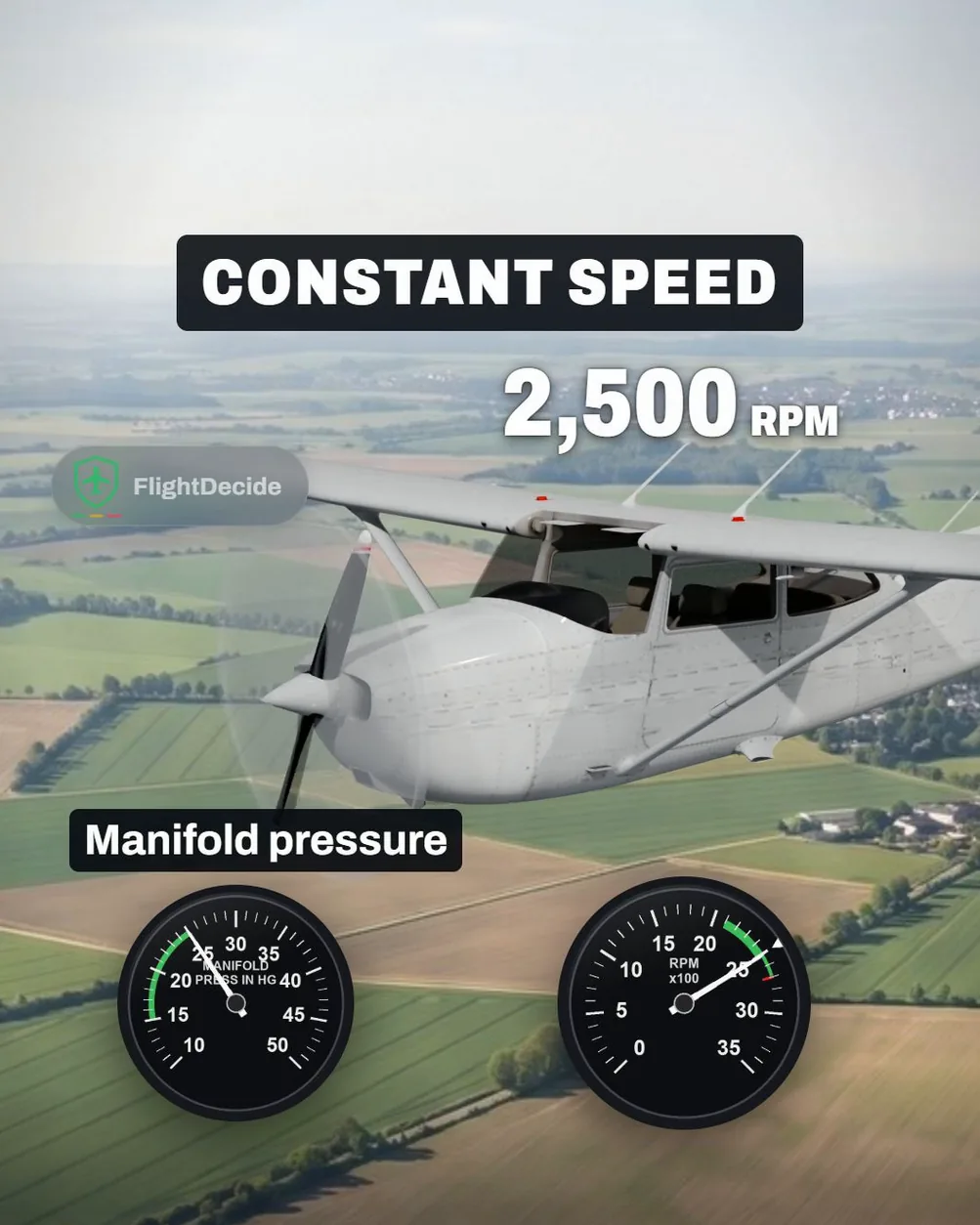
With a constant-speed propeller, the throttle sets the power and the blue propeller knob sets the RPM. The knob doesn't set the blade angle directly. That is the angle each blade makes with the circle it spins in.
A governor on the engine sets it. It twists the blades steeper, a bigger bite of air each turn, or flatter, a smaller bite. So the RPM holds as you climb and descend, as long as the blades have room to twist.
Why a fixed-pitch propeller's RPM wanders
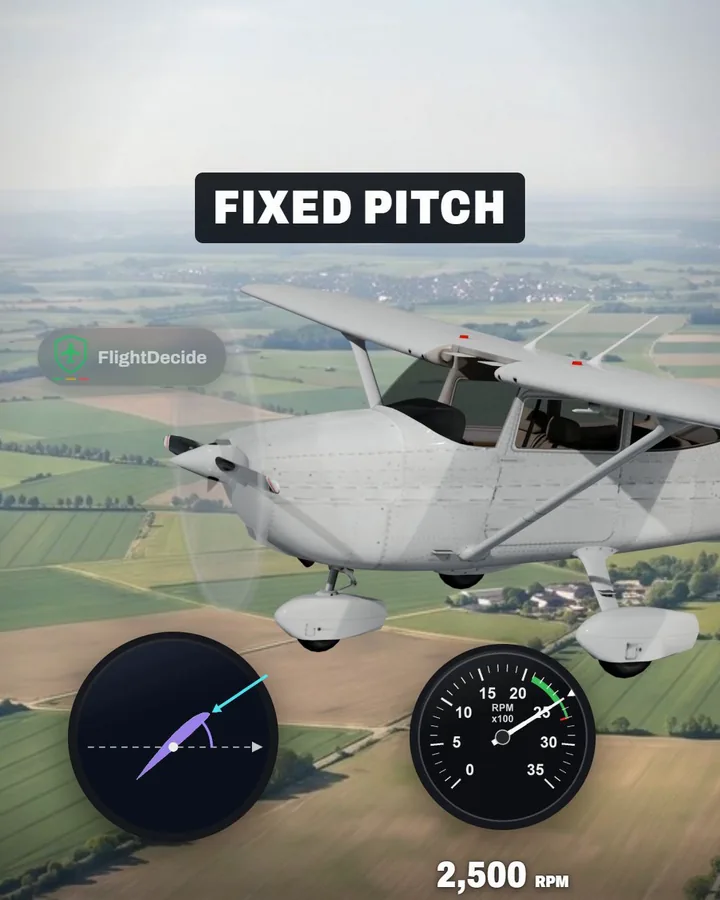
A fixed-pitch propeller has one blade angle, or pitch, set by the manufacturer. That angle is most efficient at only one airspeed and RPM, and you control the RPM with the throttle alone.
Leave the throttle where it is and the RPM follows the airspeed. Climb and slow down, and the air meets the blades at a bigger angle of attack, the angle between blade and oncoming air. The heavier load drags the RPM down. Lower the nose and speed up, and the RPM rises.
How the governor holds the RPM
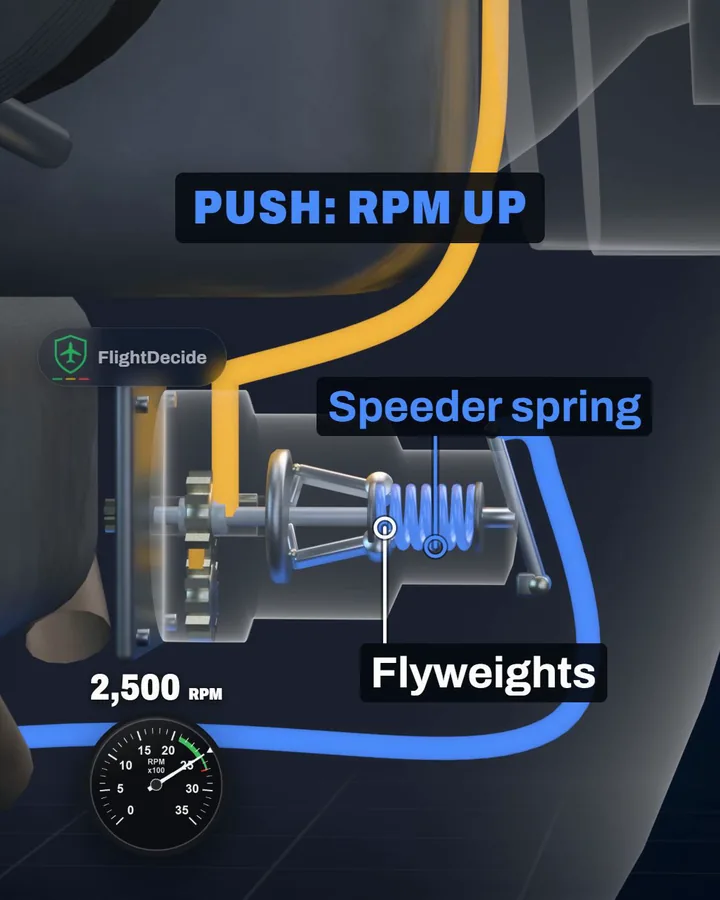
The governor sits on the engine, geared to the crankshaft. Inside it, two small flyweights spin with the engine, and the faster they spin, the harder they swing outward.
A speeder spring presses against them from the other side. The blue knob sets how hard that spring presses, and pushing the knob in squeezes it harder.
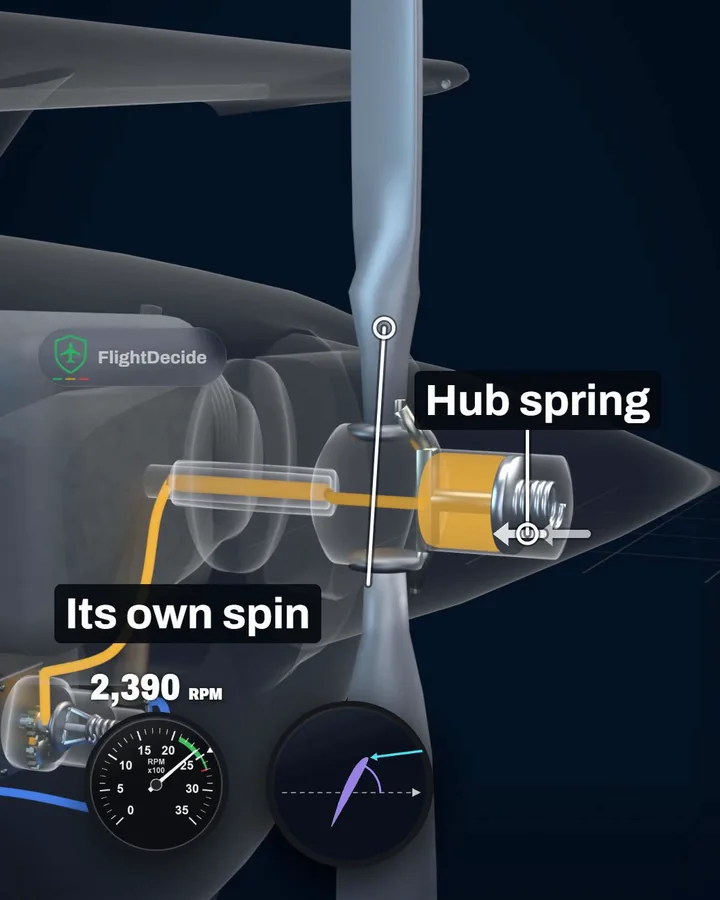
The flyweights and the spring position a small pilot valve between them. It sends engine oil to the propeller hub or lets oil drain from it. In the 172RG, as in most single-engine airplanes, oil in the hub pushes a piston that twists the blades to a bigger bite. When oil drains, the blades' own spin and a hub spring twist them flatter.
When the flyweights balance the spring, the propeller is on speed, at the RPM you set. The valve sits centered and the blade angle holds.
Push the knob in and the spring wins. Oil drains from the hub, the blades flatten and the RPM rises until the flyweights balance the stiffer spring. Pull the knob out and it all runs the other way.
When the nose goes down and RPM rises
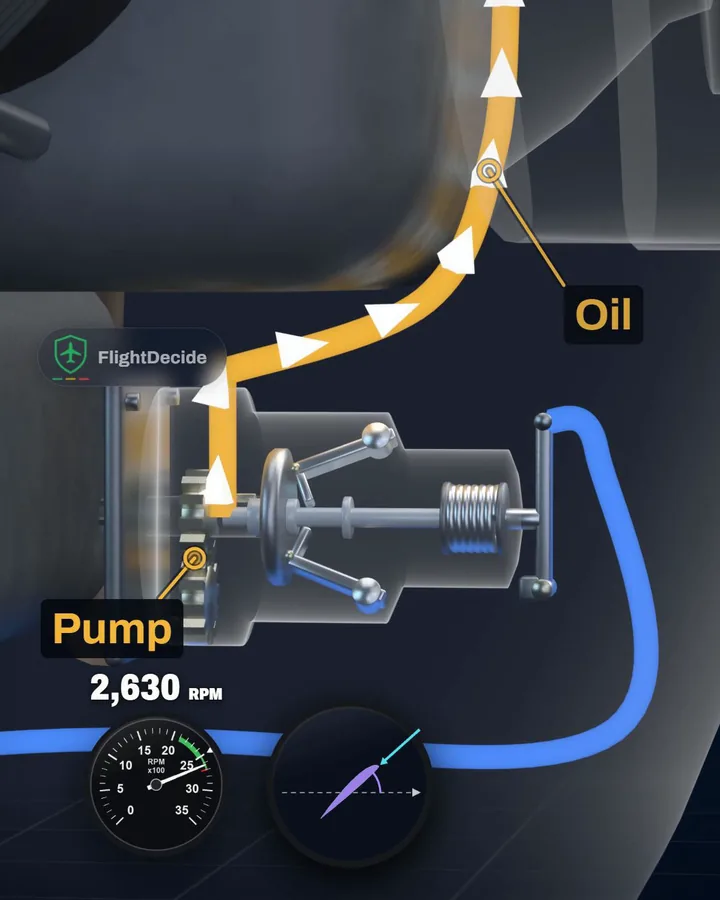
Lower the nose and the airplane speeds up. The faster air meets the blades at a smaller angle of attack, so they load the engine less. The propeller starts to spin faster than the RPM you set, which mechanics call an overspeed condition.
The flyweights swing outward and move the pilot valve. Engine oil, boosted by the governor's own pump, flows to the hub through the hollow engine shaft.
This incoming oil pushes the piston, which twists both blades steeper. The extra load slows the propeller, and the RPM settles back where you set it.
When the nose comes up and RPM falls
Raise the nose and the airplane slows. Now the slower air meets the blades at a bigger angle of attack, and the extra load slows the propeller below your RPM. That is an underspeed condition.
The flyweights fall inward, and the speeder spring pushes the pilot valve the other way. That opens a path for the oil to leave the hub.
Now the blades twist toward a smaller bite, pushing the piston back and the oil out. The lighter load lets the RPM climb back to the setting.
Mistakes with the throttle and the blue knob
Set power with the manifold pressure gauge as you move the throttle, and cross-check the tachometer. It shows the pressure in the engine's intake, in inches of mercury, and power depends on it and the RPM together.
Change power in the right order. To add power, raise the RPM first and then the manifold pressure. To reduce it, bring the manifold pressure down first and then the RPM.
Avoid high manifold pressure at low RPM. It can cause detonation, where the fuel-air charge explodes instead of burning smoothly, and damage the engine. Use the power charts in your Pilot's Operating Handbook (POH).
Push the knob full forward for takeoff, to the low-pitch, high-RPM setting. In the 172RG the knob is labeled PROP RPM, PUSH INCR.
Expect the RPM to follow the airspeed at a pitch stop, the end of the blades' travel. There the governor can twist them no further, as with a fixed-pitch propeller.
| Item | Value |
|---|---|
| Engine rating | 180 horsepower at 2,700 RPM |
| Tachometer red line | 2,700 RPM |
| Normal climb power | 25 inches of manifold pressure and 2,500 RPM |
| Low-pitch stop, the flattest blade angle | 12.0 degrees, measured 30 inches out from the hub center |
| High-pitch stop, the steepest blade angle | 26.5 degrees, measured 30 inches out from the hub center |
Check yourself
1. With a constant-speed propeller, what did the blades just do if you lowered the nose and the RPM held at 2,500?
2. What happens to the blade angle and the RPM when you push the blue knob in?
3. Why could the RPM start falling in a slow climb when you haven't touched the knob?
4. When adding power with a constant-speed propeller, which do you raise first, the RPM or the manifold pressure?
Answers
1. They twisted to a bigger bite. In the 172RG the governor sent oil to the hub to keep the propeller from speeding up.
2. The blades flatten to a smaller angle and the RPM rises.
3. The blades may have reached their low-pitch stop. From there the RPM follows the airspeed, as with a fixed-pitch propeller.
4. The RPM first, then the manifold pressure. High manifold pressure at low RPM can cause detonation.
Where to read more
Everything above rests on these sources.
- Airplane Flying Handbook (FAA-H-8083-3), Chapters 12 and 13Chapter 12 · Chapter 13
- Pilot's Handbook of Aeronautical Knowledge (FAA-H-8083-25), Chapter 7
- Aviation Maintenance Technician Handbook, Powerplant (FAA-H-8083-32), Chapter 7
- Cessna 172RG Cutlass Pilot's Operating Handbook (1981)the aircraft's own handbook
Keep reading
- ExplainerHow a carburetor works
- ExplainerHow magnetos work
- ExplainerWhat are left-turning tendencies

Score the next flight before you go
FlightDecide reads the weather, the NOTAMs, your fuel and your weight and balance for the planned window, then scores them into a go / no-go call you can check against the raw data.
Get FlightDecide on the App StoreEducational content for pilots. It is advisory only and not a substitute for an official weather briefing, your POH, or your own judgment as pilot in command (14 CFR 91.3). The sources this explainer rests on are listed above.
Picture credits: 3D model: “Cessna172” by KOG_THORNS (sketchfab.com), CC BY 4.0, modified.