Home › Explainers › What causes induced drag
The short version
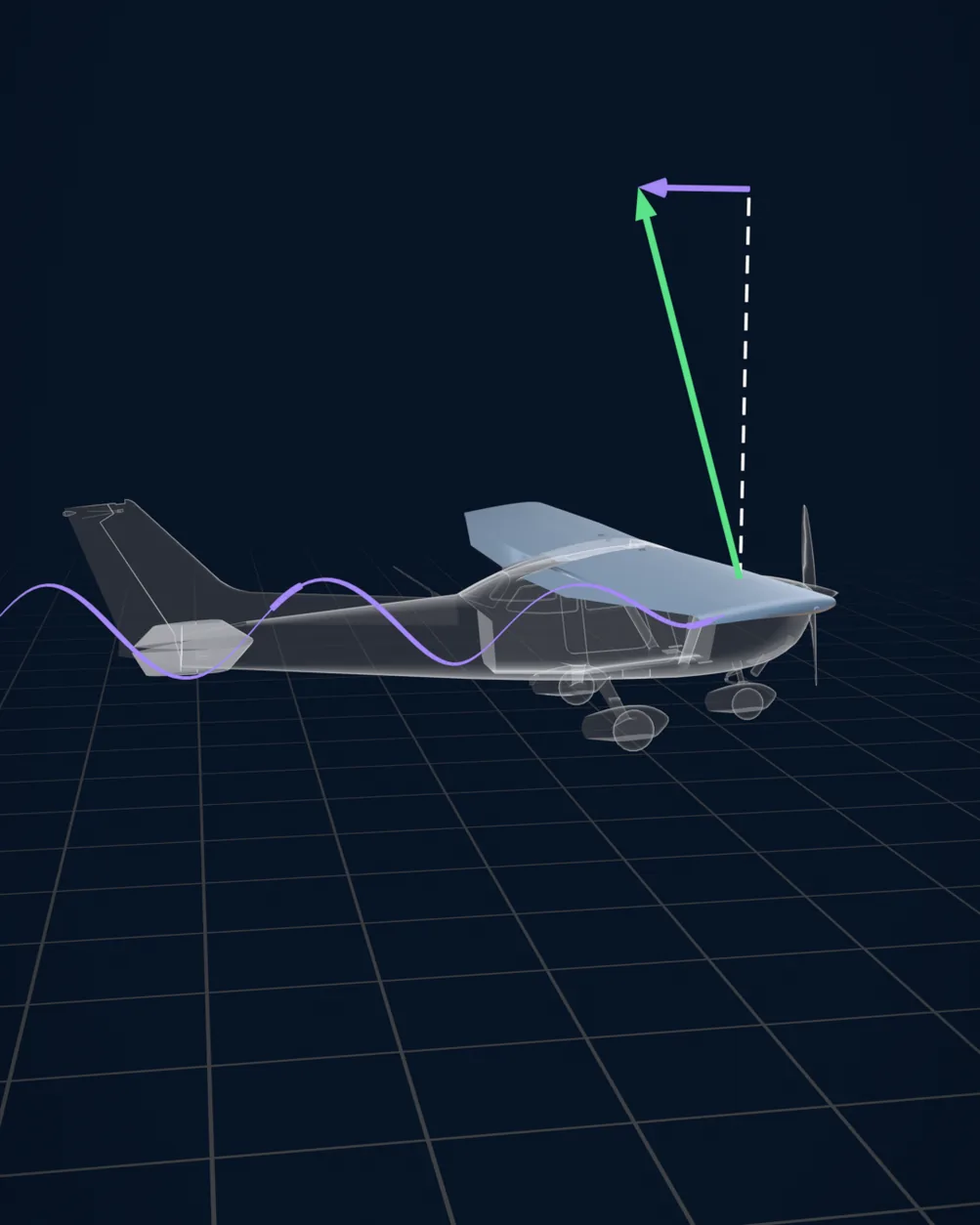
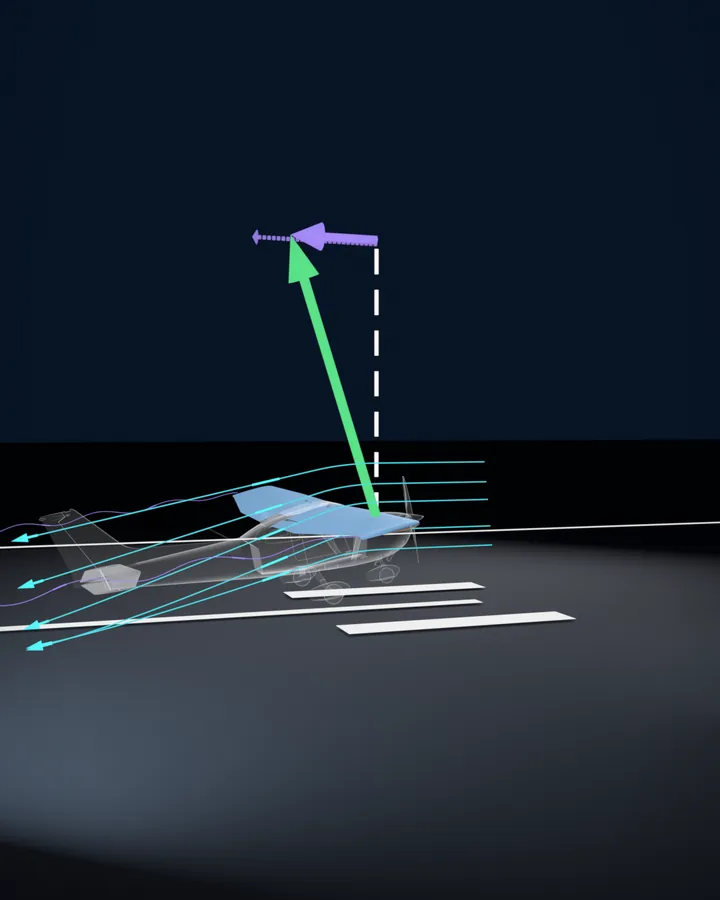
Induced drag is the drag that comes with making lift. The wingtip vortices tilt the air the wing meets downward, the lift leans back with it, and its backward part is induced drag.
It grows as you slow down. In level flight, half the airspeed means four times the induced drag.
Where the wingtip vortices come from
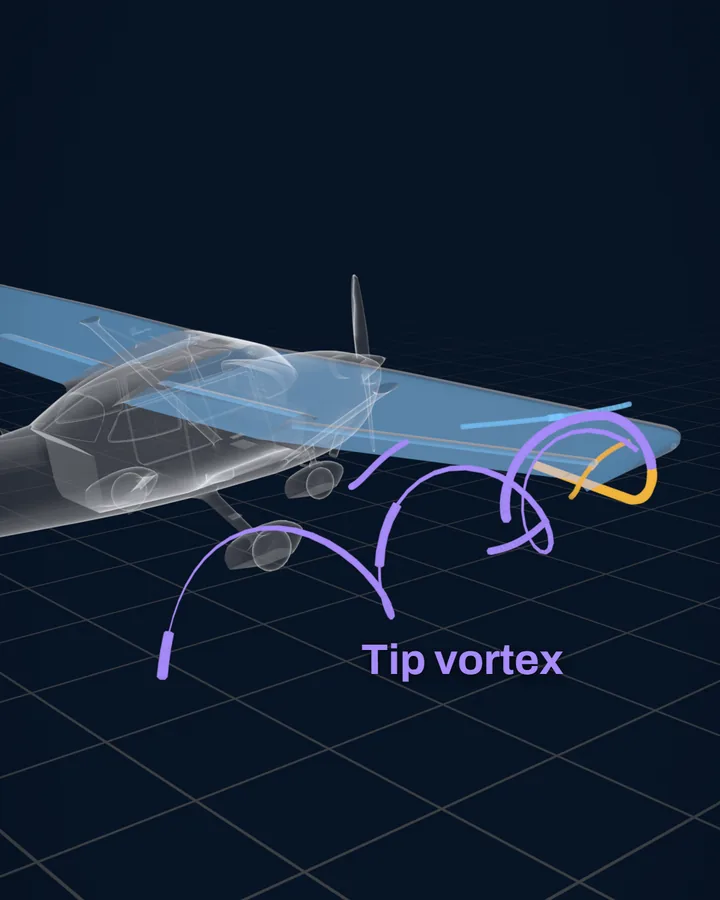
A wing making lift has higher air pressure under it than on top. Air moves from high pressure toward low, and the easiest way around the wing is past its tips.
Under the wing the air slides outward, away from the fuselage, while on top it slides inward. At each tip the air from below curls up and over the top and sets up a whirlpool called a wingtip vortex.
Seen from behind, the vortex turns counterclockwise at the right tip and clockwise at the left. Both trail behind the airplane whenever the wing makes lift.
How the vortices tilt the lift back
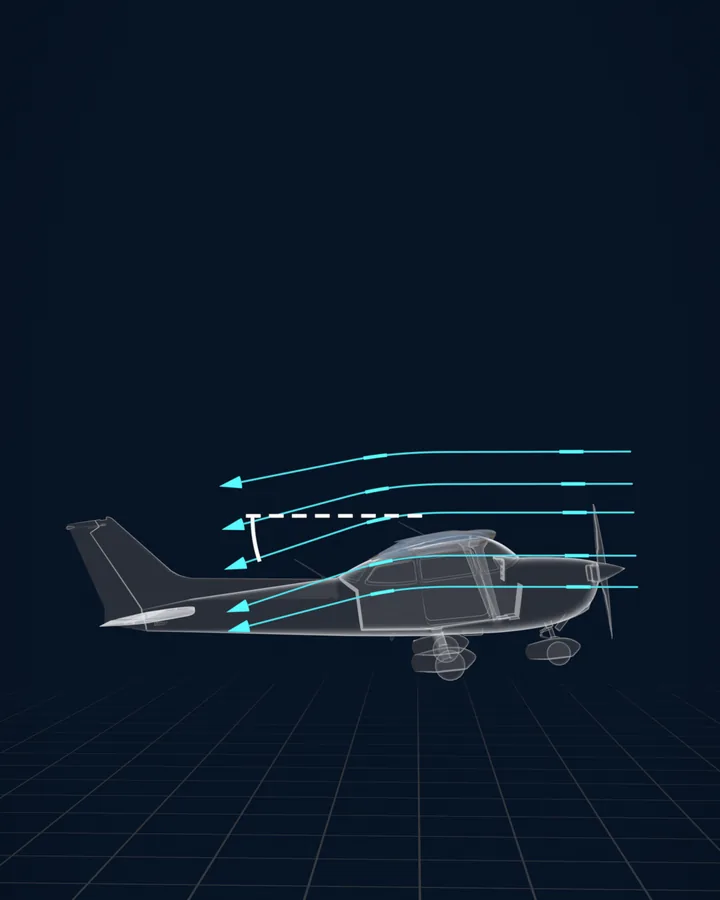
The vortices push air up beyond the tips and down behind the wing, and that downwash reaches forward over the wing itself. So the relative wind, the local air the wing meets, arrives tilted slightly down from the flight path.
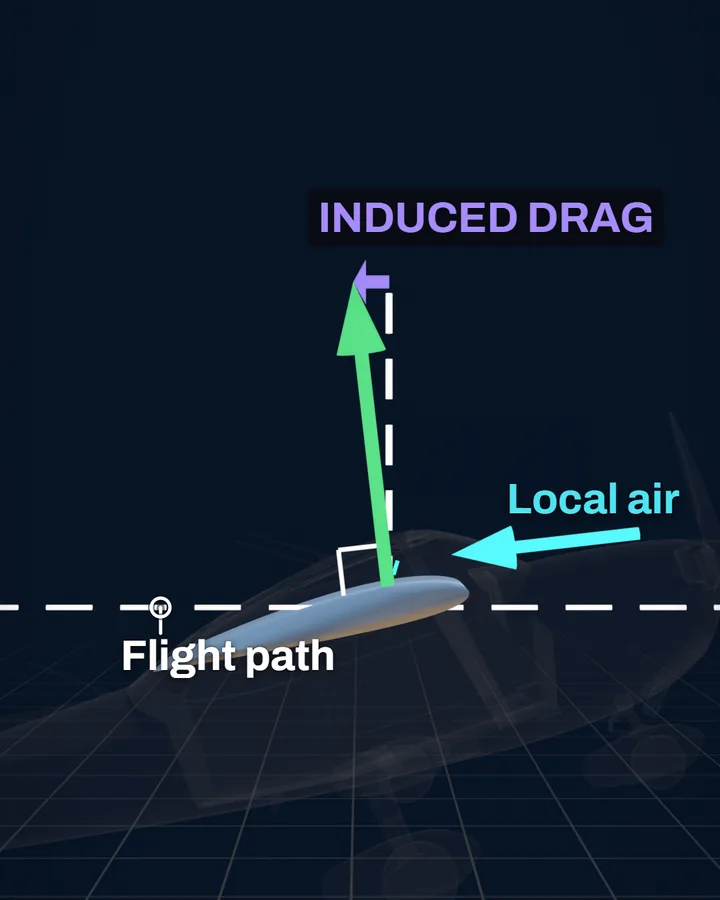
Lift always acts at a right angle to the relative wind. When the relative wind tilts down, the lift leans back by the same small angle.
Split the leaning lift in two. The upward part holds the airplane up, and the rearward part, pulling against the direction of flight, is induced drag.
Why slow and heavy make more of it
To hold altitude at a lower speed, the wing needs a higher angle of attack, its angle to the relative wind. The vortices get stronger and the lift leans back further.
Induced drag varies inversely with the square of the airspeed.
Weight makes more of it too, because more weight needs more lift at the same speed. At one airspeed the induced drag grows with the weight squared. Load a 172P from 1,900 lb to its 2,400 lb maximum takeoff weight, about a quarter heavier, and its induced drag rises about 60 percent.
Parasite drag, from pushing the airplane through the air, grows with the square of the airspeed instead. So at low speed induced drag takes over. Below the best-endurance speed, the bottom of the power curve, flying slower takes more power. That is the back side.
Wing shape matters too. A high-performance glider's long, narrow wing, with an aspect ratio of 39 to 1 against a 172's 7.5, makes little of it. Winglets reduce it too, but they do not noticeably weaken a jet's wake.
Three mistakes near the ground and behind jets
The first mistake is arriving at the flare fast. Within about one wingspan of the runway, 36 feet for a 172, the ground restricts the downwash and the vortices. Induced drag drops, by 23.5 percent at a quarter of the span, so extra speed carries you far down the runway.
The second is letting a low, slow approach get slower. On the back side it keeps slowing unless you act. Add power early. Lowering the nose alone makes you sink fast, but when full power is not enough, it is the only way to regain speed, even near the ground.
The third is flying below a big jet's flight path. Its vortices are strongest when it is heavy and slow with its flaps up, and they sink several hundred feet per minute. If a big jet passes above you on the same track, move sideways, preferably upwind. Landing behind it, land beyond its touchdown point.
Check yourself
1. In level flight at the same weight, what happens to induced drag when you cut your airspeed in half?
2. Why does the lift lean back on a wing that trails wingtip vortices?
3. You reach the flare with extra speed. Why does the airplane keep floating?
4. A heavy airliner has just landed ahead of you on the same runway. Where do you touch down?
Answers
1. It gets four times bigger, because induced drag varies inversely with the square of the airspeed.
2. The vortices tilt the relative wind down, and lift stays at a right angle to the relative wind.
3. Close to the ground the downwash and vortices shrink, so induced drag drops and the airplane slows down less.
4. Beyond its touchdown point, after staying at or above its approach path. It made vortices until its wheels touched.
Where to read more
Everything above rests on these sources.
- Pilot's Handbook of Aeronautical Knowledge (FAA-H-8083-25), Chapters 4, 5 and 11
- Glider Flying Handbook (FAA-H-8083-13), Chapter 3
- Airplane Flying Handbook (FAA-H-8083-3)
- AC 90-23
- Cessna 172P Pilot's Operating Handbookthe aircraft's own handbook
- Cessna 172S Pilot's Operating Handbookthe aircraft's own handbook
Keep reading
- ExplainerGround effect in the flare
- ExplainerStall speed rising with bank angle
- Free toolDensity Altitude Calculator

Score the next flight before you go
FlightDecide reads the weather, the NOTAMs, your fuel and your weight and balance for the planned window, then scores them into a go / no-go call you can check against the raw data.
Get FlightDecide on the App StoreEducational content for pilots. It is advisory only and not a substitute for an official weather briefing, your POH, or your own judgment as pilot in command (14 CFR 91.3). The sources this explainer rests on are listed above.
Picture credits: 3D model: “Cessna172” by KOG_THORNS (sketchfab.com), CC BY 4.0, modified. Sky: Kloofendal 38d Partly Cloudy (Pure Sky) by Greg Zaal (polyhaven.com), CC0.