Home › Explainers › What is parasite drag
Parasite drag is all the drag that does not come from making lift: it does nothing to help the airplane fly, it comes as form drag, skin friction and interference drag, each shown on the Cessna 172, and it grows with the square of the airspeed, which is why a Cessna 172R's optional teardrop wheel covers are worth about 2 knots and why frost comes off before flight.
What the picture shows
The labels printed on the illustration, in reading order.
- Parasite drag
The short version
Parasite drag is all the drag that does not come from making lift. It does nothing to help the airplane fly, and it comes in three kinds: form drag, skin friction and interference drag.
Every blunt shape, rough patch and joint adds some, and all of it grows quickly with speed.
Form drag comes from shape
Form drag comes from an object's shape and the way the air flows around it.
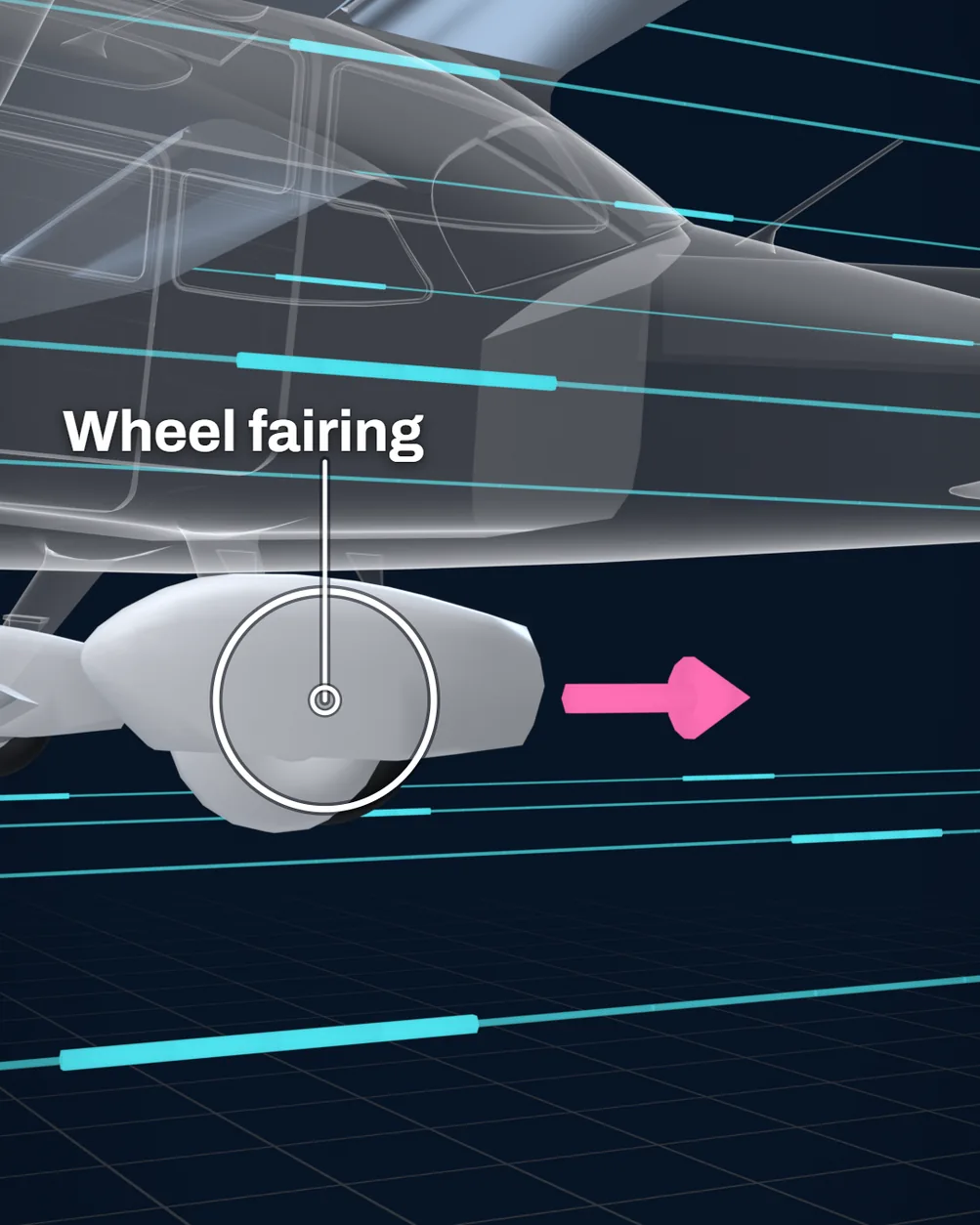
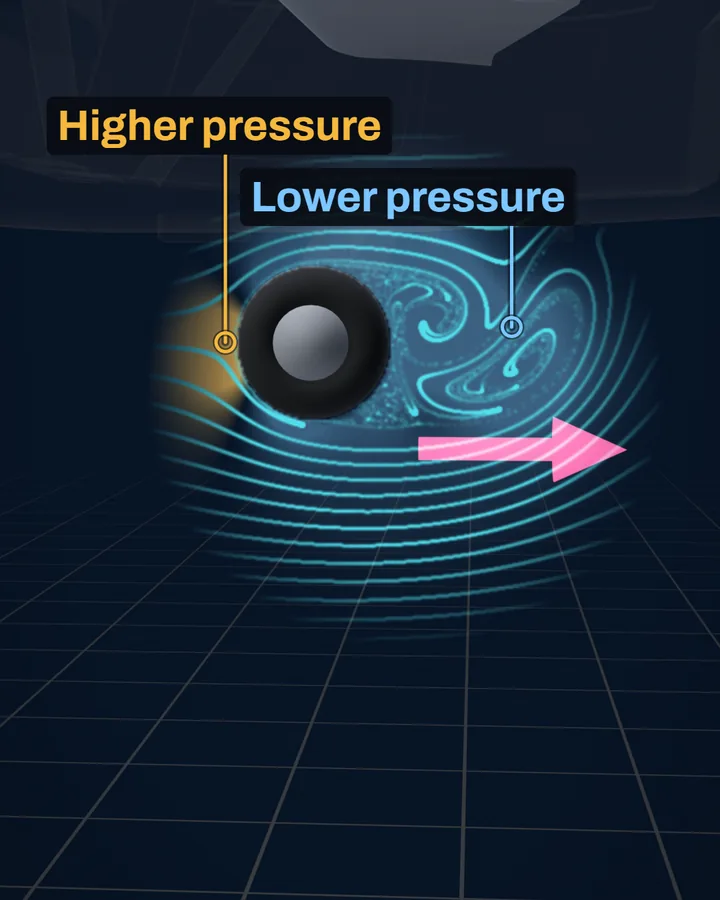
A bare wheel is blunt.
Air piles up against its front at higher pressure, then tears away behind it into a churning, low-pressure wake. With more pressure pushing on the front than on the back, the wheel is pushed backward, and that push is form drag.
Form drag is the easiest kind for a designer to reduce, by streamlining. A teardrop cover around the wheel, called a wheel fairing or wheel pant, lets the air close in smoothly behind it, so the wake shrinks and so does the drag. On a Cessna 172R, the optional teardrop covers on the wheels are worth about 2 knots of cruise speed.
Skin friction and the boundary layer
Skin friction is the drag of moving air in contact with the airplane's surface.
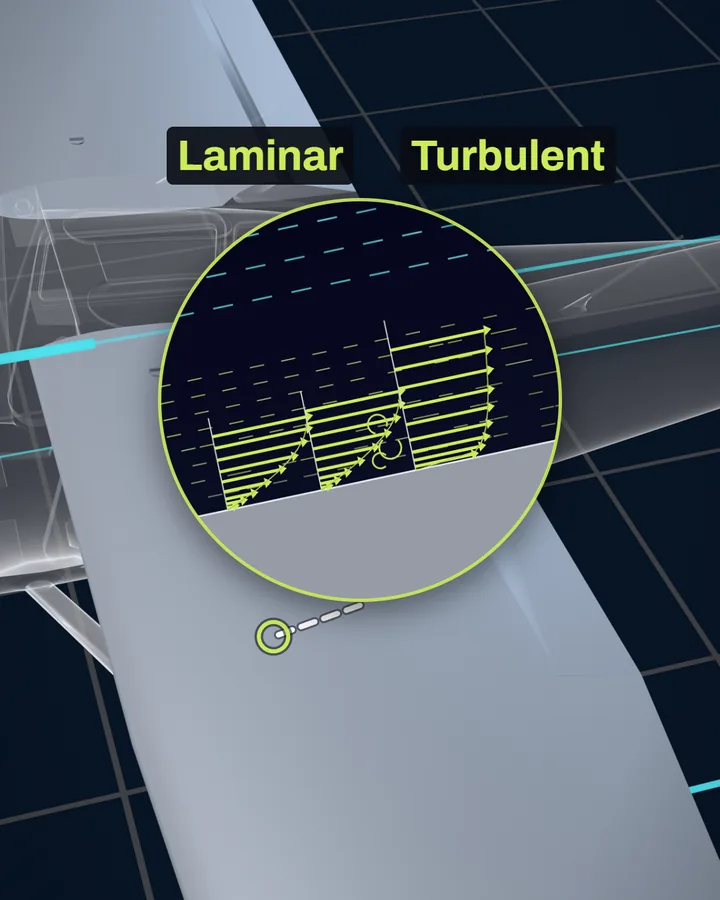
The air touching the skin is almost still. Each layer above it moves a little faster, until the air moves at the speed of the air flowing around the airplane. That thin region is the boundary layer, and as its layers slide over each other they rub.
Near the leading edge the boundary layer flows smoothly, which is called laminar flow. Some way back it breaks down into swirls and eddies, which is turbulent flow, and turbulent flow makes more skin friction than laminar flow.
So designers use flush rivets, remove anything that sticks up above the wing surface and give the airplane a smooth, glossy finish.
Interference drag where parts meet
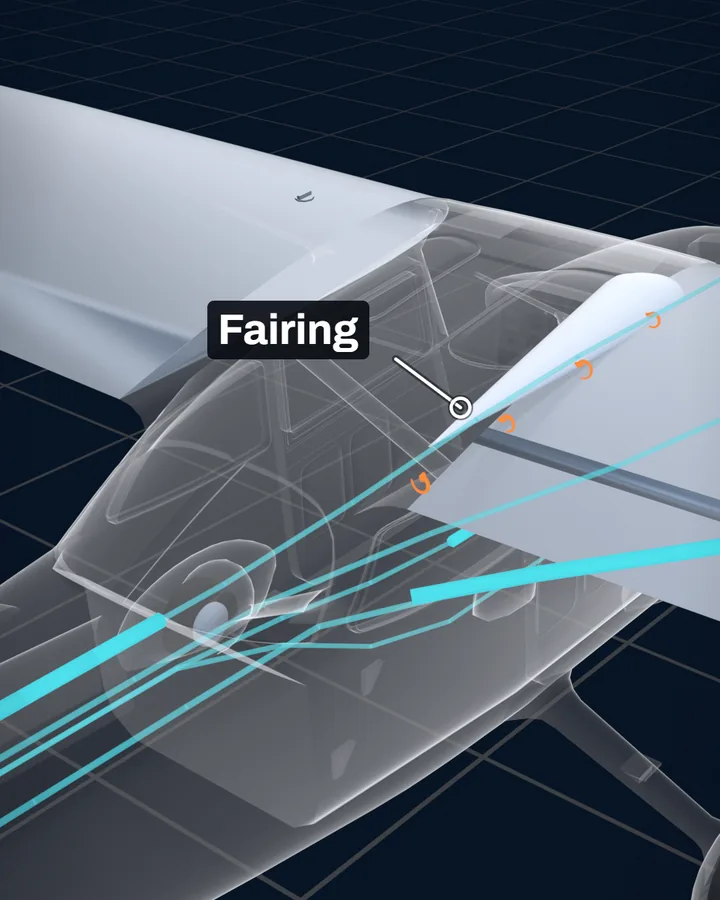
Interference drag comes from airstreams meeting, which sets up eddies and turbulence or blocks the smooth flow. The wing root makes a lot of it. There, air flowing around the fuselage collides with air flowing over the wing.
It is worst where two surfaces meet at a right angle, and the joined parts make more drag than the same parts would apart.
Smooth, curved fairings at the joints reduce it, and so does more distance between a lifting surface and anything hung near it.
Two mistakes that add drag, and speed
The first mistake is taking off with frost on the wings, tail or any other surface, however thin. Frost, snow or ice on the leading edge or top of the wing, even no thicker or rougher than coarse sandpaper, can cut lift by as much as 30 percent and add up to 40 percent more drag.
The second is flying a dirty airplane. Dirt disrupts the smooth flow of air over the surface and adds drag, so keep it clean and waxed.
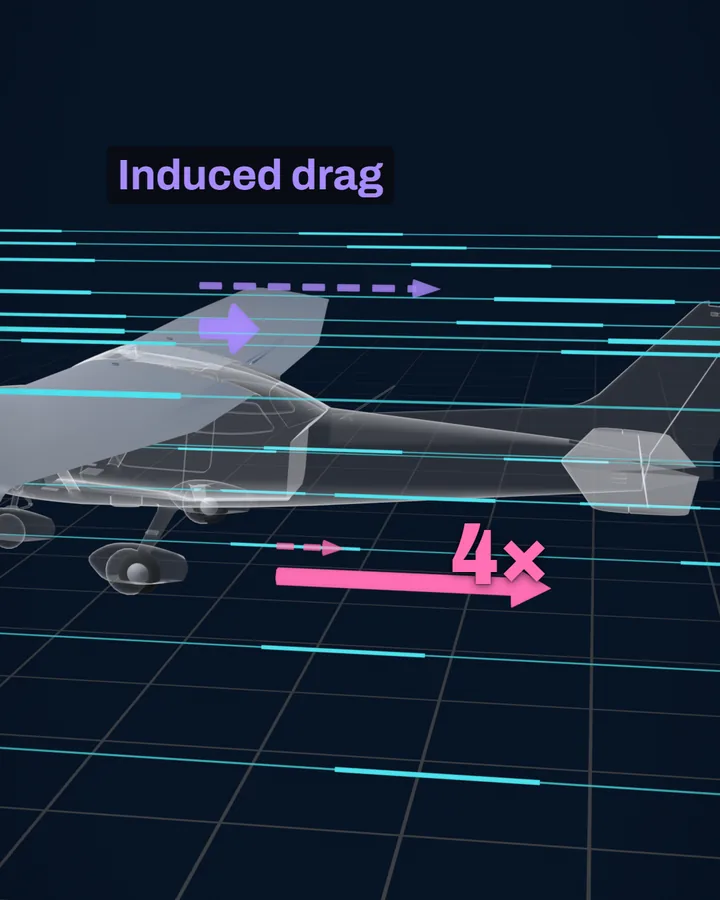
All three kinds grow with the square of the airspeed. Double an airplane's airspeed, from 60 to 120 knots say, and its parasite drag becomes four times as great.
Induced drag, the drag that comes with making lift, does the opposite. In level flight at the same weight, at twice the speed it is about a quarter of what it was.
Check yourself
1. At the same altitude you fly twice as fast, so how much bigger does the parasite drag get?
2. Why does a teardrop cover make less drag than a bare wheel?
3. Why do designers use flush rivets and a smooth, glossy finish?
4. A thin layer of frost as rough as coarse sandpaper covers the wing before a morning flight, so what do you do?
Answers
1. About four times bigger, because parasite drag grows with the square of the airspeed.
2. The air closes in smoothly behind it, so the low-pressure wake shrinks and so does the form drag.
3. Anything that sticks up or roughens the skin adds skin friction drag.
4. Clean every bit of it off before the flight, because even that much frost adds drag and cuts lift.
What this teaches
- Parasite drag is the drag not associated with making lift; it is called parasite because it in no way functions to aid flight, and there are three types: form drag, interference drag and skin friction (PHAK ch 5 p 5-6).
- Form drag comes from the airplane's shape and the airflow around it: the air separates to move around a body and rejoins behind it, and how quickly and smoothly it rejoins is representative of the resistance; it is the easiest kind to reduce when designing an aircraft, by streamlining as many parts as possible (PHAK p 5-6, Fig 5-7, the sphere with a fairing). A blunt body has higher pressure on its front, where the air piles up, than in the separated, low-pressure wake behind it, and the integrated pressure difference resolved in the drag direction is the form drag (AFH glossary).
- The Cessna 172R's optional speed fairings, the wheel and brake fairings, increase its cruise speeds by approximately 2 knots; without them, cruise speeds are 2 knots lower (172R POH (1996) Section 1 Performance-Specifications, Fig 5-8 note, Section 6 equipment list). Wheel pants are covers used to reduce aerodynamic drag (AFH ch 2).
- Skin friction drag is the resistance due to moving air in contact with the airplane's surface; every surface is rough under a microscope; the air in contact with the surface is virtually motionless and each layer above moves slightly faster until it moves at the speed of the air around the aircraft, a layer called the boundary layer (PHAK p 5-6). The boundary layer starts as smooth laminar flow and some distance back from the leading edge breaks down into turbulent flow with swirls or eddies; laminar flow creates less skin friction drag than turbulent flow (PHAK p 5-46). Designers use flush mount rivets, remove irregularities that protrude above the wing surface and use a smooth, glossy finish; dirt disrupts the free flow of air and increases drag, so keep the surfaces clean and waxed (PHAK p 5-7).
- Interference drag comes from the intersection of airstreams that creates eddy currents, turbulence or restricts smooth airflow; the wing root has significant interference drag, as air flowing around the fuselage collides with air flowing over the wing; the most is observed where two surfaces meet at perpendicular angles; with two identical wing tanks the overall drag is greater than the sum of the individual tanks; fairings and distance between lifting surfaces and external components reduce it (PHAK p 5-6).
- Parasite drag increases as the square of the airspeed: if the speed doubles, parasite drag increases four times (GFH ch 3 p 3-5; PHAK p 5-8), as from 100 to 200 knots it becomes four times as great (PHAK ch 11 p 11-5). Induced drag varies inversely with the square of the airspeed: at twice the speed it is one-fourth (PHAK p 5-8, 11-6). Arithmetic: D proportional to V^2, (2)^2 = 4.
- Frost, snow and ice on the leading edge or upper surface of the wing no thicker or rougher than a piece of coarse sandpaper can reduce lift by 30 percent and increase drag up to 40 percent (Aviation Weather Handbook FAA-H-8083-28 ch 20 p 20-7); frost disrupts the airflow over the wing, reduces lift and increases drag, and an aircraft must be thoroughly cleaned and free of frost before beginning a flight (PHAK ch 12, Dew and Frost).
Where to read more
Everything above rests on these. They are the FAA's own publications, free to read.
- Pilot's Handbook of Aeronautical Knowledge (FAA-H-8083-25), Chapter 5see Chapter 5
- Pilot's Handbook of Aeronautical Knowledge (FAA-H-8083-25), Chapter 11see Chapter 11
- Pilot's Handbook of Aeronautical Knowledge (FAA-H-8083-25), Chapter 12see Chapter 12
- Aviation Weather Handbook (FAA-H-8083-28), Chapter 20see Chapter 20
- Airplane Flying Handbook (FAA-H-8083-3), Chapter 2Chapter 2 as a PDF · the whole handbook
- FAA-H-8083-13, Chapter 3see Chapter 3
- Cessna 172R POH (1996) sec 1, 5 and 6 speed fairings
Keep reading
- ExplainerGround effect in the flare
- ExplainerStall speed rising with bank angle
- Free toolDensity Altitude Calculator

Score the next flight before you go
FlightDecide reads the weather, the NOTAMs, your fuel and your weight and balance for the planned window, then scores them into a go / no-go call you can check against the raw data.
Get FlightDecide on the App StoreEducational content for pilots. It is advisory only and not a substitute for an official weather briefing, your POH, or your own judgment as pilot in command (14 CFR 91.3). The sources this explainer rests on are listed above.